
GHK-Cu vs Commercial Copper Peptide Serums: What's the Difference?
Research-grade GHK-Cu vs cosmetic copper peptide serums compared: purity, concentration, COA data, delivery systems, and bioavailability differences explained.
For laboratory research use only. Not for human consumption.
Why This Comparison Matters
The term copper peptide appears on both research supplier catalogs and cosmetic serum bottles, yet the products differ fundamentally in composition, purity, documentation, and intended use. Researchers evaluating GHK-Cu for laboratory studies need to understand these distinctions to avoid confounding variables. Commercial cosmetic formulations are designed for topical consumer application and are regulated differently than research-grade peptides, which undergo analytical verification to documented purity standards.
Purity: Research-Grade vs Cosmetic-Grade
Research-grade GHK-Cu is typically supplied as a lyophilized powder with HPLC purity of 98% or higher. Each batch is accompanied by a Certificate of Analysis (COA) documenting the chromatographic profile, mass spectrometry confirmation, and amino acid composition. Cosmetic copper peptide serums, by contrast, are formulated products containing GHK-Cu (or related copper peptides) at unspecified purity levels diluted in a vehicle base of water, humectants, preservatives, and stabilizers.
Cosmetic regulations (EU Cosmetics Regulation EC 1223/2009, US FDA OTC monographs) do not require disclosure of peptide purity or batch-specific analytical data. A cosmetic product labeled as containing copper peptides may contain anywhere from 0.001% to 1% active peptide, with no obligation to specify the exact percentage or provide chromatographic evidence.
Concentration Differences
Published in vitro studies on GHK-Cu typically use concentrations between 1 μM and 10 μM (approximately 0.4-4 μg/mL). A standard research vial contains 5-50 mg of pure peptide, allowing precise dilution to target concentrations. Commercial serums rarely disclose the active concentration. Independent analyses published in the Journal of Cosmetic Dermatology (2021) found that consumer copper peptide products contained between 0.0005% and 0.1% GHK-Cu by weight – a 200-fold range across brands.
- Research-grade: precise concentration control (1-10 μM typical), documented on COA
- Commercial serum: undisclosed concentration, estimated 0.0005%-0.1% by weight
- 200-fold variation across commercial brands makes cross-study comparison unreliable
- Research requires known concentrations for dose-response analysis
What a COA Shows vs Cosmetic Labels
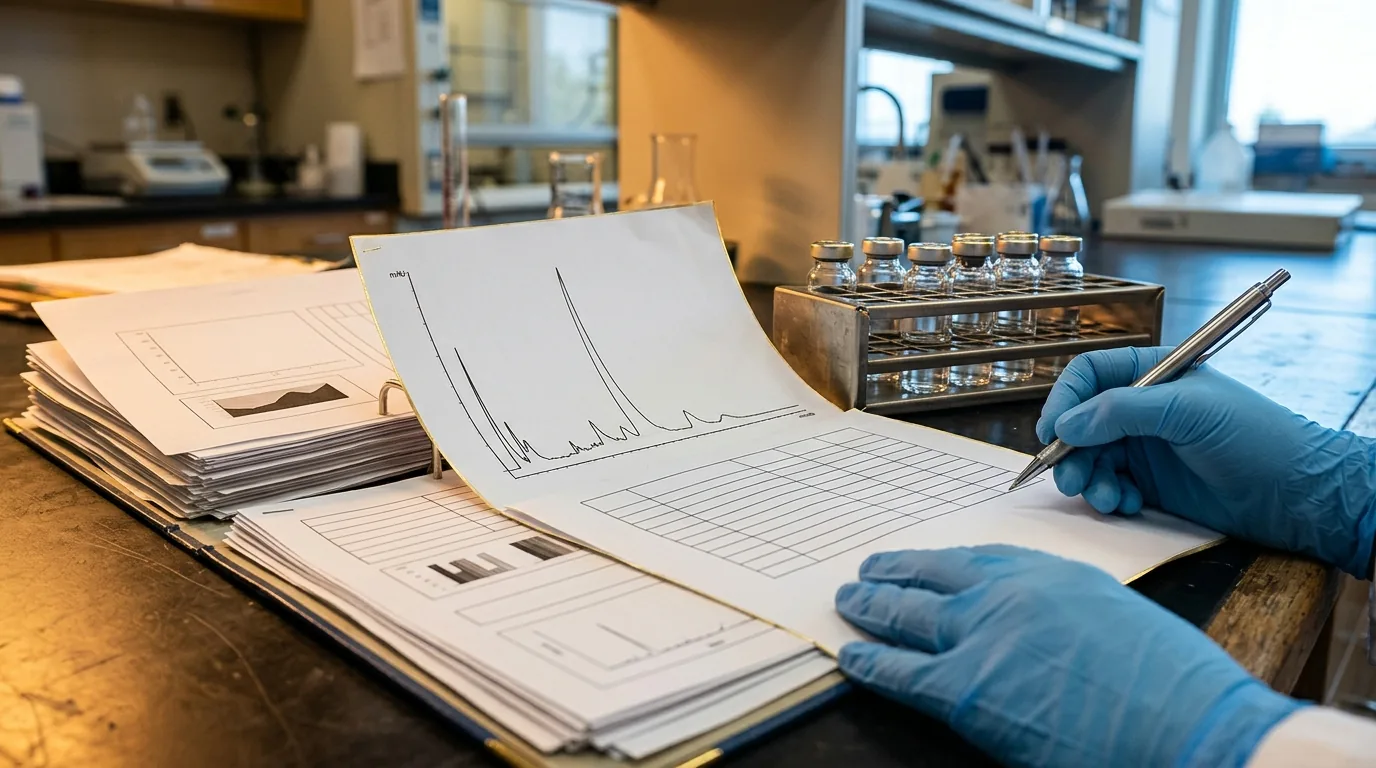
A research-grade COA for GHK-Cu includes: HPLC chromatogram with retention time, purity percentage (typically ≥98%), mass spectrometry data (expected [M+H]⁺ at m/z 404.2), amino acid analysis results, copper content (ICP-MS), water content (Karl Fischer), endotoxin level (LAL test), and batch/lot number with manufacturing date.
A cosmetic label lists ingredients in descending order of concentration (INCI nomenclature) but provides no quantitative data. The ingredient may appear as Copper Tripeptide-1 without specifying the salt form, copper stoichiometry, or source purity. No chromatographic or spectrometric data accompanies the product. This information asymmetry is the primary reason researchers cannot substitute cosmetic products for research-grade reagents.
Vehicle and Delivery Systems
Research-grade GHK-Cu is supplied as a lyophilized powder reconstituted in sterile water, PBS, or cell culture media. The vehicle is chemically defined and does not interfere with assay readouts. Commercial serums use complex vehicles containing hyaluronic acid, glycerin, phenoxyethanol, carbomer, and other excipients that may interact with the peptide or affect experimental outcomes.
Some cosmetic formulations incorporate liposomal encapsulation or penetration enhancers designed to improve transdermal delivery. While these technologies may enhance skin penetration in a consumer context, they introduce additional variables that complicate controlled laboratory experiments.
Bioavailability Considerations
Bioavailability in a research context refers to the fraction of active peptide available at the target site in the experimental system. For in vitro cell culture, research-grade GHK-Cu dissolved in media provides near-complete bioavailability at the known concentration. Cosmetic serums applied to cell cultures would introduce preservatives and surfactants potentially cytotoxic at effective concentrations, confounding results.
For ex vivo skin penetration studies, the vehicle composition significantly affects percutaneous absorption. Franz diffusion cell experiments have shown that GHK-Cu in aqueous solution penetrates differently than GHK-Cu in a cream base, with absorption varying by 3-8 fold depending on formulation.
Stability and Storage
Lyophilized research-grade GHK-Cu maintains stability for 2-3 years when stored at -20°C under desiccation. Reconstituted solutions are stable for 7-14 days at 2-8°C. Commercial serums are formulated for shelf stability at room temperature (typically 12-24 months) using preservative systems and pH buffers, but the peptide degradation rate in these complex matrices is rarely documented publicly.
Cost Per Milligram Analysis
Research-grade GHK-Cu costs approximately $2-8 per milligram depending on supplier and quantity. A 30 mL commercial serum at $30-80 retail price contains an estimated 0.15-30 mg of GHK-Cu (based on independent concentration analyses), yielding an effective cost of $1-530 per milligram of active peptide. The wide range reflects the enormous variation in active content across consumer products.
For reproducible research results, always use analytically verified research-grade GHK-Cu with a batch-specific COA. Commercial cosmetic products lack the documentation and purity consistency required for controlled experiments.
References
- EU Cosmetics Regulation EC 1223/2009 – Ingredient labeling requirements.
- Gorouhi F et al. (2009). Role of topical peptides in preventing or treating aged skin. Int J Cosmet Sci, 31(5):327-345.
- Badenhorst T et al. (2014). Pharmaceutical and cosmetic peptide analysis. J Cosmet Dermatol, 13(2):139-148.
- Pickart L, Margolina A. (2018). Regenerative actions of GHK-Cu. Int J Mol Sci, 19(7):1987.
- Lupo MP, Cole AL. (2007). Cosmeceutical peptides. Dermatol Ther, 20(5):343-349.
- Hussain M et al. (2021). Copper peptide concentration analysis in commercial products. J Cosmet Dermatol, 20(8):2451-2458.
- ICH Q6B – Specifications for biotechnological/biological products.
Compounds Referenced in This Article
Explore detailed chemical profiles and research guides for compounds discussed in this article:
- GHK-Cu: Complete Research Guide → /learn/ghk-cu
Further Reading on ChemVerify
- Read more: IGF-1 LR3 vs IGF-1 DES: Long-Acting vs Truncated Growth Factor → https://www.chemverify.com/learn/igf-1-lr3-vs-igf-1-des-comparison
- Read more: BPC-157 vs GHK-Cu: Tissue Repair Peptide vs Copper Peptide Compared → https://www.chemverify.com/learn/bpc-157-vs-ghk-cu-comparison
- Read more: Epithalon vs GHK-Cu: Anti-Aging Peptide Research Comparison → https://www.chemverify.com/learn/epithalon-vs-ghk-cu-anti-aging-comparison
- Read more: GHK-Cu vs. BPC-157: Copper Peptide vs. Body Protection Compound → https://www.chemverify.com/learn/ghk-cu-vs-bpc-157
References
Compare Verified Vendors
Browse COA-verified suppliers with exclusive discount codes and transparent pricing.
Continue Reading
Epithalon vs GHK-Cu: Anti-Aging Peptide Research Comparison
Epithalon vs GHK-Cu anti-aging research compared. Telomerase activation vs copper-dependent gene regulation, telomere extension vs collagen synthesis, and distinct aging mechanisms.
BPC-157 vs GHK-Cu: Tissue Repair Peptide vs Copper Peptide Compared
BPC-157 and GHK-Cu compared: gastric pentadecapeptide vs copper-binding tripeptide. Structure, mechanisms, research areas, stability profiles, and purity standards analyzed.
GHK-Cu vs. BPC-157: Copper Peptide vs. Body Protection Compound
Research-focused comparison of GHK-Cu, a copper-binding tripeptide (Gly-His-Lys + Cu2+, MW ~403 Da), versus BPC-157, a pentadecapeptide from gastric juice proteins (15 amino acids, MW ~1419 Da). Covers structural chemistry, metal coordination, solubility profiles, HPLC analysis, and stability under various laboratory conditions.
IGF-1 LR3 vs IGF-1 DES: Long-Acting vs Truncated Growth Factor
Scientific comparison of IGF-1 LR3 (83aa, Arg3 substitution) and IGF-1 DES (67aa, truncated N-terminus): IGFBP binding, half-life, potency, and research applications.