
How Peptide Vendors Test Purity: Behind the Scenes of Quality Control
Inside peptide vendor QC labs: HPLC purity testing, mass spectrometry identity confirmation, amino acid analysis, endotoxin testing, and COA interpretation.
For laboratory research use only. Not for human consumption.
Why Vendor Quality Control Matters
The quality of research peptides directly determines the reliability and reproducibility of experimental results. A peptide advertised as 98% pure but actually containing 85% target compound and 15% deletion sequences, truncated products, and oxidized variants will produce dose-response curves that do not match published literature, binding constants that cannot be reproduced, and biological assay results that vary between batches. Understanding how reputable vendors test their products – and what to look for on a Certificate of Analysis – empowers researchers to distinguish high-quality suppliers from those cutting corners on quality control.
The analytical methods used in peptide QC have been refined over decades and are well-standardized across the industry. The core testing panel includes reversed-phase HPLC for purity determination, mass spectrometry for identity confirmation, and – for higher-end products – amino acid analysis for composition verification and net peptide content determination. Additional tests for sterility, endotoxin content, and residual solvents are performed on peptides intended for cell culture or in vivo research applications.
HPLC Purity Testing: The Primary Metric
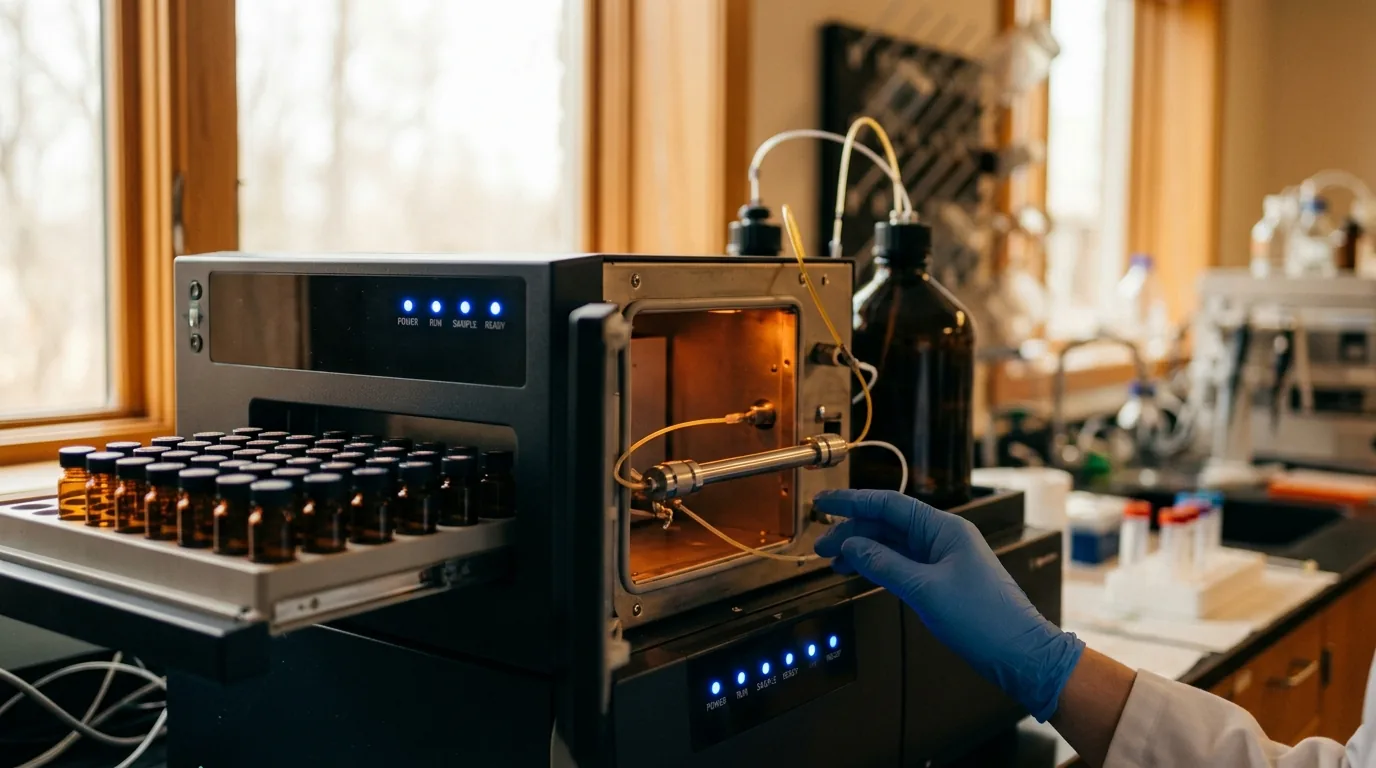
Reversed-phase high-performance liquid chromatography (RP-HPLC) is the industry-standard method for determining peptide purity. The technique separates the target peptide from synthesis-related impurities (deletion sequences, truncated products, diastereomers, oxidized variants) based on differences in hydrophobicity. A C18 column (typically 4.6 x 150 mm, 3-5 um particle size) with a linear gradient of acetonitrile in water (both containing 0.1% TFA) elutes peptide species in order of increasing hydrophobicity. UV detection at 214 nm (peptide bond absorption) provides universal detection of all peptide species.
Purity is calculated as the area of the main peak divided by the total area of all peptide peaks, expressed as a percentage. A well-synthesized 20-residue peptide at >95% purity shows a dominant main peak with minor satellite peaks representing deletion peptides (missing one amino acid) and oxidation products. The gradient conditions, column temperature, flow rate, and detection wavelength should be specified on the COA – purity values obtained under different chromatographic conditions are not directly comparable.
HPLC purity reflects only the peptide-related species detected at the chosen wavelength. It does not account for non-UV-absorbing contaminants like salts, counterions, or residual solvents that reduce net peptide content.
Mass Spectrometry: Identity Confirmation
Mass spectrometry (MS) provides the molecular weight of the synthesized peptide, confirming that the correct amino acid sequence was assembled. MALDI-TOF (Matrix-Assisted Laser Desorption/Ionization Time-of-Flight) and ESI (Electrospray Ionization) are the two techniques most commonly used. MALDI-TOF produces predominantly singly-charged [M+H]+ ions and is ideal for rapid molecular weight screening of peptides up to 10,000 Da. ESI generates multiply-charged ion envelopes that are deconvoluted to determine the neutral mass, and is preferred for larger peptides and for LC-MS applications.
The mass accuracy expected from a QC mass spectrum is typically +/- 0.1% for MALDI-TOF and +/- 0.01% for ESI instruments. For a peptide with theoretical MW 1,500 Da, the observed [M+H]+ should be 1,501.0 +/- 1.5 Da by MALDI or +/- 0.15 Da by ESI. Mass spectrometry can detect amino acid substitution errors (delta mass = difference between substituted residues), missing residues (delta mass = residue weight), and common modifications like oxidation (+16 Da), deamidation (+1 Da), and TFA adduction (+114 Da).
Amino Acid Analysis: Composition and Quantification
Amino acid analysis (AAA) hydrolyzes the peptide into individual amino acids and quantifies each residue. This provides two critical pieces of information: composition verification (the correct amino acids are present in the expected molar ratios) and absolute peptide content (the weight percentage of actual peptide in the sample, excluding counterions, moisture, and salts). AAA is the most accurate method for determining peptide concentration and is considered the gold standard for quantification.
Not all vendors include AAA on standard COAs because it is time-consuming and expensive (approximately $100-200 per sample). AAA is most commonly provided for bulk quantities (>100 mg), custom synthesis orders, and premium research-grade products. When AAA data is included, the net peptide content typically ranges from 60-85% for TFA salt peptides – the remainder being counterion, moisture, and residual synthesis by-products. This value is essential for preparing accurate molar concentrations.
Endotoxin and Sterility Testing
Peptides intended for cell culture or in vivo research applications require endotoxin testing to ensure that bacterial lipopolysaccharide (LPS) contamination is below acceptable limits. The Limulus Amebocyte Lysate (LAL) assay is the standard method, with acceptable limits typically set at less than 1 EU/mg (endotoxin units per milligram) for cell culture applications and less than 0.25 EU/mg for in vivo use. Endotoxin contamination can activate immune cells, confound inflammatory assays, and cause fever and sepsis-like responses in animal models.
Sterility testing verifies the absence of viable microorganisms in the final product. This is performed by membrane filtration or direct inoculation of growth media (TSB and FTM) with incubation at 20-25C and 30-35C for 14 days according to USP <71> or EP 2.6.1. Sterility testing is typically reserved for peptides sold as sterile products intended for injection in animal research. Standard lyophilized research peptides are not guaranteed sterile and should be reconstituted with sterile technique and filtered through 0.22 um membranes before use in cell culture.
Reading a Certificate of Analysis (COA)
A complete COA should include: product identification (peptide name, sequence, lot number, quantity), HPLC purity with chromatogram and method details (column, gradient, detection wavelength), mass spectrometry data with observed versus theoretical molecular weight, appearance description (white/off-white powder), solubility information, and storage recommendations. Premium COAs additionally include AAA results with net peptide content, counterion identification, residual solvent analysis, water content (Karl Fischer), and endotoxin levels.
Always verify that the COA is lot-specific – it should reference the exact lot number on your product vial. Generic COAs that describe 'typical' results rather than actual analytical data for your specific batch provide no quality assurance. The HPLC chromatogram should show a clean baseline with a well-resolved main peak; broad, tailing, or split main peaks suggest potential quality issues even if the calculated purity percentage appears acceptable.
Red Flags in Vendor QC Documentation
Warning signs that indicate inadequate quality control include: COAs without lot-specific data, missing HPLC chromatograms (purity number without supporting data), absence of mass spectrometry confirmation, purity claims without specification of method conditions, reluctance to provide raw analytical data upon request, and inconsistency between stated purity and actual chromatographic appearance. Vendors who cannot provide original analytical data for a specific lot may be reselling product from other manufacturers without independent verification.
Request the raw HPLC chromatogram and mass spectrum for your specific lot number. Reputable vendors provide this data routinely. Reluctance to share raw analytical data is a significant red flag.
Third-Party Testing and Independent Verification
Independent third-party testing provides the highest level of quality assurance by having an unaffiliated analytical laboratory verify the vendor's claims. Contract research organizations (CROs) and analytical testing laboratories offer peptide characterization services including HPLC purity, mass spectrometry, amino acid analysis, and endotoxin testing. Costs range from $100-500 per peptide depending on the testing panel. While not necessary for every purchase, third-party verification is recommended when using a new vendor for the first time, for peptides used in pivotal experiments, and whenever vendor COA data appears questionable.
Platforms like ChemVerify aggregate and verify vendor quality data to help researchers make informed purchasing decisions without the cost of individual third-party testing for routine orders. Comparing analytical data across multiple vendors supplying the same peptide sequence can reveal outliers in purity, identity, or peptide content that warrant further investigation.
References
- European Pharmacopoeia 10.0 (2020). 2.2.29 Liquid chromatography. EDQM.
- USP General Chapter <621> Chromatography. United States Pharmacopeia.
- Sarin VK et al. (1981). Quantitative monitoring of solid-phase peptide synthesis. Anal Biochem, 117(1):147-157.
- Pace CN et al. (1995). How to measure and predict molar absorption coefficient of a protein. Protein Sci, 4(11):2411-2423.
- FDA Guidance for Industry (2012). Pyrogen and Endotoxins Testing. U.S. Food and Drug Administration.
- Fountoulakis M, Lahm HW (1998). Hydrolysis and amino acid composition analysis of proteins. J Chromatogr A, 826(2):109-134.
- ICH Q6B (1999). Specifications: Test procedures and acceptance criteria for biotechnological/biological products.
Further Reading on ChemVerify
- Read more: Peptide Counterions Explained: TFA, Acetate, HCl → https://www.chemverify.com/learn/peptide-counterions-tfa-acetate-hcl-impact
- Read more: What Is Solid-Phase Peptide Synthesis (SPPS)? → https://www.chemverify.com/learn/what-is-spps-solid-phase-peptide-synthesis-beginners
References
Compare Verified Vendors
Browse COA-verified suppliers with exclusive discount codes and transparent pricing.