
What Is Lyophilization? How Freeze-Drying Preserves Peptides
Understand lyophilization (freeze-drying) and why it is the gold standard for peptide preservation. Covers the science of sublimation, cake structure, and storage stability.
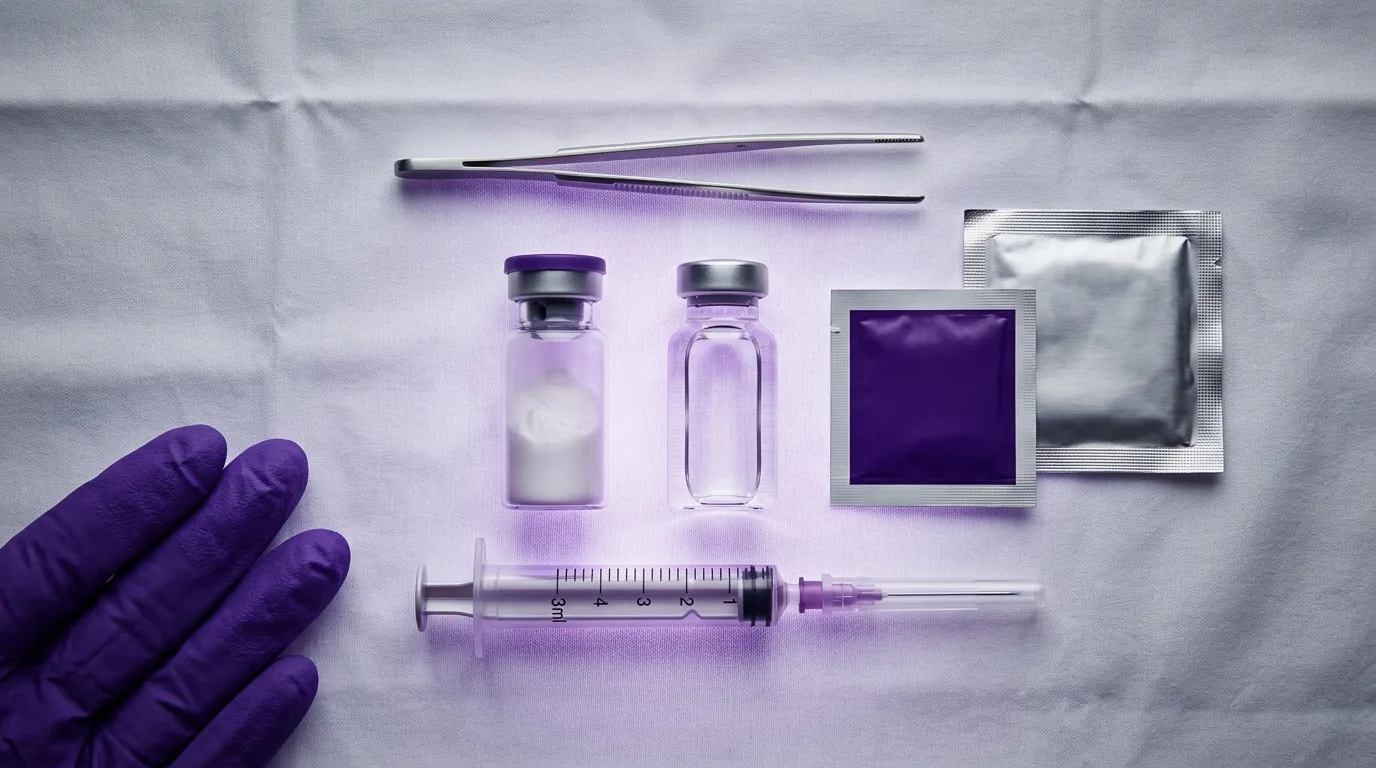
For laboratory research use only. Not for human consumption.
Research Use Disclaimer
This article explains the lyophilization process as it relates to peptide chemistry and laboratory research. ChemVerify does not provide medical advice or usage recommendations. All peptides are for laboratory research use only.
Lyophilization: The Gold Standard for Peptide Preservation
Lyophilization – commonly known as freeze-drying – is the process of removing water from a frozen sample by sublimation (converting ice directly to vapor under vacuum). It is the preferred preservation method for research peptides because it eliminates the aqueous environment that drives hydrolysis, deamidation, and microbial growth, producing a stable dry powder that can be stored for months to years with minimal degradation.
Nearly all commercially available research peptides are supplied in lyophilized form. Understanding the process helps researchers appreciate why proper storage conditions matter and how to assess the quality of lyophilized material upon receipt.
The Science of Freeze-Drying
Lyophilization exploits the phase diagram of water. Below the triple point (0.006 atm, 0.01 degrees Celsius), water exists only as ice or vapor – liquid water cannot form. By freezing the sample and then reducing pressure below the triple point, the ice sublimes directly into water vapor without passing through the liquid phase. This avoids the concentration effects, surface tension forces, and thermal stress that conventional evaporative drying would impose on peptides.
The process requires precise control of temperature, pressure, and time. Industrial lyophilizers use programmable shelf temperatures and vacuum systems to optimize sublimation rates while preventing sample collapse or melt-back – conditions where the frozen structure softens and the cake loses its porous architecture.
Three Phases: Freezing, Primary Drying, Secondary Drying
The freezing phase cools the peptide solution below its eutectic temperature or glass transition temperature, forming ice crystals that create a porous matrix. The cooling rate affects ice crystal size: slow freezing produces large crystals and larger pores (faster sublimation), while fast freezing produces small crystals and a finer pore structure. Most peptide lyophilization uses controlled slow-freezing protocols.
Primary drying is the longest phase, during which approximately 95% of the water is removed by sublimation under vacuum. Shelf temperature is carefully maintained below the collapse temperature of the formulation. This phase typically requires 12-48 hours depending on fill volume and vial geometry.
Secondary drying removes residual bound water (typically reducing moisture from 5-8% to below 1-2%) by raising the shelf temperature while maintaining vacuum. This phase ensures long-term storage stability by eliminating water molecules adsorbed to the peptide surface and within the amorphous matrix.
Lyophilized Cake Structure and Appearance
A well-formed lyophilized cake appears as a white to off-white, fluffy, porous solid that retains the shape of the original frozen solution within the vial. The porous structure is essential for rapid and complete reconstitution – it provides channels for the solvent to penetrate and dissolve the peptide uniformly.
Common cake defects include collapse (a dense, glassy appearance indicating the sample exceeded its collapse temperature during drying), shrinkage (the cake pulls away from the vial walls), and melt-back (partial liquefaction during drying). While cosmetic defects do not always indicate chemical degradation, they can slow reconstitution and may suggest suboptimal processing conditions.
Why Lyophilization Works Especially Well for Peptides
Peptides are particularly well-suited to lyophilization because their primary degradation pathways – hydrolysis, deamidation, and oxidation – are all water-dependent. In the dry state, molecular mobility is dramatically reduced, slowing chemical reactions by orders of magnitude. A peptide that degrades 5% per month in aqueous solution at 4 degrees Celsius might degrade less than 1% per year as a lyophilized powder at minus 20 degrees Celsius.
The amorphous glassy state formed during lyophilization further protects peptides by physically immobilizing molecules, preventing the conformational flexibility that precedes aggregation and chemical modification.
Excipients and Cryoprotectants
Pharmaceutical lyophilization often includes excipients to protect the peptide during freezing and drying. Common cryoprotectants include mannitol (provides cake structure as a crystalline bulking agent), trehalose and sucrose (amorphous stabilizers that substitute for water hydrogen bonds on the peptide surface), and glycine (a crystalline bulking agent that improves cake appearance).
Research-grade peptides may be lyophilized with or without excipients depending on the supplier. The Certificate of Analysis should specify the formulation composition. For unformulated peptides, the lyophilized material consists primarily of the peptide and its counterion salt (typically TFA or acetate).
Reconstituting Lyophilized Peptides
Proper reconstitution reverses the lyophilization process by reintroducing water to the porous cake. The solvent should be added slowly down the vial wall to allow gradual hydration without mechanical disruption of the cake structure. Gentle swirling – never shaking or vortexing – ensures complete dissolution while preserving peptide integrity.
The reconstitution time depends on the peptide sequence, cake structure, and solvent. Most well-formed lyophilized peptides dissolve within 1-5 minutes with gentle swirling. If dissolution is slow, allowing the vial to sit undisturbed for 10-15 minutes often resolves the issue as the solvent fully penetrates the pore network.
Quality Indicators of Properly Lyophilized Material
- Uniform white to off-white cake that retains vial shape without collapse
- Rapid and complete dissolution upon reconstitution (within 5 minutes)
- Clear, particle-free solution after reconstitution
- Residual moisture content below 2% as specified on the CoA
- HPLC purity consistent with the labeled specification
- Mass spectrum confirming expected molecular weight without degradation products
References
This article references pharmaceutical lyophilization science and peptide stability literature.
References
Compare Verified Vendors
Browse COA-verified suppliers with exclusive discount codes and transparent pricing.