
Peptide Expiration: Can You Use Expired Research Peptides?
Understand peptide expiration dates, shelf life of lyophilized vs reconstituted peptides, and degradation indicators. Learn when expired research peptides may still be usable.
For laboratory research use only. Not for human consumption.
Research Use Disclaimer
This article addresses peptide stability and shelf life in the context of laboratory research only. ChemVerify does not provide medical advice or recommend any use of peptides outside controlled research settings. All peptides discussed are for laboratory research use only and are not intended for human consumption.
What Peptide Expiration Dates Actually Mean
Peptide expiration dates indicate the period during which the manufacturer guarantees the product meets its stated specifications – typically purity, identity, and net peptide content. An expired peptide has not necessarily degraded; rather, the manufacturer has not tested stability beyond the labeled date. Most research peptide suppliers assign expiration dates of 12-24 months from the date of manufacture for lyophilized material stored under recommended conditions.
Expiration dates are determined through accelerated stability testing according to ICH Q1A guidelines, where samples are stored at elevated temperatures and humidity to predict long-term stability. The actual shelf life under proper storage conditions often exceeds the labeled expiration by a significant margin.
Shelf Life of Lyophilized Peptides
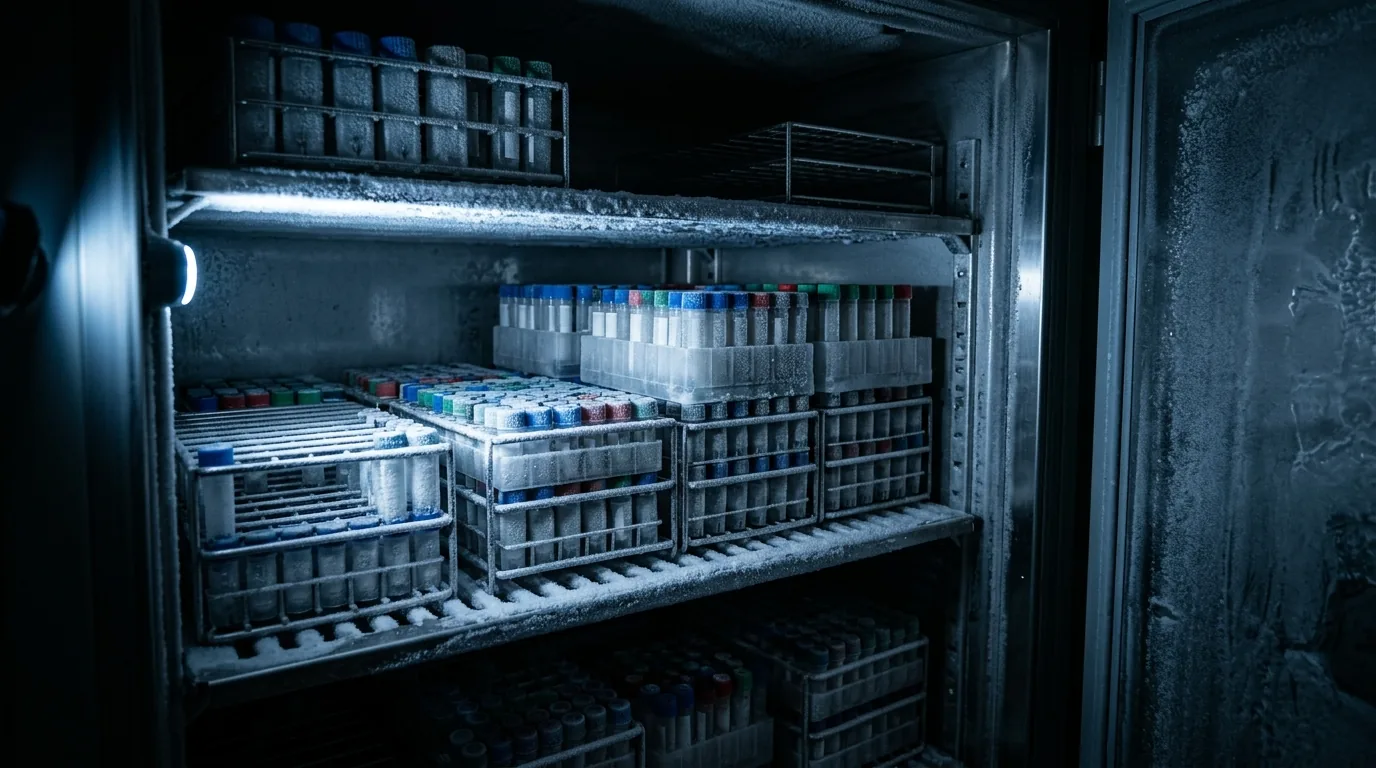
Lyophilized (freeze-dried) peptides are among the most stable forms of peptide storage. With moisture removed and the material in a solid amorphous or crystalline state, the chemical degradation pathways – hydrolysis, deamidation, oxidation – are dramatically slowed. Properly sealed lyophilized peptides stored at minus 20 degrees Celsius with desiccant routinely maintain specification for 2-5 years, and some sequences remain stable for a decade or more.
The key factors that determine lyophilized stability are residual moisture content (ideally below 2%), storage temperature (minus 20 degrees Celsius is standard, minus 80 degrees Celsius extends stability further), protection from light, and the integrity of the vial seal. If any of these conditions are compromised, degradation accelerates regardless of the printed expiration date.
Shelf Life of Reconstituted Peptides
Reconstituted peptides have dramatically shorter stability windows than lyophilized material. In bacteriostatic water at 2-8 degrees Celsius, most peptides maintain acceptable stability for 14-28 days. In sterile water without preservative, the practical window is 24-72 hours before microbial contamination risk becomes significant.
Frozen reconstituted peptides (minus 20 degrees Celsius) can be stable for 1-3 months if aliquoted to avoid freeze-thaw cycles. However, some sequences – particularly those containing methionine, cysteine, or asparagine – are prone to oxidation or deamidation even in frozen aqueous solution, making lyophilized storage always preferable for long-term retention.
Common Peptide Degradation Pathways
The primary chemical degradation pathways for synthetic peptides are well-characterized in pharmaceutical literature. Deamidation converts asparagine residues to aspartate or isoaspartate, changing the peptide mass by +1 Da and potentially altering biological activity. Oxidation affects methionine (to methionine sulfoxide) and tryptophan residues, detectable by mass spectrometry as +16 Da mass shifts. Hydrolysis cleaves peptide bonds, particularly at aspartate-proline sequences, generating truncated fragments.
Racemization – the conversion of L-amino acids to their D-isomer counterparts – occurs slowly under acidic or basic conditions and is accelerated by heat. Disulfide bond scrambling in cysteine-containing peptides can lead to misfolded or aggregated species.
Visual and Analytical Indicators of Degradation
Visual inspection provides a first-pass assessment of peptide integrity. Lyophilized peptides that have absorbed moisture may appear glassy, sticky, or collapsed rather than the expected fluffy white to off-white cake. Color changes – yellowing, browning, or darkening – suggest oxidative or Maillard-type degradation. Reconstituted solutions that are cloudy, contain particles, or have an unusual color should be treated as potentially degraded.
Analytical confirmation requires HPLC (to assess purity relative to the original CoA value) and mass spectrometry (to detect specific degradation products). A purity decrease of more than 5% from the original CoA specification is generally considered significant and may warrant discarding the material.
Can Expired Peptides Still Be Used in Research?
For many research applications, expired peptides that have been properly stored may still be usable. The decision depends on the research context: qualitative screening assays and structure-activity relationship studies are more tolerant of minor degradation than quantitative binding assays or in-vivo studies. If the expired peptide can be re-analyzed by HPLC and mass spectrometry and still meets the required purity specifications, there is no scientific reason to discard it.
However, researchers should document the use of expired material in their laboratory notebooks and note that the CoA specifications may no longer be current. For any work intended for publication or regulatory submission, using material within its labeled shelf life is strongly recommended.
Strategies to Extend Peptide Shelf Life
- Store lyophilized peptides at minus 20 degrees Celsius or colder in a non-frost-free freezer
- Include desiccant packets in secondary containers to control humidity
- Use argon or nitrogen gas overlay in vials before sealing to reduce oxidation
- Aliquot reconstituted peptides into single-use volumes immediately after preparation
- Wrap vials in aluminum foil or use amber containers to prevent photodegradation
- Avoid storing peptides in door compartments of freezers where temperature fluctuates
- Record storage conditions and access dates for each vial in the laboratory inventory system
When to Discard: Decision Framework
Discard research peptides when visual inspection reveals moisture absorption, color change, or particulate formation in the lyophilized cake. Discard when re-analysis shows purity has dropped more than 5% below the original CoA specification. Discard when mass spectrometry reveals degradation products that could interfere with the planned assay. Discard if storage conditions were compromised – for example, a freezer failure that exposed material to room temperature for an extended period.
When in doubt, the cost of re-ordering a fresh vial is almost always less than the cost of troubleshooting ambiguous experimental results caused by degraded starting material.
References
This article references pharmaceutical stability science and peptide chemistry literature.
References
Compare Verified Vendors
Browse COA-verified suppliers with exclusive discount codes and transparent pricing.