
Peptide Impurities: Deletion Sequences, Truncations, and How to Detect Them
Understand common peptide synthesis impurities including deletion sequences, truncations, and side products. Learn detection methods via HPLC, MS, and amino acid analysis.
For laboratory research use only. Not for human consumption.
Why Peptide Impurities Matter
No peptide synthesis achieves 100% yield of the desired product. Every batch contains a mixture of the target peptide and various impurities that arise from incomplete coupling reactions, premature chain termination, side reactions, and incomplete deprotection steps. For research applications, these impurities can confound experimental results by introducing off-target biological activity, masking the true potency of the desired peptide, or producing unexpected toxicity in cell-based assays [1].
Understanding the types of impurities, how they form, and how to detect them is essential for any researcher who depends on peptide quality for reliable experimental outcomes. A Certificate of Analysis (COA) that reports only HPLC purity without mass spectrometry confirmation may miss critical impurities that co-elute with the target peptide.
Deletion Sequences: Missing Residues
Deletion sequences are the most problematic class of peptide impurities. They arise when a coupling step fails to add the intended amino acid residue, but subsequent coupling steps proceed normally. The result is a peptide that is one amino acid shorter than the target sequence but otherwise has the same N-terminal and C-terminal residues. Because deletion sequences differ from the target by only one residue, they are extremely difficult to separate by HPLC [2].
In solid-phase peptide synthesis (SPPS), coupling efficiencies of 99.5% per step are considered excellent. However, for a 30-residue peptide, even 99.5% coupling efficiency means that approximately 14% of the final crude product consists of sequences with at least one deletion. The cumulative effect of imperfect coupling is the primary reason why longer peptides are more difficult to synthesize at high purity [3]. Double coupling and capping unreacted amines with acetic anhydride are standard strategies to minimize deletion sequences.
Truncation Products: Incomplete Chains
Truncation products result from premature termination of chain assembly. Unlike deletion sequences, truncated peptides are missing all residues beyond the point of termination. They are generally shorter than the target peptide and usually easier to separate by HPLC due to greater differences in retention time. Common causes include incomplete Fmoc deprotection, resin cleavage during synthesis, and aggregation of the growing peptide chain on the resin [4].
Capping strategies help manage truncation products. After each coupling step, unreacted free amines are capped with an acetyl group, preventing further chain elongation on those sites. This converts potential deletion sequences into truncated, capped sequences that have different chromatographic behavior and are more easily removed during purification.
Side-Reaction Products and Modifications
Side reactions during synthesis and cleavage introduce chemical modifications that alter the peptide's mass and potentially its biological activity. Common side reactions include aspartimide formation from aspartic acid residues, methionine oxidation to methionine sulfoxide, alkylation of tryptophan and cysteine side chains, and diketopiperazine formation at the N-terminus [5].
Racemization – the conversion of L-amino acids to their D-isomers during coupling – is particularly insidious because the resulting diastereomeric peptides have identical molecular weights and very similar chromatographic behavior. Detecting racemization typically requires chiral analysis methods such as Marfey's reagent derivatization followed by LC-MS. Even low levels of racemization can significantly alter receptor binding and biological activity.
Detection by HPLC: Chromatographic Separation
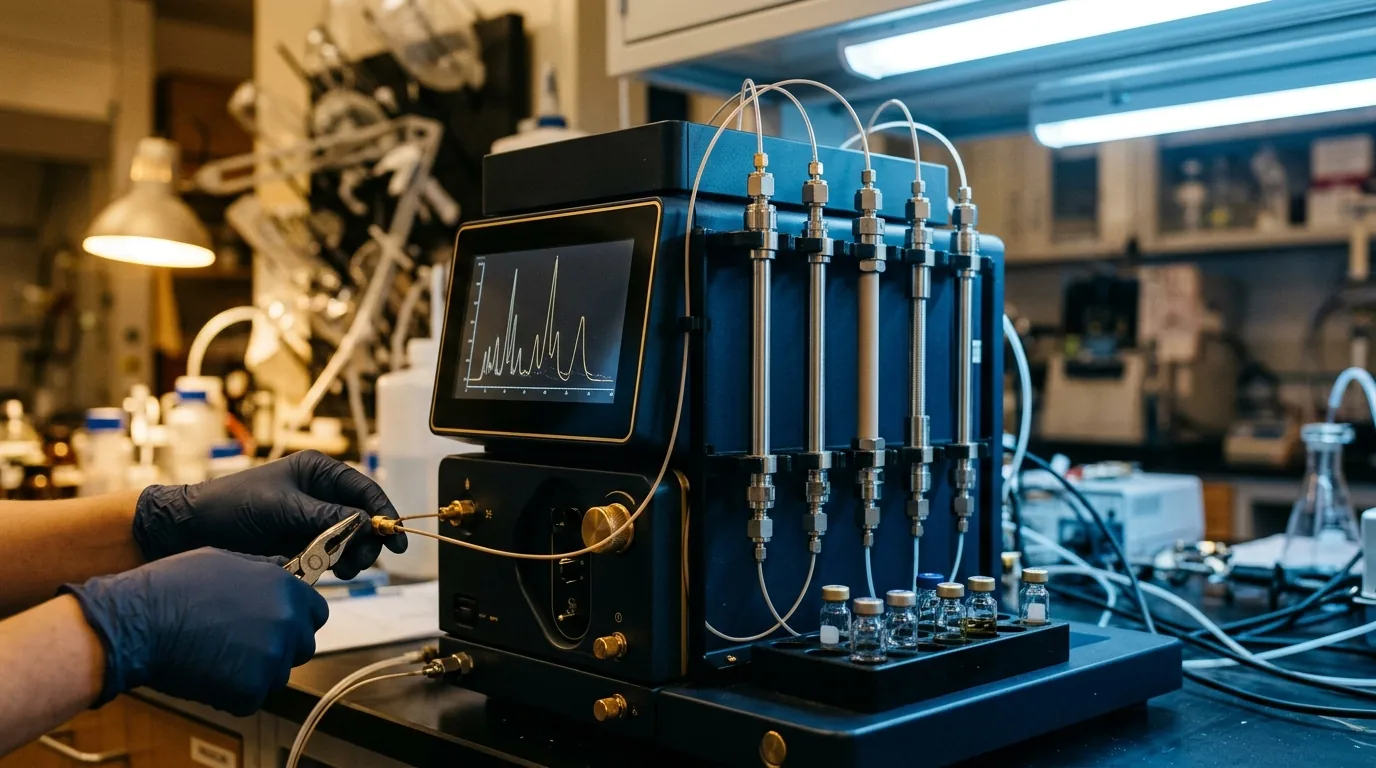
Reversed-phase HPLC (RP-HPLC) is the primary tool for assessing peptide purity. Peptides are separated based on hydrophobicity using a C18 or C8 column with acetonitrile/water gradients containing 0.1% trifluoroacetic acid. UV detection at 214 nm (peptide bond absorption) provides the purity chromatogram. The reported purity percentage represents the target peptide peak area relative to total peak area [6].
However, HPLC purity has significant limitations. Co-eluting impurities – particularly single-residue deletion sequences – may overlap with the target peak, inflating the apparent purity. Different gradient conditions, column chemistries, and temperatures can yield different purity values for the same sample. A reputable vendor will specify the exact HPLC conditions used, and researchers should be aware that a stated 98% purity by HPLC does not guarantee the absence of structurally similar impurities.
Mass Spectrometry for Impurity Identification
Mass spectrometry (MS) is indispensable for identifying peptide impurities. Electrospray ionization mass spectrometry (ESI-MS) confirms whether the observed molecular weight matches the theoretical mass of the target sequence. Any mass discrepancy indicates either the wrong sequence, a chemical modification, or an adduct. LC-MS, which couples HPLC separation with MS detection, can identify individual impurity peaks [7].
High-resolution mass spectrometry (HRMS) using Orbitrap or time-of-flight (TOF) analyzers provides mass accuracy to within 1–5 ppm, enabling definitive identification of modifications such as oxidation (+16 Da), deamidation (+1 Da), or deletion of a specific amino acid. Tandem mass spectrometry (MS/MS) fragments the peptide and generates sequence-specific ions that confirm the amino acid sequence and pinpoint the location of modifications.
Amino Acid Analysis and Sequencing
Amino acid analysis (AAA) hydrolyzes the peptide into its constituent amino acids and quantifies each residue. The ratios should match the theoretical composition. Significant deviations suggest the presence of deletion sequences (reduced ratio of the deleted residue) or other impurities. AAA is particularly useful for confirming that the overall composition is correct, even when MS data appear normal [8].
Edman degradation sequentially removes and identifies amino acids from the N-terminus, providing direct sequence confirmation. While slower and more expensive than MS-based methods, Edman sequencing can distinguish between isomeric amino acids (leucine and isoleucine) that have identical masses. For high-stakes research applications, combining MS, AAA, and Edman sequencing provides the most comprehensive quality assessment.
Acceptable Impurity Limits and Specifications
Acceptable impurity levels depend on the research application. For initial screening studies, 90–95% HPLC purity may be sufficient. For quantitative binding assays, enzyme kinetics, or in vivo studies, 95–98% purity with MS confirmation is generally recommended. For studies that will be published or used to support regulatory filings, 98%+ purity with comprehensive characterization (HPLC, MS, AAA) is the standard [9].
When evaluating a COA, look for mass spectrometry data confirming the correct molecular weight, HPLC chromatograms showing a clean major peak with identified minor peaks, and batch-specific (not generic) documentation. A vendor that provides only HPLC purity without MS data is omitting a critical quality control step that could mask identity errors or significant impurities.
Key Takeaways
Deletion sequences, truncation products, and chemical modifications are the three major categories of peptide synthesis impurities. Deletion sequences are the most difficult to detect and remove because they closely resemble the target peptide. HPLC purity alone is insufficient – mass spectrometry confirmation is essential for reliable quality assessment. Longer peptides accumulate more impurities due to the multiplicative effect of per-step coupling inefficiency. Researchers should request batch-specific COAs with both HPLC and MS data for any peptide used in quantitative research.
For laboratory research use only. Not for human consumption.
References
Compare Verified Vendors
Browse COA-verified suppliers with exclusive discount codes and transparent pricing.