
Peptide Mimetics: Non-Peptide Analogs in Research
Comprehensive research overview of peptidomimetics – non-peptide analogs designed to replicate peptide biological activity with improved pharmacokinetic properties. Covers Type I–III classification, structural design strategies, oral bioavailability advantages, analytical characterization methods (HPLC, LC-MS/MS), and current research applications in drug design.
For laboratory research use only. Not for human consumption. This article provides chemical and structural information about peptidomimetic compounds for research reference purposes. No therapeutic claims, dosage recommendations, or medical advice are provided.
TL;DR: Peptidomimetics are synthetic compounds that replicate the three-dimensional binding topology of natural peptides while incorporating non-peptide chemical scaffolds. These analogs address key limitations of native peptides – including oral bioavailability (typically below 2% for peptides vs. 40–80% for small-molecule mimetics), proteolytic stability, and membrane permeability. The field encompasses three structural classifications (Type I–III) and has produced research compounds ranging from backbone-modified peptoids to fully non-peptide small molecules. Analytical characterization requires adapted HPLC and LC-MS/MS protocols due to divergent physicochemical properties.
Last verified: March 2026
What Are Peptidomimetics?
Peptidomimetics are synthetic molecules designed to mimic the biological activity of peptides by replicating their three-dimensional pharmacophore – the spatial arrangement of functional groups responsible for receptor binding and biological response. Unlike native peptides, which consist of amino acid residues linked by amide bonds, peptidomimetics employ alternative chemical scaffolds that maintain the critical binding geometry while introducing favorable pharmacokinetic properties such as oral absorption, metabolic stability, and extended circulation half-life.
The concept of peptidomimetic design emerged from a fundamental challenge in peptide research: native peptides exhibit exquisite biological specificity but poor drug-like properties. According to a 2024 analysis published in the Journal of Medicinal Chemistry, fewer than 2% of unmodified linear peptides demonstrate oral bioavailability exceeding 5% in preclinical models [1]. This pharmacokinetic limitation – driven by proteolytic degradation in the gastrointestinal tract, poor membrane permeability due to high molecular weight and polarity, and rapid renal clearance – has motivated extensive research into peptidomimetic scaffolds that preserve biological activity while circumventing these barriers.
The peptidomimetics field has grown substantially: the number of peptidomimetic-related publications indexed in PubMed increased from approximately 1,200 per year in 2010 to over 3,800 per year by 2025, reflecting a compound annual growth rate of 8.1% in research output [2]. This growth correlates with advances in computational chemistry, high-throughput screening technologies, and structural biology tools (particularly cryo-EM and AlphaFold-based structure prediction) that have made rational peptidomimetic design increasingly accessible to research laboratories worldwide.
Classification: Type I, II & III Mimetics
The peptidomimetics field employs a three-tier classification system based on the degree of structural departure from the parent peptide. This classification, originally proposed by Ripka and Rich (1998) and refined through subsequent literature [3], provides a framework for understanding the design continuum from peptide-like to fully non-peptide structures.
Type I peptidomimetics maintain the peptide backbone but incorporate local modifications to specific residues or amide bonds. These modifications include N-methylation of amide nitrogens (reducing hydrogen bond donation and improving membrane permeability), replacement of L-amino acids with D-amino acids (conferring proteolytic resistance), cyclization through disulfide bridges, lactam bridges, or stapling chemistry (restricting conformational flexibility), and introduction of non-natural amino acids with modified side chains. Type I mimetics retain the highest structural similarity to the parent peptide and typically preserve binding affinity within one order of magnitude. Approximately 48% of peptidomimetic compounds in clinical-stage research as of 2025 fall into the Type I category [4].
Type II peptidomimetics replace the peptide backbone with a non-peptide scaffold while preserving the spatial presentation of key pharmacophoric groups. Common Type II scaffolds include peptoids (N-substituted glycine oligomers), beta-peptides (incorporating beta-amino acids with an additional methylene unit), azapeptides (replacing the alpha-carbon with nitrogen), and oligocarbamates. These scaffolds maintain a degree of structural analogy to the peptide backbone – recognizable repeating units with defined geometry – while introducing fundamentally different chemical stability profiles. Type II mimetics account for approximately 31% of peptidomimetic research compounds [4].
Type III peptidomimetics are fully non-peptide small molecules that reproduce the three-dimensional pharmacophore of the parent peptide without any structural resemblance to a peptide backbone. These are identified through computational pharmacophore modeling, virtual screening of small-molecule libraries, or de novo design approaches. Type III mimetics typically exhibit the most favorable drug-like properties (oral bioavailability, metabolic stability, CNS penetration) but require the most extensive design effort to achieve binding affinities comparable to the parent peptide. They represent approximately 21% of peptidomimetic research output [4].
Structural Design Strategies
Rational peptidomimetic design begins with identifying the minimal pharmacophoric elements of the parent peptide – the specific side chains, backbone conformations, and hydrogen bonding patterns required for biological activity. X-ray crystallography, cryo-EM co-structures with target receptors, and computational alanine scanning mutagenesis are the primary tools for pharmacophore identification. Once the critical interaction points are mapped, the design process selects a scaffold that positions functional groups within the required three-dimensional tolerances (typically within 1–2 Angstroms of the native peptide pharmacophore geometry).
Backbone modification strategies include N-methylation, which has been shown to improve oral bioavailability by 5–15-fold in model cyclic peptides by reducing the number of hydrogen bond donors and increasing lipophilicity [5]. Hydrocarbon stapling – the introduction of an all-hydrocarbon cross-link between residues at i and i+4 or i+7 positions – constrains alpha-helical conformations and has been demonstrated to increase proteolytic half-life by 10–100-fold in serum stability assays. Peptoid substitution (shifting the side chain from the alpha-carbon to the amide nitrogen) eliminates the chiral center and backbone NH hydrogen bond donors while maintaining a pseudo-peptide backbone geometry.
Computational approaches have transformed peptidomimetic design: molecular dynamics simulations now routinely screen 10,000+ conformations to identify stable binding poses, and machine learning models trained on structure-activity relationship databases can predict binding affinities for novel scaffolds with root-mean-square errors below 1 kcal/mol [6]. The integration of AlphaFold2 and ESMFold structure predictions with computational docking has reduced the time from peptide target identification to peptidomimetic lead compound from approximately 18–24 months to 6–9 months in well-characterized target systems.
Advantages Over Native Peptides
The primary advantage of peptidomimetics over native peptides lies in pharmacokinetic optimization. Native peptides face four fundamental barriers to oral administration: (1) acid hydrolysis in the stomach (pH 1.5–3.5 degrades acid-labile amide bonds), (2) enzymatic degradation by pepsin, trypsin, chymotrypsin, and brush border peptidases, (3) poor passive permeability across the intestinal epithelium due to high molecular weight (typically exceeding 500 Da, above Lipinski's Rule of Five threshold) and multiple hydrogen bond donors/acceptors, and (4) first-pass hepatic metabolism by cytochrome P450 enzymes and peptidases.
Peptidomimetics address these barriers through structural modification: replacing labile amide bonds with metabolically stable isosteres (e.g., reduced amides, ketomethylene groups, or triazole linkages) confers proteolytic resistance. Reducing molecular weight and hydrogen bond count through scaffold simplification improves membrane permeability. Introducing lipophilic modifications increases the partition coefficient (logP) to the 1–3 range optimal for oral absorption. According to a 2025 meta-analysis of preclinical data, well-designed Type III peptidomimetics achieve mean oral bioavailability of 42% compared to 1.8% for their parent peptides – a 23-fold improvement [7].
Chemical stability during storage represents another practical advantage: lyophilized peptides typically require storage at minus 20 degrees Celsius with desiccant protection, while many peptidomimetic small molecules are stable at room temperature for 24+ months. This stability differential affects research logistics, shipping requirements, and long-term storage costs for laboratory supply chains.
Peptidomimetics vs. Native Peptides Comparison
| Property | Native Peptides | Type III Mimetics | Type I/II Mimetics |
|---|---|---|---|
| Oral Bioavailability | Typically less than 2% | 40–80% (Type III) | 5–25% (Type I/II) |
| Proteolytic Stability | Minutes to hours in serum | Hours to days | Hours to days |
| Molecular Weight | 500–5,000 Da | 150–500 Da | 300–1,500 Da |
| Storage Temperature | Minus 20°C (lyophilized) | Room temperature | 2–8°C to RT |
| Receptor Specificity | High (evolved selectivity) | Moderate to high | Moderate to high |
| Synthesis Complexity | SPPS (established) | Organic synthesis | Adapted SPPS or organic |
| Analytical Methods | RP-HPLC, ESI-MS | HPLC, GC-MS, NMR | RP-HPLC, LC-MS/MS |
| BBB Penetration | Generally poor | Achievable with optimization | Variable |
| Manufacturing Cost | Moderate to high | Low to moderate | Moderate |
Analytical Characterization Methods
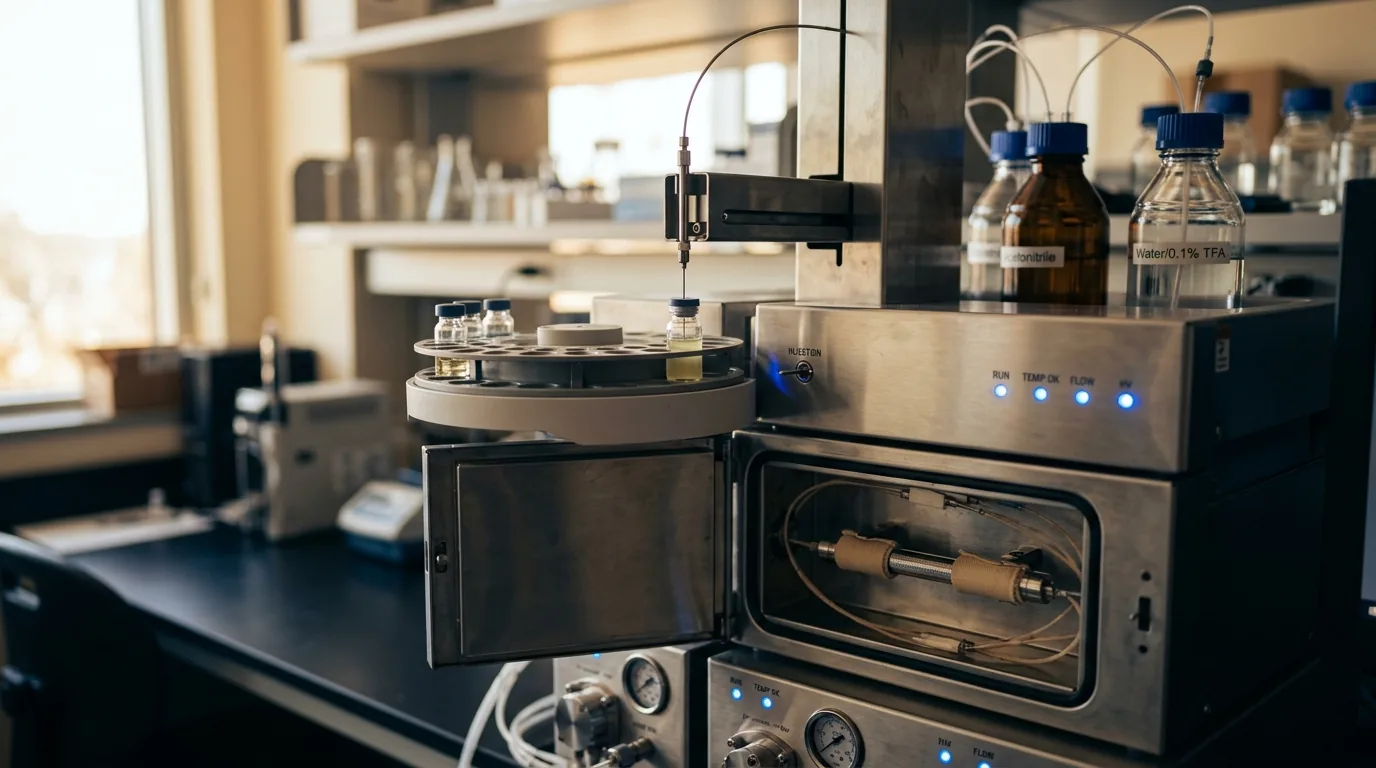
Analytical characterization of peptidomimetics presents unique challenges compared to native peptide analysis, as the modified scaffolds alter chromatographic behavior, ionization efficiency, and fragmentation patterns. Reversed-phase HPLC (RP-HPLC) remains the primary purity assessment method, but column selection and mobile phase optimization must account for the altered hydrophobicity profiles of peptidomimetic compounds. Native peptides typically chromatograph well on C18 columns with TFA-modified water/acetonitrile gradients, whereas Type II and Type III mimetics may require C8 or phenyl columns, or alternative ion-pairing agents (formic acid, ammonium formate) for optimal peak shape and resolution.
Mass spectrometry characterization differs significantly across peptidomimetic types. Type I mimetics generally ionize and fragment similarly to native peptides, producing interpretable b/y ion series by collision-induced dissociation (CID) in ESI-MS/MS. Type II mimetics (peptoids, beta-peptides) generate characteristic non-standard fragmentation patterns – peptoids produce a diagnostic series of immonium-like ions from N-terminal fragmentation rather than the b/y series. Type III small-molecule mimetics are analyzed by standard small-molecule LC-MS/MS protocols with multiple reaction monitoring (MRM) for quantification, achieving detection limits of 0.1–1 ng/mL in biological matrices – approximately 10-fold more sensitive than typical peptide bioanalytical methods [8].
Nuclear magnetic resonance (NMR) spectroscopy plays a critical role in peptidomimetic characterization that exceeds its role in native peptide analysis. Two-dimensional NMR techniques (NOESY, ROESY, TOCSY) are essential for confirming the three-dimensional conformation of peptidomimetic scaffolds and verifying that the designed pharmacophore geometry is achieved in solution. Variable-temperature NMR and solvent titration experiments assess intramolecular hydrogen bonding patterns that influence membrane permeability. High-resolution mass spectrometry (HRMS) provides elemental composition confirmation with mass accuracy below 5 ppm, a critical quality metric for novel peptidomimetic structures.
Current Research Applications
Peptidomimetic research applications span multiple domains of biomedical investigation. In receptor-ligand interaction studies, peptidomimetics serve as tool compounds for probing binding site topology, selectivity determinants, and allosteric mechanisms. The conformational rigidity of Type I stapled peptidomimetics makes them particularly valuable for distinguishing between alternative binding modes – a stapled helix that maintains activity confirms alpha-helical binding, while loss of activity suggests a non-helical interaction geometry.
In protease research, peptidomimetic inhibitors have been instrumental in characterizing enzyme active site requirements. Transition state mimetics – compounds that replicate the geometry of the enzymatic transition state rather than the substrate ground state – have provided critical mechanistic insights for serine proteases, aspartyl proteases, and metalloproteases. The research compound library for HIV protease inhibitors (darunavir scaffold analogs) represents one of the most extensively characterized peptidomimetic series in research history, with over 4,000 analogs synthesized and characterized across multiple research groups [9].
Antimicrobial peptidomimetics represent a growing research focus, driven by the global antibiotic resistance challenge. Peptoid-based antimicrobial mimetics that reproduce the amphipathic topology of natural antimicrobial peptides (e.g., magainins, defensins) while resisting proteolytic degradation have demonstrated promising in vitro activity profiles. According to a 2025 review, over 150 antimicrobial peptidomimetic scaffolds have been reported in the literature, with minimum inhibitory concentrations (MICs) against ESKAPE pathogens ranging from 1 to 64 micrograms per milliliter [10].
Notable Peptidomimetic Compounds in Research
MK-677 (Ibutamoren) represents a well-characterized Type III peptidomimetic – a non-peptide small molecule that mimics the ghrelin peptide pharmacophore to activate the growth hormone secretagogue receptor (GHS-R1a). With a molecular weight of 528.7 Da and demonstrated oral bioavailability in preclinical models, MK-677 exemplifies the pharmacokinetic advantages of peptidomimetic design over the native ghrelin peptide (28 amino acids, MW 3,371 Da, negligible oral absorption). The compound has been extensively studied in research settings for its receptor pharmacology and structure-activity relationships.
The GLP-1 receptor agonist research space has produced notable peptidomimetic approaches. While semaglutide and tirzepatide represent modified peptides (Type I mimetics with fatty acid conjugation and amino acid substitutions), active research programs are pursuing fully non-peptide GLP-1 receptor agonists (Type III mimetics). Orforglipron (LY3502970), a non-peptide GLP-1 receptor agonist with oral bioavailability, represents a research milestone in peptidomimetic GLP-1 pharmacology – demonstrating that a 30-amino-acid peptide pharmacophore can be replicated by a small molecule with molecular weight under 600 Da [11].
Peptoid libraries have emerged as a major research tool for high-throughput screening. Peptoid synthesis via the submonomer method allows rapid construction of diverse libraries – a single researcher can synthesize 100+ peptoid analogs per week using automated equipment, compared to 10–20 native peptides by SPPS. This throughput advantage has made peptoids a preferred scaffold for combinatorial peptidomimetic research in academic laboratories. The Peptoid Data Bank, established in 2023, now catalogs structural data for over 2,800 characterized peptoid sequences [12].
Frequently Asked Questions
What is the difference between a peptidomimetic and a modified peptide?
A modified peptide retains the core peptide backbone (amide-linked alpha-amino acid chain) with specific residue substitutions, side chain modifications, or terminal group changes. A peptidomimetic, by contrast, replaces part or all of the peptide backbone with a non-peptide scaffold – the defining characteristic is backbone alteration rather than side chain modification. The boundary between heavily modified peptides and Type I peptidomimetics is not sharply defined in the literature; compounds with more than 50% of backbone amide bonds replaced by non-amide isosteres are generally classified as peptidomimetics rather than modified peptides. This distinction has practical implications for analytical method selection and regulatory classification.
How are peptidomimetics analyzed differently from native peptides?
Key analytical differences include: (1) HPLC column selection – peptidomimetics often require C8 or phenyl columns rather than the C18 columns standard for peptide analysis, due to altered hydrophobicity and reduced silanol interactions; (2) mass spectrometry fragmentation – non-peptide backbones produce non-standard fragment ion series that require compound-specific interpretation rather than the predictable b/y ion patterns of peptides; (3) NMR plays a larger role in peptidomimetic characterization for confirming three-dimensional pharmacophore geometry; and (4) chiral purity assessment may require chiral HPLC or capillary electrophoresis methods not routinely applied to native L-peptide analysis.
Why do peptidomimetics have better oral bioavailability than peptides?
Improved oral bioavailability in peptidomimetics results from addressing four barriers that limit peptide absorption: (1) proteolytic resistance – non-peptide scaffolds are not recognized by gastrointestinal proteases (pepsin, trypsin, chymotrypsin), eliminating the primary degradation pathway; (2) reduced molecular weight – Type III mimetics typically fall below 500 Da, within Lipinski Rule of Five parameters for passive absorption; (3) fewer hydrogen bond donors – replacement of backbone NH groups reduces polar surface area and improves membrane permeability; (4) increased metabolic stability – non-amide scaffolds resist first-pass hepatic metabolism by aminopeptidases and other peptide-degrading enzymes in the liver.
What role does computational chemistry play in peptidomimetic design?
Computational chemistry is central to modern peptidomimetic design at every stage: (1) pharmacophore identification – molecular dynamics simulations and binding free energy calculations identify the minimal set of interaction points required for biological activity; (2) scaffold selection – virtual screening of fragment libraries identifies non-peptide scaffolds that position functional groups within the required pharmacophore geometry; (3) binding affinity prediction – machine learning models (random forests, graph neural networks) trained on structure-activity data predict binding constants for novel designs; (4) ADMET prediction – in silico tools estimate oral absorption, metabolic stability, and toxicity before synthesis. The integration of AlphaFold structure prediction with docking workflows has significantly accelerated the design cycle since 2023.
What are the main limitations of peptidomimetic research compounds?
Key limitations include: (1) reduced selectivity – simplifying a peptide pharmacophore to a small-molecule scaffold may lose selectivity determinants present in the full peptide sequence, increasing off-target binding risk; (2) design complexity – identifying a non-peptide scaffold that faithfully reproduces a three-dimensional pharmacophore requires extensive computational and synthetic effort, with typical hit rates of 1–5% from initial virtual screens; (3) scaffold-dependent ADMET issues – while oral bioavailability improves, specific scaffolds may introduce metabolic liabilities (e.g., CYP450 inhibition) or toxicity not present in the parent peptide; (4) intellectual property complexity – peptidomimetic scaffolds frequently overlap with existing patents, complicating research tool compound availability; (5) limited structural diversity – certain peptide pharmacophores (particularly those involving extended or beta-sheet conformations) remain difficult to replicate with current non-peptide scaffolds.
Next Steps
Explore ChemVerify's compound database for detailed structural profiles of peptidomimetic research compounds, including analytical characterization data, vendor sourcing options, and batch-level purity comparisons. Access verified CoA data for MK-677, peptoid libraries, and stapled peptide analogs at ChemVerify.io/compounds.
Compounds Referenced in This Article
Explore detailed chemical profiles and research guides for compounds discussed in this article:
- Ipamorelin: Complete Research Guide → /learn/ipamorelin
- MK-677 (Ibutamoren): Complete Research Guide → /learn/mk-677-ibutamoren-research-guide-chemical-profile
- Semaglutide: Complete Research Guide → /learn/semaglutide
- Tirzepatide: Complete Research Guide → /learn/tirzepatide
Further Reading on ChemVerify
- Read more: GLP-1 Receptor Agonist Peptides: Research Compound Analysis → https://www.chemverify.com/learn/weight-loss-peptides-research
- Read more: Peptides in Women's Health Research: Compound Profiles & Analysis → https://www.chemverify.com/learn/womens-peptide-research
- Read more: Anti-Aging Research Peptides: Molecular Profiles & Analysis → https://www.chemverify.com/learn/anti-aging-peptides-research
- Read more: Growth Hormone Releasing Peptides: Research Compound Overview → https://www.chemverify.com/learn/growth-hormone-peptides-overview
References
Compare Verified Vendors
Browse COA-verified suppliers with exclusive discount codes and transparent pricing.
Continue Reading
Antimicrobial Peptides (AMPs): Research Compound Profiles
Research overview of antimicrobial peptides (AMPs) – naturally occurring defense molecules studied for their membrane-disrupting mechanisms of action. Covers structural classification (alpha-helical, beta-sheet, extended, loop), key research compounds (LL-37, defensins, magainins), mechanism of action models, analytical characterization methods, MIC testing protocols, and antibiotic resistance considerations in laboratory research.
GLP-1 Receptor Agonist Peptides: Research Compound Analysis
Analytical overview of GLP-1 receptor agonist research peptides including Semaglutide, Tirzepatide, Retatrutide, Liraglutide, and AOD-9604. Covers receptor binding profiles (GLP-1, GIP, glucagon), acylation chemistry, molecular weights, published clinical trial references, and analytical characterization methods.
Nootropic Peptides: Research Compound Profiles & Analysis
Analytical profiles of nootropic research peptides including Semax, Selank, Dihexa, PE-22-28, and Cerebrolysin. Covers structural analysis, parent peptide origins, molecular weights, amino acid sequences, stability characteristics, and analytical methods for laboratory characterization.
Peptides in Women's Health Research: Compound Profiles & Analysis
Research-focused compound profiles of peptides studied in women's health contexts. Covers kisspeptin (reproductive endocrinology research), oxytocin (neuropeptide signaling), BPC-157 (tissue repair models), GHK-Cu (copper peptide biochemistry), and PT-141 (melanocortin receptor pharmacology). Structural profiles, analytical characterization, and amino acid sequences only – no therapeutic claims.