
Peptide Reconstitution: How Much Bacteriostatic Water to Add (With Examples)
Learn the exact formula for calculating bacteriostatic water volumes when reconstituting lyophilized peptides. Includes concentration tables, syringe tips, and common beginner mistakes to avoid.
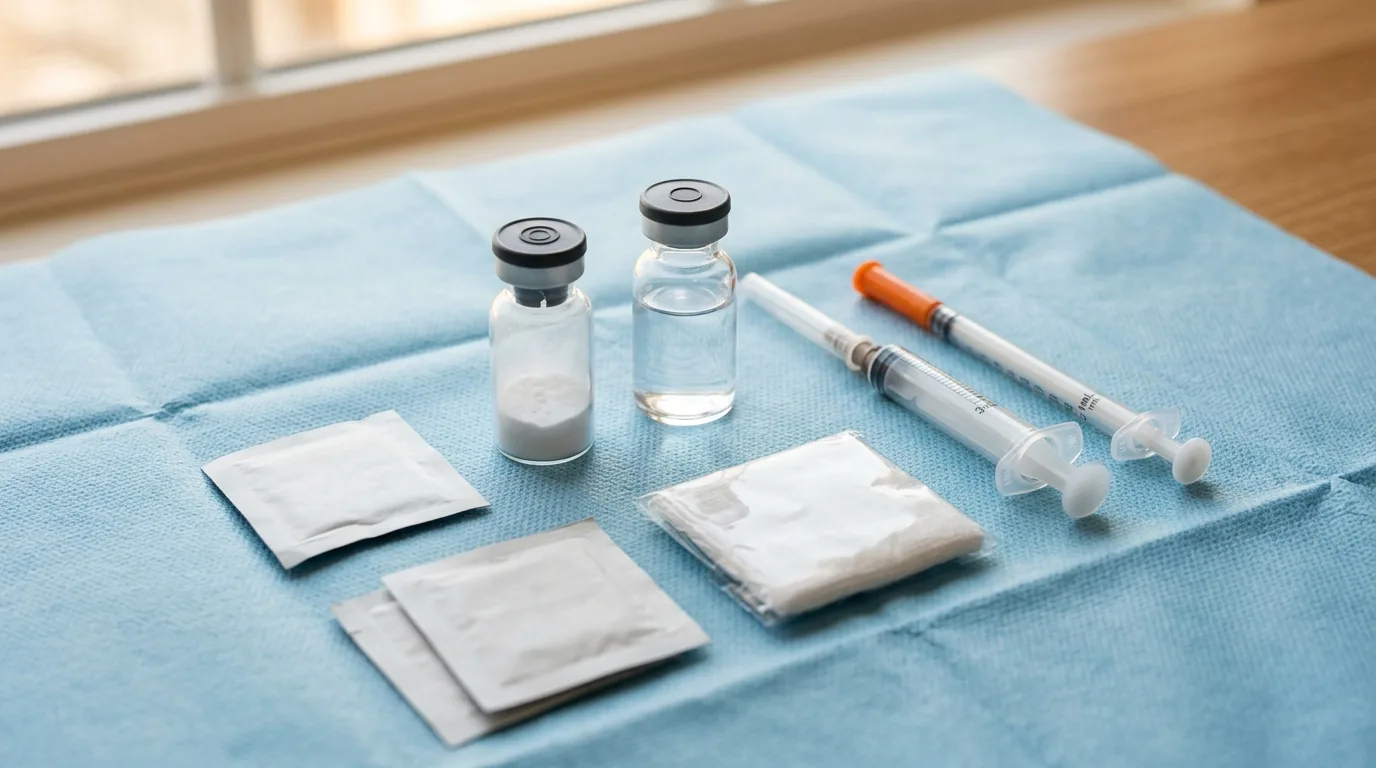
For laboratory research use only. Not for human consumption.
Research-Use Compliance Notice
All information in this article is provided exclusively for laboratory research purposes. Peptides discussed here are research chemicals and are not approved for human consumption, therapeutic use, or self-administration. Always follow institutional safety protocols and local regulations when handling research peptides.
What Is Peptide Reconstitution?
Reconstitution is the process of dissolving a lyophilized (freeze-dried) peptide powder back into a liquid solution. Most research peptides ship as dry powder inside sealed glass vials. Before they can be used in laboratory assays, cell culture experiments, or analytical testing, they must be dissolved in a suitable solvent – most commonly bacteriostatic water.
The lyophilization process removes water under vacuum at low temperatures, preserving the peptide's chemical structure. When you add solvent back, the peptide returns to its active, dissolved state. The volume of solvent you add directly determines the concentration of the resulting solution, which is why precise calculation matters.
Bacteriostatic Water vs. Sterile Water
Bacteriostatic water (BAC water) contains 0.9% benzyl alcohol as a preservative. This preservative inhibits microbial growth, allowing the reconstituted solution to be stored and used over multiple sessions – typically up to 28 days when refrigerated. Sterile water, by contrast, contains no preservative and must be used in a single session to avoid contamination.
For most multi-use research protocols, bacteriostatic water is the standard choice. However, certain peptides may be sensitive to benzyl alcohol. In those cases, sterile water or normal saline (0.9% NaCl) may be specified by the manufacturer or protocol documentation.
The Reconstitution Formula Explained
The core formula is straightforward: Concentration (mg/mL) = Peptide Amount (mg) / Solvent Volume (mL). If you have a 5 mg vial and add 2 mL of bacteriostatic water, the resulting concentration is 5 mg / 2 mL = 2.5 mg/mL. To work backward – deciding how much water to add for a desired concentration – rearrange: Solvent Volume (mL) = Peptide Amount (mg) / Desired Concentration (mg/mL).
For example, if you want a 1 mg/mL solution from a 10 mg vial, you would add 10 mL of bacteriostatic water. If you want a higher concentration of 5 mg/mL from the same vial, you would add only 2 mL. Higher concentrations mean less water but may increase the risk of solubility issues with certain peptides.
Concentration Reference Table (Common Vials)
The following reference shows common vial sizes and the resulting concentrations at different solvent volumes. A 2 mg vial with 1 mL yields 2 mg/mL; with 2 mL yields 1 mg/mL. A 5 mg vial with 1 mL yields 5 mg/mL; with 2 mL yields 2.5 mg/mL; with 5 mL yields 1 mg/mL. A 10 mg vial with 1 mL yields 10 mg/mL; with 2 mL yields 5 mg/mL; with 5 mL yields 2 mg/mL; with 10 mL yields 1 mg/mL.
Always verify solubility limits before choosing a high concentration. Most peptides dissolve well at 1–5 mg/mL in bacteriostatic water, but hydrophobic sequences may require lower concentrations or co-solvents like dilute acetic acid.
Step-by-Step Reconstitution Procedure
Step 1: Allow the lyophilized vial and bacteriostatic water to reach room temperature (15–25 °C). Step 2: Swab the vial stopper and water vial with 70% isopropyl alcohol. Step 3: Draw the calculated volume of bacteriostatic water into a sterile syringe. Step 4: Insert the needle through the stopper at an angle, aiming the stream against the glass wall – not directly onto the powder. Step 5: Allow the water to run slowly down the side of the vial. Step 6: Gently swirl (do not shake) the vial until the powder is fully dissolved. Step 7: If the solution is not clear within 5 minutes of gentle swirling, allow it to sit at room temperature for up to 30 minutes.
Syringe Selection and Measurement Tips
Use insulin syringes (U-100, 1 mL) for volumes under 1 mL – they offer the finest graduation marks and the least dead-space volume. For larger volumes, standard Luer-lock syringes of 3 mL or 5 mL are appropriate. Always use a fresh, sterile needle for each penetration of a vial stopper to prevent coring (small rubber particles entering the solution).
When measuring small volumes, hold the syringe at eye level and align the plunger edge with the desired graduation mark. Air bubbles can cause inaccurate measurements – tap the syringe gently with the needle pointing upward to move bubbles to the top, then push the plunger slightly to expel them before injecting into the vial.
Common Beginner Mistakes to Avoid
Mistake 1: Spraying water directly onto the powder cake. This can cause foaming and denaturation. Always aim the stream along the glass wall. Mistake 2: Shaking the vial vigorously. Peptides are fragile molecules – shaking introduces air and can break peptide bonds at the surface. Swirl gently. Mistake 3: Using too little solvent. High concentrations can exceed solubility limits, leaving undissolved particles. Mistake 4: Forgetting to swab the stopper. Contamination is the most common reason reconstituted peptides degrade faster than expected. Mistake 5: Storing at room temperature after reconstitution. Reconstituted peptides should be refrigerated at 2–8 °C immediately.
References
For laboratory research use only. Not for human consumption. Always consult your institutional protocols.
References
Compare Verified Vendors
Browse COA-verified suppliers with exclusive discount codes and transparent pricing.