
Peptide Research Equipment List: What You Need to Get Started
Essential laboratory equipment for peptide research: analytical balances, pipettes, pH meters, centrifuges, HPLC systems, and proper storage solutions.
For laboratory research use only. Not for human consumption.
Setting Up a Peptide Research Laboratory
Working with research peptides requires specific laboratory equipment to ensure accurate preparation, proper storage, and reliable analytical characterization. The equipment needs range from basic items like analytical balances and calibrated pipettes to sophisticated instruments such as HPLC systems and mass spectrometers. This guide covers the essential equipment categories organized by function, with specific model considerations and minimum specifications for peptide research applications.
The investment required varies dramatically depending on your research goals. A basic reconstitution and storage setup can be assembled for under $5,000, while a fully equipped analytical laboratory with HPLC and mass spectrometry capabilities requires $150,000-500,000. Many researchers access expensive analytical instruments through shared core facilities rather than purchasing them outright.
Weighing and Measuring: Balances and Pipettes
An analytical balance with readability of 0.01 mg (10 microgram) is essential for weighing milligram quantities of lyophilized peptides. Research peptides are typically supplied in 1-10 mg quantities, and weighing errors directly translate to concentration errors in all downstream experiments. The balance should have a draft shield, internal calibration function, and be placed on a vibration-dampened surface away from air conditioning vents and foot traffic. Calibration should be verified daily with certified reference weights.
Calibrated micropipettes covering the 0.5-10 uL, 10-100 uL, 100-1000 uL, and 1-5 mL ranges are required for accurate reconstitution and dilution. Positive-displacement pipettes are preferred over air-displacement models for viscous solutions and organic solvents (DMSO, HFIP). All pipettes should be calibrated at least annually by a certified service, with interim gravimetric verification using distilled water on the analytical balance.
Reconstitution Equipment: Vials, Water, and pH Meters
Low-bind polypropylene tubes (Eppendorf LoBind or equivalent) minimize peptide adsorption to container surfaces – standard polypropylene tubes can lose 10-30% of peptide at low concentrations (below 0.1 mg/mL) through surface binding. Sterile bacteriostatic water (0.9% benzyl alcohol) is the preferred reconstitution solvent for peptides that will be stored after reconstitution, as it inhibits microbial growth. For immediate use or cell culture applications, sterile water for injection (WFI) without preservative is appropriate.
A benchtop pH meter with a micro-electrode suitable for 0.5-1 mL volumes is necessary for verifying solution pH after reconstitution, particularly for peptides sensitive to pH extremes. Two-point calibration using pH 4.0 and 7.0 standard buffers before each use ensures measurement accuracy. pH indicator strips (range pH 2-10) provide a quick screening alternative when precise measurement is not critical.
Always use low-bind tubes for peptide solutions below 0.5 mg/mL. Standard polypropylene and especially glass can adsorb 10-30% of the peptide, leading to inaccurate concentrations.
Storage Equipment: Freezers, Desiccators, and Containers
A -20C freezer is the minimum requirement for storing lyophilized peptides. A -80C ultra-low temperature freezer significantly extends shelf life and is essential for reconstituted peptide aliquots and sensitive sequences containing methionine, cysteine, or phosphorylated residues. Both freezers should be equipped with temperature monitoring and alarms – a freezer failure resulting in thawing can destroy an entire peptide inventory. Backup power (UPS or generator connection) for -80C freezers protects valuable samples during power outages.
A vacuum desiccator with indicating silica gel or Drierite maintains the dry environment essential for lyophilized peptide storage outside the freezer. Amber glass or opaque containers protect light-sensitive peptides (those containing tryptophan or FITC/rhodamine labels) from photodegradation. Parafilm or PTFE tape provides additional moisture barrier when wrapping vial caps for long-term storage.
Centrifuges and Sample Preparation Tools
A microcentrifuge capable of 16,000g (approximately 14,000 RPM for a standard rotor) is used to pellet insoluble peptide aggregates after reconstitution and to clarify solutions before analytical injection. Temperature-controlled centrifuges (refrigerated to 4C) prevent thermal degradation of sensitive peptides during centrifugation. A vortex mixer assists in dissolving lyophilized peptides but should be used gently – excessive vortexing creates air-water interfaces that promote aggregation of hydrophobic sequences.
A sonicating water bath (37-40 kHz) helps dissolve stubborn lyophilized peptides that resist simple vortexing. Brief sonication pulses (10-30 seconds) with intervening rest periods are more effective than continuous sonication, which can generate local heating. Syringe filters (0.22 um PVDF or PES membrane) are essential for sterilizing reconstituted peptide solutions intended for cell culture applications.
Analytical Instruments: HPLC, Mass Spec, and UV-Vis
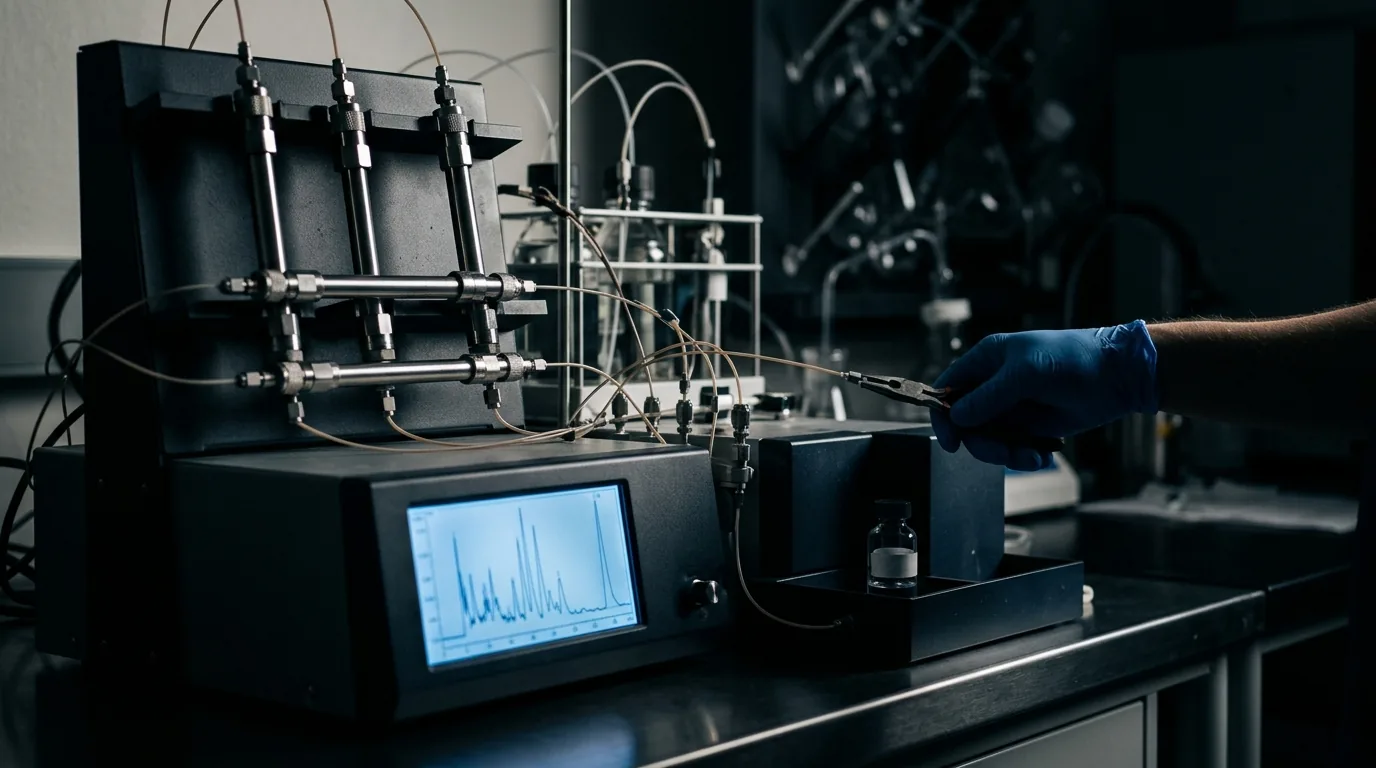
Reversed-phase HPLC with a C18 column (4.6 x 150 mm, 5 um particle size) and UV detection at 214 nm is the standard method for assessing peptide purity and detecting degradation products. A gradient HPLC system with binary pump, autosampler, column oven (set to 30-40C), and photodiode array (PDA) detector provides the analytical capability to verify peptide identity and purity against the Certificate of Analysis. Mobile phases are typically water and acetonitrile, each containing 0.1% TFA or 0.1% formic acid.
A UV-Vis spectrophotometer (or nanodrop instrument for small volumes) enables peptide concentration determination using absorbance at 280 nm (for peptides containing Trp or Tyr) or 205-214 nm (for peptides without aromatic residues). Mass spectrometry – either MALDI-TOF or ESI – provides molecular weight confirmation that is the most definitive identity test for synthetic peptides. Many core facilities offer mass spectrometry services for researchers without dedicated instruments.
Safety Equipment and Personal Protective Gear
Standard laboratory PPE for peptide research includes nitrile gloves (powder-free, to avoid contaminating samples), safety glasses or goggles, and a laboratory coat. A chemical fume hood is required when working with organic solvents used in peptide handling – TFA, HFIP, DMSO, acetonitrile, and methanol all require ventilated handling. Specialized safety equipment includes face shields for work with TFA (corrosive) and HFIP (reproductive toxicant), and appropriate waste containers for halogenated (TFA, HFIP) and non-halogenated organic solvents.
Safety data sheets (SDS) should be readily accessible for all peptides and reagents. While research peptides themselves are generally low-hazard materials, some are biologically potent at microgram quantities. Handling should always follow the precautionary principle: avoid skin contact, inhalation of lyophilized powder, and oral exposure. Spill kits appropriate for biological materials and chemical solvents should be available in the work area.
Budget Tiers: Starter, Intermediate, and Advanced Labs
A starter setup for basic peptide reconstitution and storage requires: an analytical balance ($2,000-4,000), calibrated micropipettes ($500-1,000), low-bind tubes ($100-200), a -20C freezer (often already available), pH meter ($500-800), vortex mixer ($200-400), and microcentrifuge ($1,500-3,000). Total investment: approximately $5,000-10,000. This setup allows proper reconstitution, aliquoting, and storage but relies on vendor COAs for purity data.
An intermediate laboratory adds UV-Vis spectrophotometry ($5,000-15,000), a -80C freezer ($5,000-15,000), and access to HPLC through a core facility (service fees $50-200 per run). An advanced analytical laboratory includes a dedicated HPLC system ($50,000-100,000), benchtop mass spectrometer ($100,000-300,000), and lyophilizer ($10,000-30,000) for in-house peptide characterization and custom formulation work.
References
- Amblard M et al. (2006). Methods and protocols of modern solid phase peptide synthesis. Mol Biotechnol, 33(3):239-254.
- Gill SC, von Hippel PH (1989). Calculation of protein extinction coefficients from amino acid sequence data. Anal Biochem, 182(2):319-326.
- Pace CN et al. (1995). How to measure and predict molar absorption coefficient of a protein. Protein Sci, 4(11):2411-2423.
- European Pharmacopoeia 10.0 (2020). 2.2.29 Liquid chromatography. EDQM.
- WHO Technical Report Series No. 961 (2011). Annex 9: Model guidance for storage and transport.
- Franks F (1998). Freeze-drying of bioproducts. Eur J Pharm Biopharm, 45(3):221-229.
- USP General Chapter <1058> Analytical Instrument Qualification. United States Pharmacopeia.
Further Reading on ChemVerify
- Read more: How to Reconstitute Research Peptides Properly → https://www.chemverify.com/learn/how-to-reconstitute-research-peptides
- Read more: Peptide Storage Guide: Lyophilized vs. Reconstituted → https://www.chemverify.com/learn/peptide-storage-guide-lyophilized-reconstituted
References
Compare Verified Vendors
Browse COA-verified suppliers with exclusive discount codes and transparent pricing.