
Peptide Research Log: How to Document Your Laboratory Work
Learn how to keep a proper peptide research log with batch tracking, reconstitution records, storage conditions, and experimental observations. Covers GLP-compliant documentation, digital templates, and common logging mistakes.
For laboratory research use only. Not for human consumption.
Research-Use Compliance Notice
All information in this article is provided exclusively for laboratory research purposes. Peptides discussed here are research chemicals and are not approved for human consumption or therapeutic use. Proper documentation is essential for reproducibility, regulatory compliance, and scientific integrity.
Why Documenting Peptide Research Matters
A research log is the foundation of reproducible science. In peptide research, small variations in reconstitution, storage, and handling can produce dramatically different experimental outcomes. Without detailed records, it becomes impossible to trace the source of unexpected results, replicate successful experiments, or troubleshoot failures.
Beyond reproducibility, documentation serves legal and regulatory purposes. Good Laboratory Practice (GLP) regulations require complete, contemporaneous records of all procedures and observations. Intellectual property claims, patent applications, and regulatory submissions all depend on the quality and completeness of laboratory documentation. A well-maintained research log transforms your daily observations into defensible scientific evidence.
Essential Fields for Every Log Entry
Every peptide-related log entry should include: date and time, researcher name or initials, peptide identity (name, sequence, and catalog number), vendor and lot/batch number, vial labeled weight, COA reference number, storage condition before use, and the purpose of the current procedure. These fields create an unbroken chain of traceability from the vendor to your experimental data.
Additionally, record the physical appearance of the peptide at each step – powder color and texture before reconstitution, solution clarity and color after reconstitution, and any changes observed over time. These qualitative observations often provide early warning of degradation problems that may not be immediately apparent in analytical data.
Recording Reconstitution Details
When reconstituting a peptide, document the following in real time: solvent type and lot number (e.g., bacteriostatic water, Fisher Scientific cat. no. XYZ, lot 12345), exact volume added (e.g., 2.0 mL via 3 mL Luer-lock syringe), resulting nominal concentration (e.g., 2.5 mg/mL based on labeled weight), corrected concentration if using net peptide content (e.g., 1.95 mg/mL based on 78% net peptide), and dissolution time (e.g., clear solution after 8 minutes of gentle swirling).
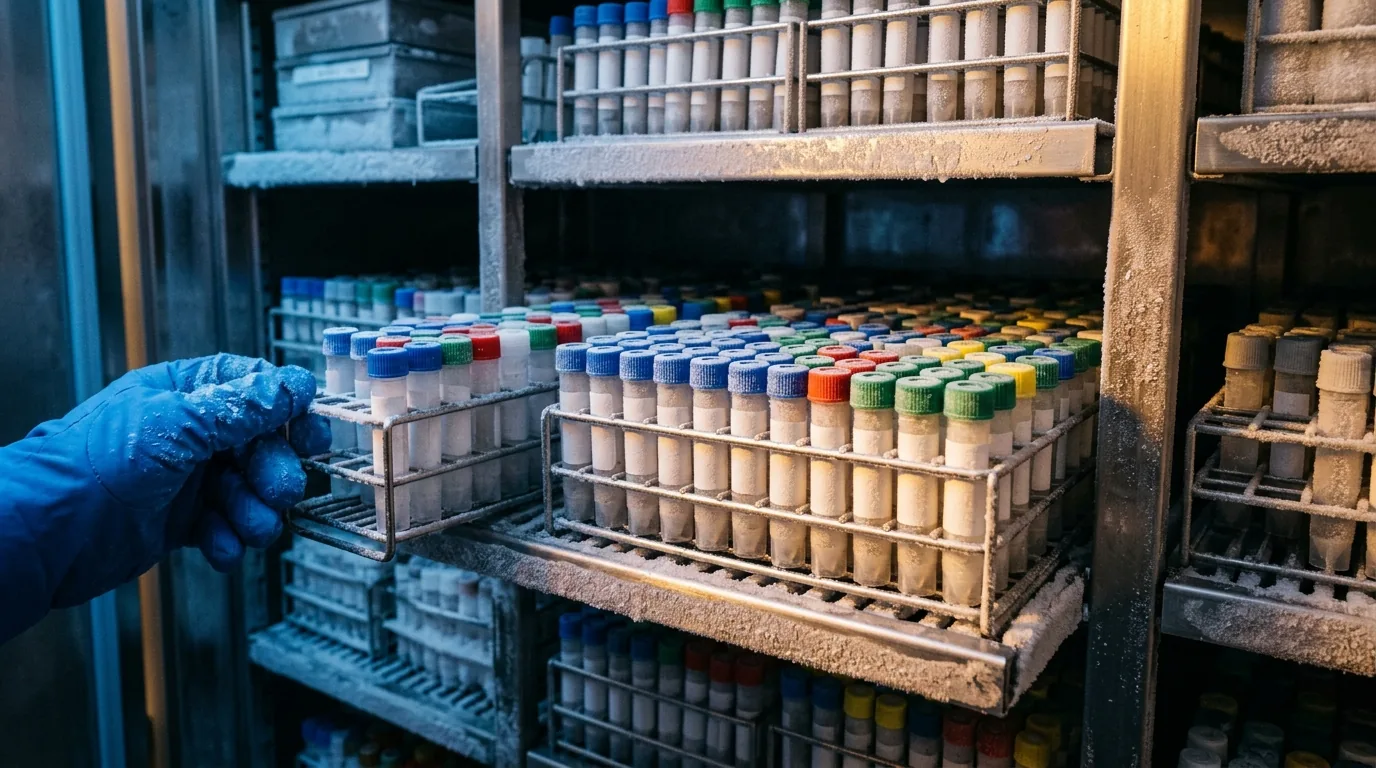
Note any unusual observations during reconstitution: excessive foaming, slow dissolution, cloudiness, color development, or visible particles. These observations help diagnose problems later if experimental results are unexpected. Record whether aliquots were made, the volume per aliquot, number of aliquots, and where each aliquot is stored (freezer location, box number, position).
Storage Condition Tracking and Temperature Logs
Record the storage location and temperature for every peptide in your inventory. For refrigerators and freezers, note the specific unit (e.g., Lab 204 refrigerator, shelf 2) and the monitored temperature range. If your institution uses continuous temperature monitoring systems, reference the monitor ID so temperature excursion data can be retrieved if needed.
Track the number of freeze-thaw cycles for each aliquot. Mark a tally on the tube label or in your log each time an aliquot is thawed and refrozen. When an aliquot exceeds your maximum freeze-thaw limit (typically 3–5 cycles), discard it and open a fresh aliquot. This simple tracking step prevents gradual quality decline from going unnoticed.
Documenting Experimental Observations
For each experiment using a peptide, record: the peptide batch/aliquot used, the volume withdrawn, the dilution steps performed, the final working concentration, and the time the peptide was at room temperature during preparation. Link each experiment to the specific aliquot and batch number so that if results are questioned, the entire chain from vendor to data point can be reconstructed.
Record both expected and unexpected results in real time – not after the fact. If a binding assay produces a lower signal than expected, note the exact values and the peptide batch used. If you later discover that a particular batch had degradation issues, these contemporaneous records allow you to identify which experiments were affected and may need to be repeated.
Digital vs. Paper Lab Notebooks
Paper lab notebooks remain the gold standard in many regulated environments because they provide tamper-evident records – entries are written in permanent ink, pages are numbered consecutively, and corrections are made by single-line strikethroughs with initials and dates. Paper notebooks are admissible as legal documents and do not depend on software or hardware infrastructure.
Digital electronic lab notebooks (ELNs) offer advantages for searchability, data organization, photograph integration, and collaborative access. Popular ELN platforms include LabArchives, Benchling, and RSpace. When using a digital notebook, ensure it provides audit trails (timestamps for all entries and edits), data backup, and compliance with 21 CFR Part 11 if your research falls under FDA oversight.
GLP-Compliant Documentation Practices
Good Laboratory Practice (GLP) regulations require that all raw data be recorded directly, promptly, and legibly in permanent ink. Entries should be dated and signed by the person performing the work. Corrections must not obscure the original entry – use a single line through the error, write the correction nearby, and initial and date the change.
GLP also requires that all reagents (including peptides) be labeled with identity, concentration, storage conditions, and expiration date. Maintain a reagent log that tracks receipt date, storage location, first use date, and disposal date for every peptide vial. This log should be cross-referenced with your experimental notebook so that any data point can be traced back to a specific reagent lot.
Common Documentation Mistakes to Avoid
Mistake 1: Filling in the notebook hours or days after the experiment. Memory is unreliable – record observations in real time. Mistake 2: Not recording negative or unexpected results. These are often more informative than positive results and essential for troubleshooting. Mistake 3: Using informal shorthand that only you understand. Your notebook should be readable by any trained scientist in your field.
Mistake 4: Not linking peptide batches to specific experiments. If you discover a quality issue with a batch, you need to identify every experiment that used it. Mistake 5: Skipping reconstitution details because the procedure is routine. Even routine procedures can go wrong, and without records, you cannot diagnose the problem. Mistake 6: Not backing up digital records. Electronic data should be backed up to at least two independent locations.
References
For laboratory research use only. Not for human consumption. Maintain complete records per institutional requirements.
References
Compare Verified Vendors
Browse COA-verified suppliers with exclusive discount codes and transparent pricing.