
Peptide Stacking: Which Peptides Can Be Combined for Research?
Comprehensive guide to peptide stacking in research: synergistic combinations like BPC-157+TB-500 and Ipamorelin+CJC-1295, antagonistic pairs, timing protocols, and reconstitution.
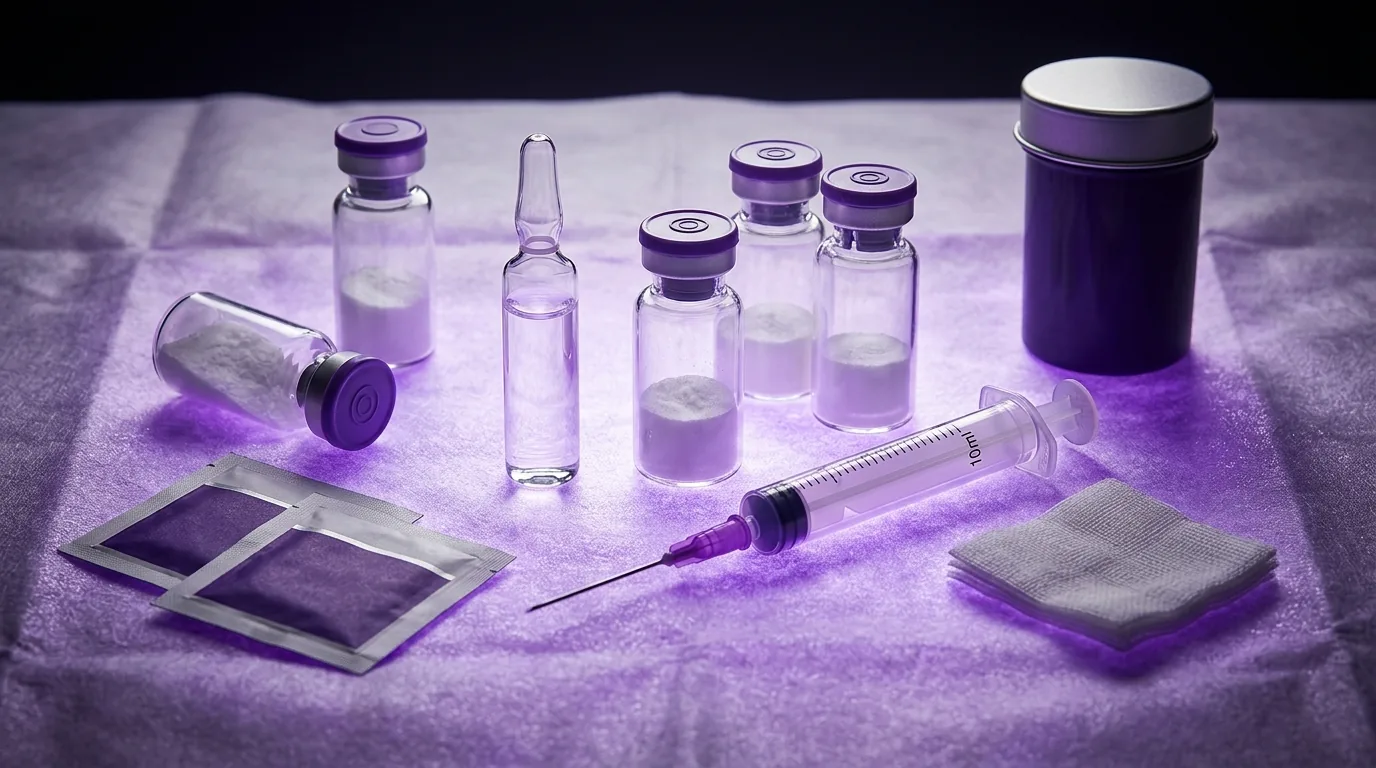
For laboratory research use only. Not for human consumption.
TL;DR: Peptide stacking—combining two or more peptides in a research protocol—can produce synergistic, additive, or antagonistic outcomes depending on the mechanisms involved. Well-characterized synergistic combinations include BPC-157 + TB-500 (complementary tissue repair pathways), Ipamorelin + CJC-1295 No DAC (GHRP + GHRH synergy on growth hormone release), and GHK-Cu + BPC-157 (matrix remodeling + angiogenesis). Antagonistic combinations arise when peptides compete for the same receptor, activate opposing signaling cascades, or destabilize each other in solution. This guide covers the pharmacological rationale, timing considerations, and practical reconstitution protocols for multi-peptide research designs.
Last verified: April 2026 | Data accuracy confirmed by ChemVerify Editorial Team
Peptide Stacking Principles: Additive, Synergistic, and Antagonistic
Peptide stacking in research contexts refers to the simultaneous or sequential administration of multiple peptides within a single experimental protocol. The pharmacological outcome of combining peptides depends on whether they activate convergent, parallel, or opposing signaling pathways. Additive effects occur when two peptides independently contribute to the same endpoint through distinct mechanisms, resulting in a combined effect equal to the sum of individual effects. Synergistic effects arise when the combined response exceeds the predicted additive sum, typically because one peptide potentiates the receptor sensitivity, signal transduction, or downstream effector response of the other [1].
Antagonistic interactions occur when one peptide directly competes with another for receptor binding (competitive antagonism), activates opposing intracellular signaling cascades (functional antagonism), or chemically interacts with the other peptide in solution to reduce bioavailability (pharmaceutical antagonism). Understanding these interaction types is essential for designing multi-peptide protocols that achieve the intended research objectives without confounding variables from unintended cross-reactions.
The Bliss independence model and Loewe additivity model provide quantitative frameworks for classifying peptide interactions. In the Bliss model, two agents acting independently on a shared endpoint should produce a combined effect of E_AB = E_A + E_B - (E_A × E_B). Deviation above this predicted value indicates synergy; deviation below indicates antagonism [2]. These models require dose-response characterization of each peptide individually before combination studies can be properly interpreted.
BPC-157 + TB-500: Tissue Repair Synergy
BPC-157 (Body Protection Compound-157) is a pentadecapeptide (Gly-Glu-Pro-Pro-Pro-Gly-Lys-Pro-Ala-Asp-Asp-Ala-Gly-Leu-Val) derived from human gastric juice proteins that promotes angiogenesis through upregulation of VEGF, eNOS, and the FAK-paxillin pathway. TB-500 is a synthetic fragment of thymosin beta-4 (Tβ4), specifically the active domain encompassing the actin-binding sequence LKKTETQ (residues 17-23), which promotes cell migration, reduces inflammation via NF-κB modulation, and stimulates extracellular matrix remodeling through matrix metalloproteinase regulation [3].
The combination targets complementary phases of tissue repair: BPC-157 drives neovascularization and blood supply to injured tissue, while TB-500 promotes cellular migration into the wound bed and modulates the inflammatory response. Preclinical studies in rodent tendon and muscle injury models have reported that concurrent administration of both peptides produces accelerated healing timelines compared to either peptide alone, with histological evidence of more organized collagen fiber deposition and earlier vascular network formation [4].
From a signaling perspective, BPC-157 activates the VEGF-VEGFR2-Akt axis while TB-500 acts through actin sequestration and subsequent nuclear translocation to influence gene expression related to cell motility. These pathways converge on tissue repair endpoints without direct receptor competition, making pharmaceutical antagonism unlikely. Both peptides are soluble in bacteriostatic water at standard research concentrations (typically 1-5 mg/mL), and pH compatibility is maintained in the 5.5-7.0 range used for subcutaneous injection studies.
Ipamorelin + CJC-1295 (No DAC): Growth Hormone Axis
Ipamorelin is a pentapeptide growth hormone secretagogue (GHS) that selectively activates the ghrelin receptor (GHSR-1a) on somatotroph cells in the anterior pituitary, triggering growth hormone (GH) release without significantly affecting cortisol or prolactin levels [5]. CJC-1295 without Drug Affinity Complex (also known as Modified GRF 1-29 or Mod GRF) is a 29-amino-acid analog of growth hormone-releasing hormone (GHRH) that activates the GHRH receptor on the same somatotroph cells.
The synergistic rationale is based on the dual-input model of GH secretion: GHRH sets the amplitude of GH pulses by directly stimulating GH synthesis and release, while ghrelin/GHS peptides amplify the pulse by reducing somatostatin inhibitory tone and enhancing the somatotroph response to GHRH. When both receptor systems are activated simultaneously, the resulting GH pulse is significantly greater than the sum of individual stimulations—a well-documented synergy confirmed by GH sampling studies in both rodent and human models [6].
Timing is critical for this combination. Both peptides should be administered simultaneously or within a narrow window (< 5 minutes) to ensure concurrent receptor activation during the same secretory episode. Administration during natural GH-release windows (corresponding to deep sleep onset or post-fasting states in the model organism) further amplifies the response. The peptides can be reconstituted separately and drawn into a single syringe immediately before administration without significant chemical interaction at standard concentrations.
GHK-Cu + BPC-157: Wound Healing & Remodeling
GHK-Cu (glycyl-L-histidyl-L-lysine copper(II) complex) is a naturally occurring tripeptide-copper chelate that modulates extracellular matrix remodeling through simultaneous upregulation of collagen synthesis and controlled activation of matrix metalloproteinases (MMP-2, MMP-9). The copper ion is essential for lysyl oxidase activity, which catalyzes collagen cross-linking, while the GHK peptide backbone influences TGF-β signaling and decorin expression [7].
Combining GHK-Cu with BPC-157 creates a multi-phase wound healing protocol: GHK-Cu provides the matrix remodeling and copper-dependent enzymatic support, while BPC-157 drives angiogenesis and nitric oxide-mediated vasodilation to the healing site. The combination addresses both the structural scaffold (collagen organization, cross-linking) and the vascular supply (new vessel formation, blood flow) simultaneously. In preclinical wound models, this dual approach has shown improved tensile strength recovery compared to single-agent protocols.
A practical consideration for this combination is that GHK-Cu contains a copper(II) ion that may interact with other peptides containing free thiol groups (cysteine residues) or metal-chelating sequences. BPC-157 does not contain cysteine residues, making it compatible for co-administration. However, researchers should avoid mixing GHK-Cu with peptides that contain disulfide bonds or free sulfhydryl groups in the same reconstitution vial, as copper-catalyzed oxidation can degrade these peptides.
Antagonistic Pairs: Combinations to Avoid
Competitive antagonism occurs when two peptides target the same receptor with different efficacies. For example, combining a full agonist and a partial agonist at the ghrelin receptor (GHSR-1a) would result in the partial agonist reducing the maximal response achievable by the full agonist. GHRP-6 (a potent GHSR-1a agonist with additional histamine-releasing and cortisol-stimulating activity) combined with Ipamorelin (a selective GHSR-1a agonist) represents a redundant combination where both compete for the same binding site without additive benefit, while GHRP-6 introduces unwanted side effects that Ipamorelin was specifically designed to avoid [5].
Functional antagonism arises when peptides activate opposing physiological pathways. Somatostatin analogs (e.g., octreotide) directly inhibit GH release and would functionally antagonize any GH-releasing peptide combination. Similarly, combining glucagon-like peptides with insulin-sensitizing peptides could create opposing metabolic signals that confound experimental endpoints.
Pharmaceutical antagonism through chemical incompatibility in solution is an underappreciated concern in multi-peptide protocols. Peptides with significantly different optimal pH ranges (e.g., acidic-stable peptides mixed with basic-stable peptides), peptides containing reactive side chains (free thiols, aldehydes), or peptides that aggregate at the working concentration of the other component can all produce reduced bioavailability without any pharmacological interaction at the receptor level.
Timing, Sequencing, and Administration Windows
The temporal relationship between peptide administrations significantly affects the outcome of stacking protocols. Simultaneous administration is appropriate when synergy requires concurrent receptor activation (e.g., Ipamorelin + CJC-1295). Sequential administration is preferred when one peptide needs to establish a biological response before the second can act on it (e.g., pre-treatment with an anti-inflammatory peptide before administering a growth-promoting peptide to a tissue with active inflammation).
Pharmacokinetic considerations determine the optimal timing window. Peptides with short half-lives (5-15 minutes, e.g., unmodified GHRH, DSIP) must be administered within a narrow window of the desired effect, while peptides with longer half-lives (hours, e.g., CJC-1295 No DAC at ~30 minutes, or TB-500 with extended tissue residence) provide more flexibility in timing. Researchers should align administration schedules with the pharmacokinetic profiles of each component to ensure overlapping active concentrations at the target tissue.
For circadian-sensitive endpoints (GH secretion, cortisol modulation, sleep architecture), timing relative to the light-dark cycle of the model organism is an additional variable. GH-releasing peptide stacks are most effective when administered during periods of low somatostatin tone, which corresponds to the early sleep phase in nocturnal rodents and the first hours after sleep onset in diurnal species [8].
Reconstitution and Co-Administration Considerations
When combining peptides in a research protocol, there are three approaches: (1) separate reconstitution and separate injection sites, (2) separate reconstitution with combined injection (drawing both into one syringe immediately before use), and (3) co-reconstitution in a single vial. The first approach eliminates all pharmaceutical interaction risk but increases the number of injection sites, which may be a welfare concern in animal studies or a confounding variable due to different absorption kinetics at different sites.
The second approach—drawing from separately reconstituted vials into a single syringe—is the most common in research practice. This minimizes contact time between peptides to seconds or minutes, reducing the risk of chemical interaction while allowing co-administration at a single site. The key requirement is that both reconstitution solvents are compatible (typically both in bacteriostatic water or sterile 0.9% NaCl) and that the combined volume does not exceed practical injection volume limits for the model species.
Co-reconstitution in a single vial is acceptable only when the peptides have been validated as chemically compatible at the working concentrations, pH range, and storage duration intended. Peptides that have been shown to be stable together include BPC-157 + TB-500 (both stable in pH 5.5-7.0 aqueous solution) and Ipamorelin + CJC-1295 No DAC (both stable in bacteriostatic water). Long-term co-storage (> 24 hours) is not recommended for any multi-peptide vial without stability validation.
Concentration, pH Compatibility, and Solvent Selection
Peptide solubility and stability are concentration-dependent. Most research peptides are soluble at 1-5 mg/mL in bacteriostatic water (0.9% benzyl alcohol), but aggregation risk increases at higher concentrations, particularly for hydrophobic peptides. When combining peptides, the total peptide concentration in the final solution should not exceed the solubility limit of the least soluble component. If one peptide requires an acidic reconstitution (e.g., 0.1% acetic acid for hydrophobic peptides) while the other is optimally stored at neutral pH, separate reconstitution is mandatory.
Bacteriostatic water containing 0.9% benzyl alcohol is the standard reconstitution solvent for most research peptides. For peptides sensitive to benzyl alcohol (rare, but documented for some glycosylated peptides), sterile water for injection can be substituted with the understanding that multi-dose vial use is then limited by microbial contamination risk. Mannitol-bulked lyophilized peptides may require gentle swirling rather than vortexing to dissolve the excipient matrix without generating foam that denatures peptide at the air-liquid interface [9].
Researchers planning multi-peptide protocols should consult the certificate of analysis (COA) for each peptide lot to confirm purity (>95% by HPLC), endotoxin levels (<5 EU/mg), and any lot-specific reconstitution guidance. Stability studies at the intended storage temperature (2-8°C for reconstituted solutions) should be performed for any combination not previously validated in the literature.
References & Further Reading
Compounds Referenced in This Article
Explore detailed chemical profiles and research guides for compounds discussed in this article:
- BPC-157: Complete Research Guide → /learn/bpc-157
- CJC-1295: Complete Research Guide → /learn/cjc-1295-no-dac
- GHK-Cu: Complete Research Guide → /learn/ghk-cu
- Ipamorelin: Complete Research Guide → /learn/ipamorelin
- TB-500: Complete Research Guide → /learn/tb-500
Further Reading on ChemVerify
- Read more: Local vs Subcutaneous Administration for BPC-157 and TB-500: What Research Shows → https://www.chemverify.com/learn/local-vs-subcutaneous-bpc157-tb500-research
- Read more: Peptide Cold Chain Interrupted: What Happens When Cooling Breaks → https://www.chemverify.com/learn/peptide-cold-chain-interrupted-what-happens
- Read more: Subcutaneous vs Intramuscular Injection: Which Method for Which Peptide? → https://www.chemverify.com/learn/subcutaneous-vs-intramuscular-injection-peptides
- Read more: Can You Mix Multiple Peptides in One Syringe? Compatibility Guide → https://www.chemverify.com/learn/mixing-peptides-one-syringe-compatibility
References
Compare Verified Vendors
Browse COA-verified suppliers with exclusive discount codes and transparent pricing.
You Might Also Like
Continue Reading
How Long Do Peptides Last? Shelf Life for Powder, Reconstituted, and Refrigerated
Lyophilized peptides last up to 48 months frozen, but reconstituted solutions degrade within 21-28 days. Learn how temperature, freeze-thaw cycles, and common storage mistakes destroy potency.
Local vs Subcutaneous Administration for BPC-157 and TB-500: What Research Shows
Compare local perilesional vs systemic subcutaneous injection for BPC-157 and TB-500. Covers animal study evidence, oral BPC-157 research, systemic distribution, and practical research considerations.
Peptide Solubility Guide: Choosing the Right Solvent for Your Research
Practical laboratory guide for dissolving research peptides. Covers solvent selection based on peptide charge and hydrophobicity, pH effects, co-solvent strategies, and troubleshooting insoluble peptides.
Peptide Cold Chain Interrupted: What Happens When Cooling Breaks
Discover what happens when the peptide cold chain breaks during shipping. Learn temperature excursion limits, lyophilized vs reconstituted stability, visual degradation signs, and when to discard.