
Peptide Water: Bacteriostatic vs Sterile vs Distilled – Which to Use
Compare bacteriostatic water, sterile water, and distilled water for peptide reconstitution. Learn which solvent preserves peptide stability and prevents contamination.
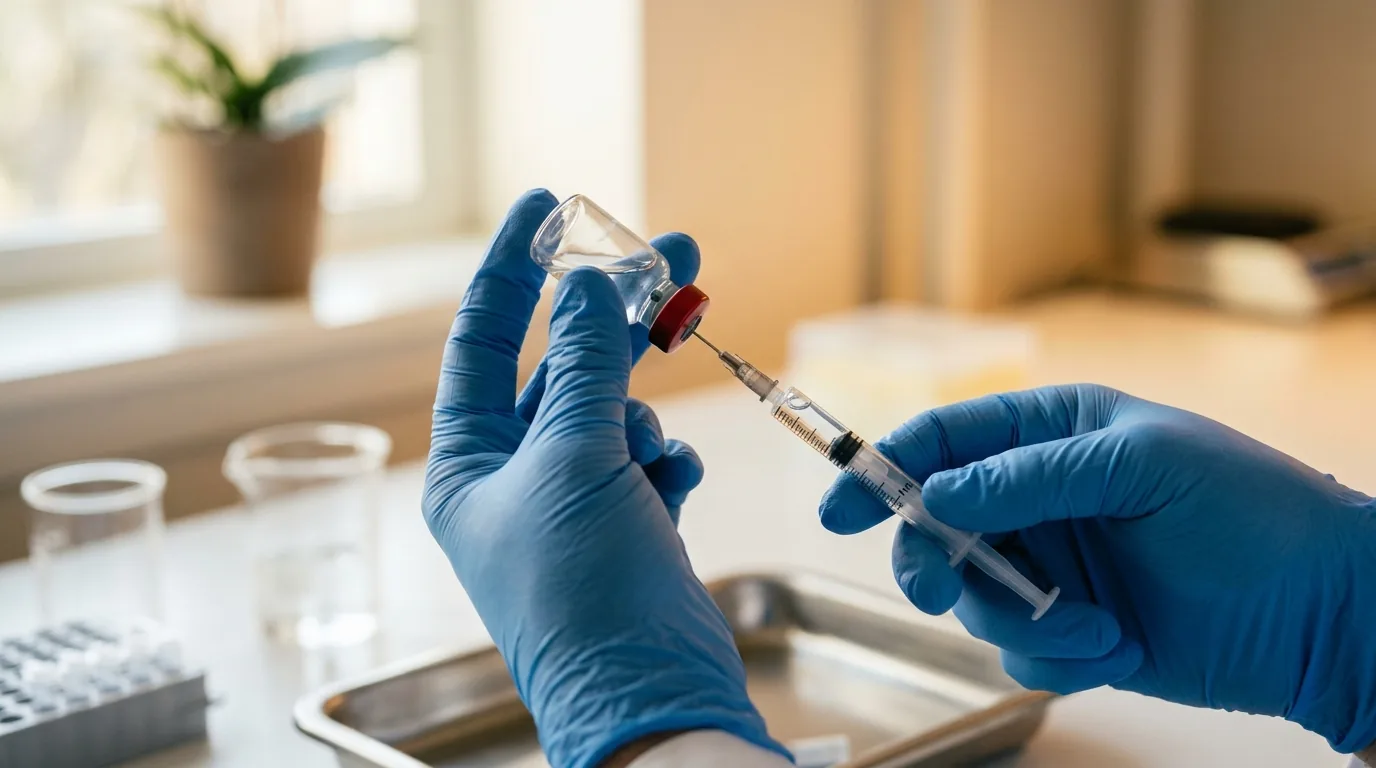
For laboratory research use only. Not for human consumption.
Research Use Disclaimer
All information in this article pertains exclusively to laboratory research applications. ChemVerify does not provide medical advice, dosage recommendations, or injection protocols. Peptides discussed here are research chemicals intended for in-vitro and preclinical study only.
Why Reconstitution Solvent Matters
Bacteriostatic water, sterile water for injection, and distilled water each serve different roles in peptide reconstitution. The correct choice depends on whether the reconstituted peptide will be used immediately or stored, whether multi-dose access is required, and the sensitivity of the peptide to microbial contamination. Choosing the wrong solvent can degrade peptide integrity within hours or introduce bacterial growth that invalidates experimental results.
The United States Pharmacopeia (USP) defines strict standards for each water type, and understanding these classifications is essential for reproducible laboratory work with research peptides.
Bacteriostatic Water: Composition and Properties
Bacteriostatic water (BW) is sterile water containing 0.9% benzyl alcohol as a preservative. The benzyl alcohol inhibits microbial growth, allowing the vial to be accessed multiple times over a 28-day period after initial puncture. According to USP Chapter 797 guidelines, multi-dose vials reconstituted with bacteriostatic water must be discarded after 28 days regardless of remaining volume.
For peptide research requiring repeated sampling from a single vial, bacteriostatic water is the standard choice. The preservative does not interact with most peptide bonds at the concentrations used, though researchers working with particularly sensitive sequences should verify compatibility through preliminary stability testing.
Sterile Water for Injection: When to Use It
Sterile water for injection (SWFI) meets USP standards for pyrogen-free, particulate-free water but contains no preservative. Once opened, it must be used immediately or within a single experimental session, as it provides no protection against microbial contamination after the seal is broken.
SWFI is preferred when benzyl alcohol might interfere with an assay or when the reconstituted peptide will be consumed in a single use. Cell culture experiments and certain bioassays may require preservative-free solvents to avoid cytotoxic effects from benzyl alcohol at the cellular level.
Distilled Water: Limitations for Peptide Work
Standard laboratory-grade distilled water is produced by boiling and condensing but is not guaranteed to be sterile or pyrogen-free. While it may be adequate for non-biological chemistry applications, it poses significant contamination risks for peptide reconstitution. Endotoxin levels in non-pharmaceutical-grade distilled water are uncontrolled and can confound experimental outcomes in sensitive bioassays.
Researchers occasionally substitute distilled water due to availability, but published literature consistently recommends against this practice for any peptide work where biological activity or structural integrity must be preserved over multiple days.
Side-by-Side Comparison Table
Bacteriostatic Water: Contains 0.9% benzyl alcohol preservative, multi-dose use within 28 days, USP-grade sterility, recommended for most peptide reconstitution. Sterile Water for Injection: No preservative, single-use only, USP-grade sterility and pyrogen-free, recommended when preservative-free conditions are required. Distilled Water: No preservative, not guaranteed sterile, variable purity grades, not recommended for peptide reconstitution.
How Solvent Choice Affects Peptide Stability
Research published in the Journal of Pharmaceutical Sciences has demonstrated that peptide degradation rates in reconstituted solutions depend heavily on pH, temperature, and microbial load. Bacteriostatic water maintained peptide integrity over 21 days at 2-8 degrees Celsius, while identical peptides in preservative-free sterile water showed measurable degradation after 72 hours when accessed multiple times due to microbial introduction.
The pH of the reconstitution solvent also matters. Most bacteriostatic water products have a pH between 4.5 and 7.0. Peptides with isoelectric points near this range may exhibit reduced solubility, requiring pH adjustment with dilute acetic acid or ammonium bicarbonate buffer.
Storage Conditions After Reconstitution
Regardless of solvent choice, reconstituted peptides should be stored at 2-8 degrees Celsius and protected from light. Repeated freeze-thaw cycles accelerate aggregation and deamidation. If long-term storage is necessary, aliquoting into single-use volumes and freezing at minus 20 degrees Celsius is the established best practice in peptide research laboratories.
Amber glass vials or foil wrapping reduces photodegradation for light-sensitive sequences. The container closure system should maintain sterility throughout the storage period.
Common Reconstitution Errors to Avoid
- Using tap water or non-pharmaceutical-grade water for peptide reconstitution
- Reusing sterile water vials after initial puncture without preservative protection
- Storing reconstituted peptides at room temperature for extended periods
- Injecting solvent directly onto the lyophilized cake instead of allowing it to run down the vial wall
- Vortexing or shaking reconstituted peptides, which causes aggregation and foam formation
- Failing to record the reconstitution date on multi-dose vials
- Using expired bacteriostatic water past its labeled beyond-use date
References
This article draws on established pharmaceutical and laboratory science references for accuracy and reproducibility.
References
Compare Verified Vendors
Browse COA-verified suppliers with exclusive discount codes and transparent pricing.