
Why Some Peptides Need Refrigerated Shipping and Others Don't
Which research peptides require cold-chain shipping and which survive ambient transport. Stability factors, degradation risks, and vendor shipping standards.
For laboratory research use only. Not for human consumption.
Why Shipping Temperature Matters for Peptides
Temperature control during peptide shipping is not a universal requirement – it depends on the physical form, chemical stability, and specific modifications of the peptide being transported. Lyophilized (freeze-dried) peptides exist as dry powders with minimal molecular mobility, making most of them stable during short ambient-temperature transit periods of 2-5 days. Reconstituted peptides in solution, however, are subject to hydrolysis, oxidation, and aggregation reactions that proceed at rates strongly dependent on temperature, making cold-chain shipping essential for any peptide in liquid form.
Understanding which peptides need cold-chain logistics helps researchers make informed decisions when ordering and helps avoid unnecessary shipping costs for stable lyophilized products while ensuring adequate protection for sensitive materials.
Lyophilized Peptides: Mostly Ambient-Safe
Most lyophilized peptides tolerate ambient shipping (15-30C) for transit periods up to 5-7 days without measurable degradation. The lyophilization process removes water to below 1-2% residual moisture, effectively halting hydrolytic degradation pathways and dramatically reducing oxidation rates. In the dry state, peptide molecules have limited conformational flexibility, preventing aggregation and fibril formation. Accelerated stability studies show that well-lyophilized peptides without sensitive modifications retain greater than 98% purity after 7 days at 40C, which far exceeds the thermal stress encountered during typical ground shipping.
The key requirement for ambient shipping of lyophilized peptides is adequate moisture protection. The vial or container must be sealed with a moisture barrier, and desiccant packets should be included in the outer packaging. Exposure to humidity during transit can rehydrate the lyophilized cake, initiating degradation reactions even at moderate temperatures.
Reconstituted Peptides: Always Cold-Chain
Peptides in aqueous solution should always be shipped on dry ice or with cold packs maintaining 2-8C. In solution, peptide bonds are susceptible to hydrolysis at rates that approximately double for every 10C increase in temperature (the Q10 rule). A peptide stable for 30 days at 4C may show detectable degradation after just 3-4 days at 25C and significant decomposition after 24 hours at 37C. Reconstituted peptides are also vulnerable to bacterial contamination if not sterile-filtered, and microbial growth accelerates dramatically above 8C.
Never ship or transport reconstituted peptides at ambient temperature. Even a single day at room temperature can cause measurable degradation in sensitive sequences.
Temperature-Sensitive Sequences and Modifications
Certain peptide sequences and post-translational modifications require cold-chain shipping even in lyophilized form. Peptides containing methionine are prone to oxidation – Met sulfoxide formation proceeds slowly even in the solid state at elevated temperatures, and Met-containing peptides should be shipped at 2-8C or on dry ice as a precaution. Cysteine-containing peptides, particularly those with free thiol groups (non-disulfide-bonded), are similarly susceptible to oxidation and disulfide scrambling.
Phosphopeptides can undergo dephosphorylation under acidic conditions and elevated temperature. Glycopeptides may experience partial deglycosylation. Peptides with N-terminal glutamine spontaneously cyclize to pyroglutamate at rates that increase with temperature and moisture. Any peptide containing asparagine adjacent to glycine (Asn-Gly motif) is prone to deamidation and isomerization, and cold shipping provides additional protection for these sequences.
Degradation Pathways Accelerated by Heat
The primary chemical degradation pathways in peptides are all temperature-dependent. Deamidation of asparagine (Asn to Asp/isoAsp conversion) follows Arrhenius kinetics with an activation energy of approximately 85 kJ/mol, meaning the rate roughly triples for every 10C increase. Hydrolysis at Asp-Pro bonds – the most labile peptide bond – has an activation energy of approximately 100 kJ/mol. Oxidation of methionine to methionine sulfoxide is catalyzed by trace metal ions and reactive oxygen species, both of which are more active at elevated temperatures.
Disulfide bond shuffling in peptides containing multiple cysteine residues is accelerated by heat and can convert the native disulfide pattern into thermodynamically stable but biologically inactive isomers. For cyclic peptides where the disulfide bond maintains the bioactive conformation, this represents a critical quality concern during shipping.
Vendor Shipping Standards and What to Expect
Reputable peptide vendors classify their products into shipping categories based on stability data. Standard lyophilized peptides without sensitive modifications are typically shipped via ambient ground service in moisture-barrier packaging with desiccant. Sensitive peptides (those with Met, Cys, phospho-, glyco- modifications, or reconstituted solutions) are shipped on dry ice or with validated cold packs that maintain 2-8C for 48-72 hours.
The Certificate of Analysis (COA) should include storage and shipping recommendations specific to the product. If the COA states 'store at -20C' but the vendor ships at ambient temperature, this may indicate that the lyophilized form is stable during short transit but should be refrigerated immediately upon receipt. Always check the COA shipping recommendations and contact the vendor if the received product appears to have experienced temperature excursion (melted ice packs, warm package on arrival).
Receiving and Inspecting Peptide Shipments
Upon receiving a peptide shipment, inspect the package condition immediately. For cold-shipped items, verify that dry ice remains (sublimation rate is approximately 5-10 kg per 24 hours depending on insulation) or that cold packs are still cold to the touch. If dry ice has completely sublimated but cold packs are still cool, the peptide likely remained within acceptable temperature range. If all cooling elements are at ambient temperature and the transit time exceeded 48 hours, contact the vendor to discuss potential quality impact.
Check the lyophilized cake appearance – it should be a white to off-white powder or fluffy cake. A collapsed, translucent, or discolored cake may indicate moisture exposure during transit. For peptides shipped in solution, verify that the solution is clear without visible precipitate or turbidity, which could indicate aggregation or degradation.
Post-Delivery Storage Recommendations
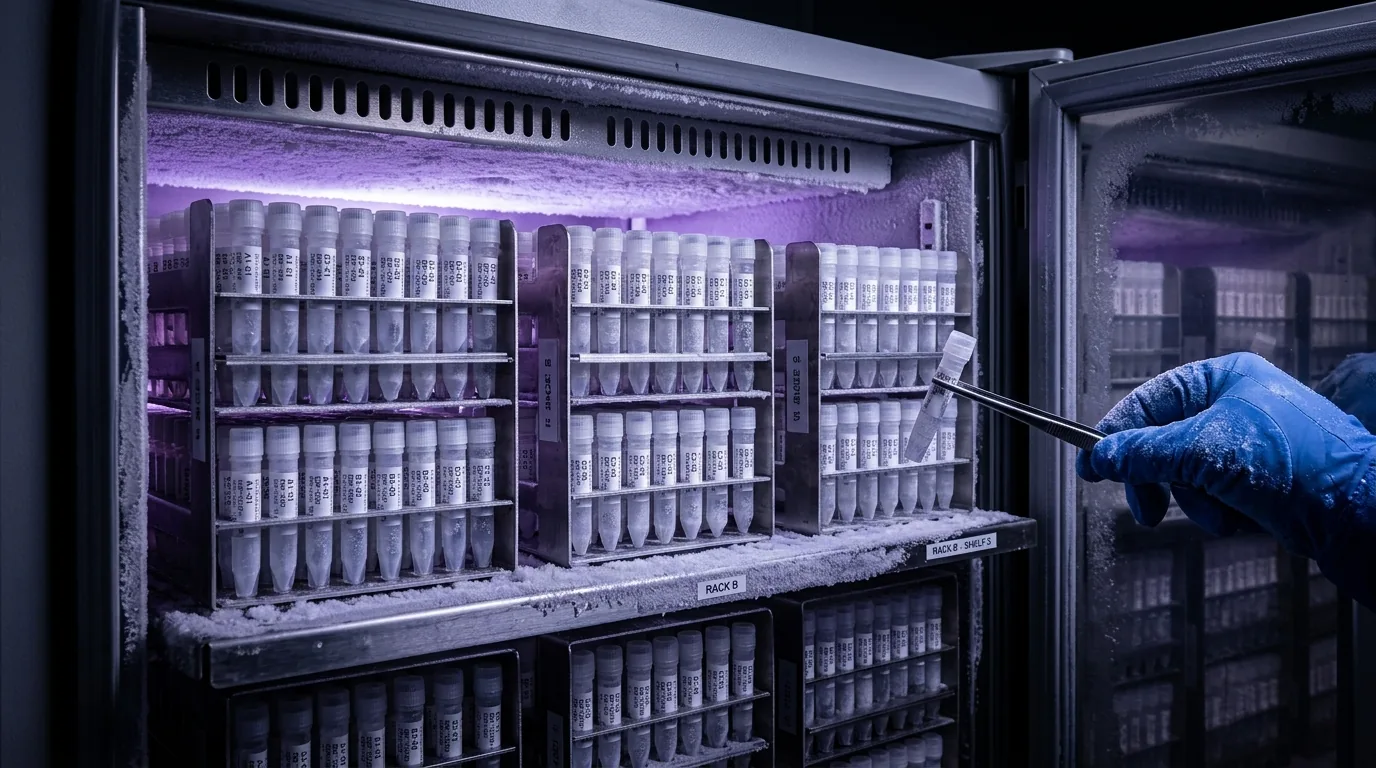
Transfer lyophilized peptides to the recommended storage temperature (-20C or -80C) immediately upon receipt. Allow sealed vials to equilibrate to room temperature for 15-30 minutes before opening to prevent moisture condensation on the cold powder. For long-term storage exceeding 6 months, -80C is preferred for all peptides regardless of their shipping classification. Aliquot large quantities into single-use portions before freezing to avoid repeated freeze-thaw cycles during future use.
After receipt, equilibrate sealed vials to room temperature for 15-30 minutes before opening. This prevents moisture condensation on the cold lyophilized powder, which accelerates degradation.
References
- Manning MC et al. (2010). Stability of protein pharmaceuticals: an update. Pharm Res, 27(4):544-575.
- Zapadka KL et al. (2017). Factors affecting the physical stability of peptide therapeutics. Interface Focus, 7(6):20170030.
- Oliyai C, Borchardt RT (1993). Chemical pathways of peptide degradation. Pharm Res, 10(1):95-102.
- Wakankar AA, Borchardt RT (2006). Formulation considerations for proteins susceptible to deamidation. J Pharm Sci, 95(11):2321-2336.
- Cleland JL et al. (1993). The development of stable protein formulations. Crit Rev Ther Drug Carrier Syst, 10(4):307-377.
- Franks F (1998). Freeze-drying of bioproducts: putting principles into practice. Eur J Pharm Biopharm, 45(3):221-229.
- Carpenter JF et al. (1997). Rational design of stable lyophilized protein formulations. Pharm Biotechnol, 10:109-133.
Further Reading on ChemVerify
- Read more: Peptide Storage Guide: Lyophilized vs. Reconstituted → https://www.chemverify.com/learn/peptide-storage-guide-lyophilized-reconstituted
- Read more: How to Reconstitute Research Peptides Properly → https://www.chemverify.com/learn/how-to-reconstitute-research-peptides
- Read more: Peptide Fibrils and Aggregation: When Peptides Form Unwanted Structures → https://www.chemverify.com/learn/peptide-fibrils-aggregation-unwanted-structures
References
Compare Verified Vendors
Browse COA-verified suppliers with exclusive discount codes and transparent pricing.