
What Happens If You Shake a Peptide Vial? Why Swirling Matters
Learn why shaking peptide vials causes aggregation and foam, degrading research compounds. Discover the correct gentle swirling technique for peptide reconstitution.
For laboratory research use only. Not for human consumption.
Research Use Disclaimer
This article discusses peptide handling techniques for laboratory research only. ChemVerify does not provide medical advice, dosage guidance, or injection protocols. All peptides discussed are research chemicals for in-vitro and preclinical applications.
Why Mechanical Stress Damages Peptides
Shaking a peptide vial vigorously introduces mechanical stress that can permanently alter the peptide structure. Unlike small molecules that are generally robust to physical agitation, peptides are susceptible to aggregation, denaturation, and adsorption at air-water interfaces created by shaking. The correct approach – gentle swirling – dissolves the lyophilized cake without creating the turbulence, foam, and surface tension forces that degrade peptide integrity.
This distinction between shaking and swirling is not trivial. Studies have demonstrated measurable potency loss in peptide solutions subjected to even brief vigorous agitation, with some sequences losing 10-30% of their biological activity after 60 seconds of shaking.
Protein and Peptide Aggregation Mechanisms
Peptide aggregation occurs when individual molecules unfold or partially denature and then associate with each other through exposed hydrophobic surfaces. Mechanical agitation accelerates this process by increasing the frequency of molecular collisions and by creating air-water interfaces where peptides preferentially accumulate and denature.
Aggregated peptides form particles ranging from nanometers to visible precipitates. Even sub-visible aggregates can alter bioassay results by reducing the effective concentration of monomeric (active) peptide, creating misleading dose-response curves, and potentially triggering immune responses in cell-based assays through pattern recognition receptor activation.
Foam Formation and Air-Water Interface Effects
When a peptide solution is shaken, air bubbles are introduced and trapped, creating a foam layer. Peptides are surface-active molecules – they migrate to air-water interfaces due to their amphiphilic nature (hydrophobic and hydrophilic regions). At these interfaces, peptides undergo conformational changes, exposing hydrophobic cores that are normally buried. This interfacial denaturation is often irreversible.
Research published in the Journal of Pharmaceutical Sciences has shown that the total air-water interfacial area – not just the shaking intensity – correlates directly with the degree of peptide degradation. Small bubbles created by vigorous shaking have a larger total surface area than large bubbles, making aggressive shaking particularly damaging.
The Correct Swirling Technique
The recommended reconstitution technique involves adding solvent slowly down the inside wall of the vial (not directly onto the lyophilized cake), then gently rolling or swirling the vial between the palms or on a flat surface. The goal is to allow the solvent to gradually hydrate the lyophilized material without creating turbulence or introducing air into the solution.
The vial should be tilted at approximately 45 degrees and rotated gently for 30-60 seconds. If the peptide does not fully dissolve, allow it to sit at room temperature for 5-10 minutes and then swirl again. Most lyophilized peptides will dissolve completely within this timeframe without any need for vigorous mixing.
Step-by-Step Reconstitution Without Shaking
- Allow the sealed lyophilized peptide vial to equilibrate to room temperature for 10-15 minutes
- Wipe the rubber septum with an alcohol swab to maintain sterility
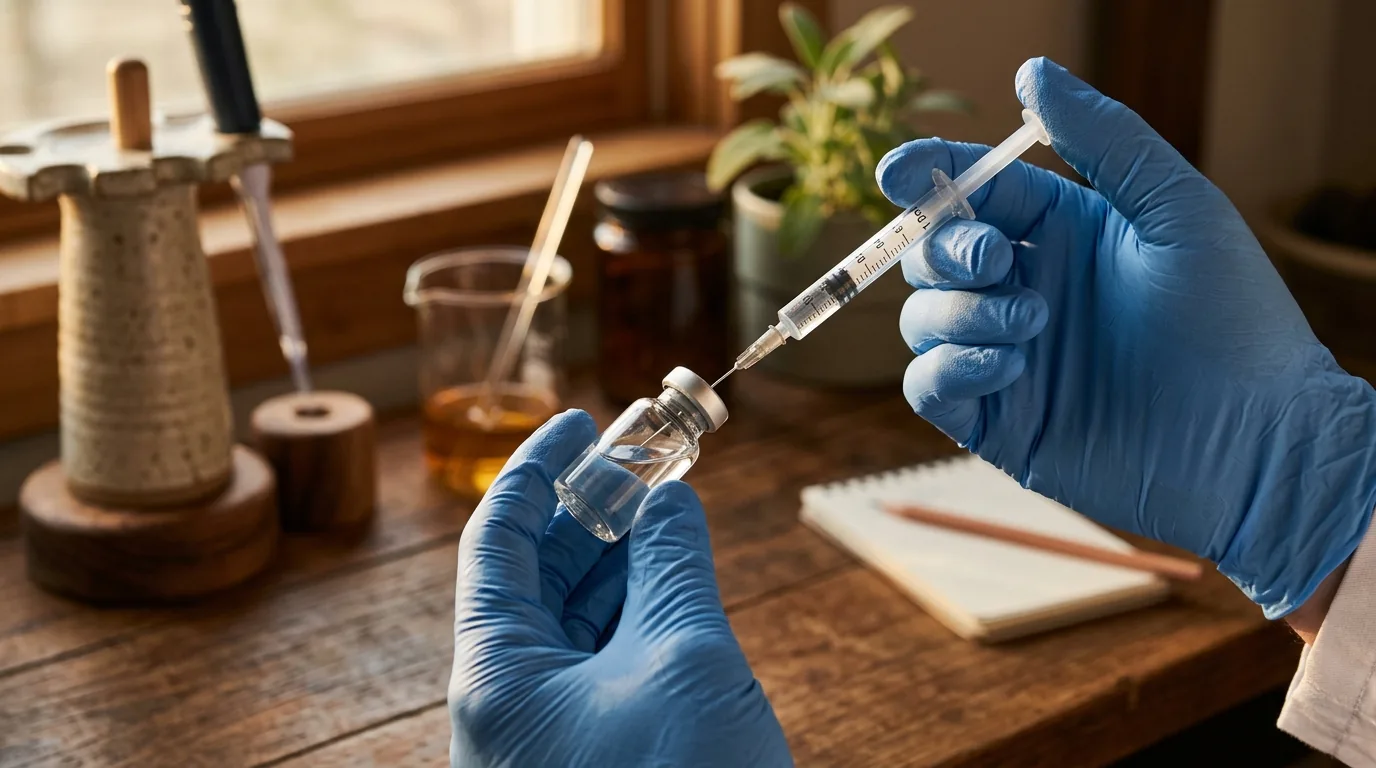
- Using a sterile syringe, slowly inject the calculated volume of bacteriostatic water or sterile water down the inside wall of the vial
- Do not aim the stream directly at the lyophilized cake – let solvent flow gently over it
- Once all solvent is added, tilt the vial to 45 degrees and gently roll between your palms
- Continue gentle swirling for 30-60 seconds until the solution appears clear
- If undissolved material remains, let the vial rest for 5-10 minutes then repeat gentle swirling
- Inspect for clarity – a properly reconstituted peptide solution should be clear and colorless to slightly yellow
Can You Use a Vortex Mixer?
Laboratory vortex mixers generate localized high-shear forces at the contact point between the tube and the oscillating platform. For peptide solutions, even brief vortexing (5-10 seconds) at low speed can introduce significant air entrainment and create the air-water interfaces that drive aggregation.
The general recommendation in peptide handling literature is to avoid vortex mixers entirely for reconstituted peptides. If mixing is needed after adding components to an already-reconstituted solution (such as adding buffer or diluting), gentle inversion (flipping the capped vial 5-10 times) is preferable to vortexing.
Visual Indicators of Damaged Peptides
A properly reconstituted peptide solution should be clear and free of visible particles. Warning signs that indicate potential mechanical damage include persistent foam that does not dissipate within a few minutes, cloudiness or turbidity in a previously clear solution, visible fibers or gel-like strands floating in the solution, and a ring of material deposited on the vial wall above the solution line.
If these signs are observed after shaking, the peptide may have aggregated irreversibly. Centrifugation can remove large aggregates, but the effective peptide concentration will be reduced and the composition of the remaining solution may not match the original specification.
References
This article references pharmaceutical science and protein chemistry literature on mechanical stress and aggregation.
References
Compare Verified Vendors
Browse COA-verified suppliers with exclusive discount codes and transparent pricing.