
What Is HPLC? High-Performance Liquid Chromatography for Beginners
Learn what HPLC is, how high-performance liquid chromatography works, why it is used to determine peptide purity, and how to read HPLC results on a COA.
For laboratory research use only. Not for human consumption.
What Is HPLC?
High-Performance Liquid Chromatography (HPLC) is an analytical technique used to separate, identify, and quantify the components of a mixture. In peptide research, HPLC is the standard method for determining the purity of a peptide sample – that is, what percentage of the sample is the desired peptide versus impurities, degradation products, or synthesis byproducts [1].
When you see a purity value like "98.5%" on a Certificate of Analysis, that number almost always comes from HPLC analysis. Understanding how HPLC works helps you interpret COAs with confidence and evaluate whether a vendor's quality claims are credible.
How HPLC Works: The Basic Principle
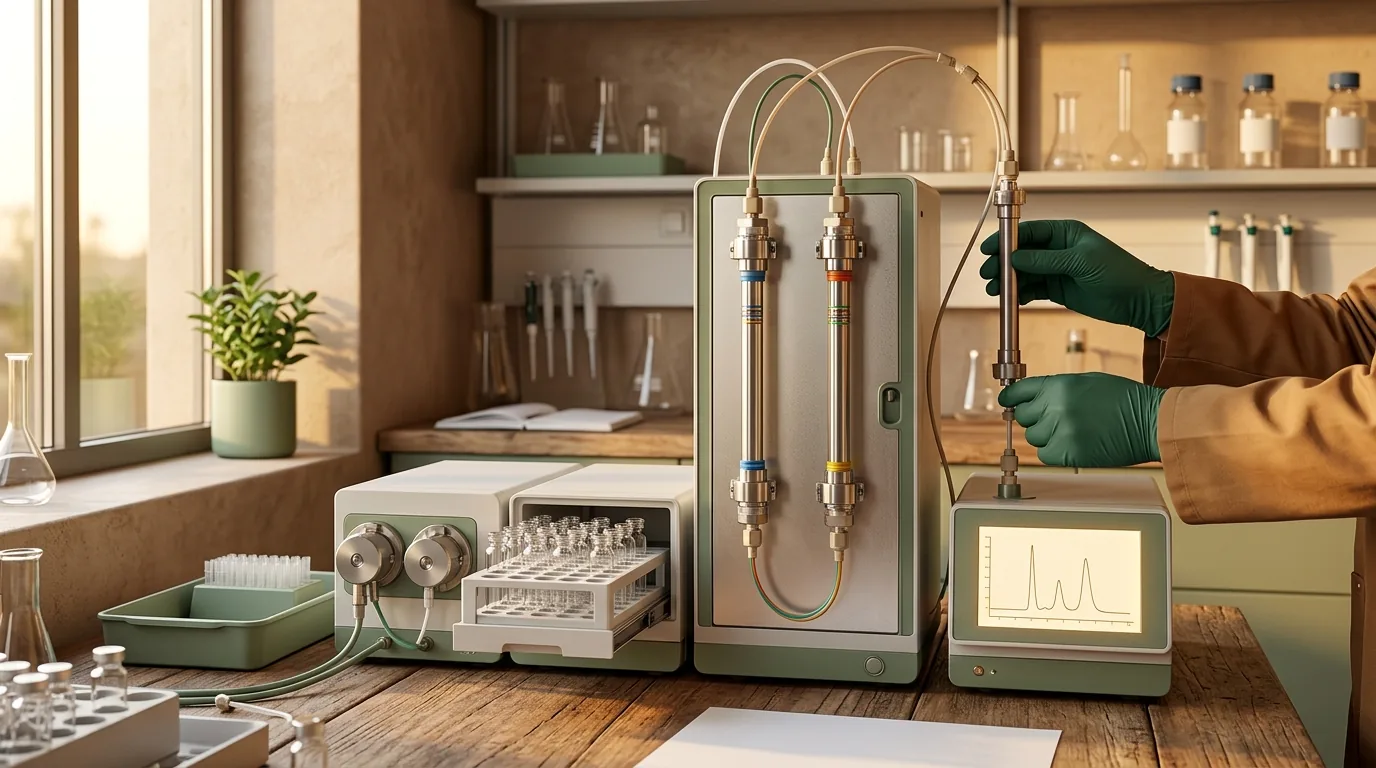
HPLC works by dissolving a sample in a liquid solvent (the mobile phase) and pumping it through a column packed with tiny particles (the stationary phase). Different molecules in the sample interact with the stationary phase to different degrees, causing them to move through the column at different speeds. Molecules that interact weakly pass through quickly; those that interact strongly take longer [2].
As each molecule exits the column, a detector records its presence and generates a signal. The result is a chromatogram – a graph with time on the x-axis and detector response (signal intensity) on the y-axis. Each peak on the chromatogram represents a different component of the sample.
Key Components of an HPLC System
An HPLC system consists of a solvent reservoir holding the mobile phase, a pump that pushes the mobile phase through the system at high pressure (typically 50–400 bar), an injector that introduces the sample into the mobile phase stream, a column packed with the stationary phase (typically C18-bonded silica particles for peptide analysis), a detector (usually UV absorbance at 214 nm or 220 nm for peptides), and a data system that records and processes the chromatogram [3].
The column is the heart of the separation. For peptide analysis, reverse-phase C18 columns are most common. These columns separate peptides based on their hydrophobicity – how much they prefer the oily stationary phase versus the water-based mobile phase.
Why HPLC Is Used for Peptide Purity Testing
HPLC is the gold standard for peptide purity testing because it can separate closely related molecules – even peptides that differ by a single amino acid or a single modification. It is quantitative (the peak area is proportional to the amount of substance), reproducible (running the same sample twice gives the same result), and sensitive (it can detect impurities at levels below 0.1%) [4].
No other routine analytical method combines these three properties as effectively for peptide analysis. Mass spectrometry confirms identity but is less quantitative. Amino acid analysis confirms composition but cannot distinguish sequence variants.
How to Read an HPLC Chromatogram
A chromatogram shows peaks along a time axis. The main peak (tallest) represents the target peptide. Smaller peaks represent impurities. The retention time (in minutes) is when each peak elutes from the column – it acts like a fingerprint for identifying the compound. The peak area (the area under the curve) is proportional to the amount of that compound [5].
Purity is calculated as the area of the main peak divided by the total area of all peaks, multiplied by 100. A chromatogram with one dominant peak and very small or absent side peaks indicates high purity. Multiple large peaks suggest significant impurities that need investigation.
Understanding Purity Percentage on a COA
When a COA states "HPLC Purity: 98.5%," it means that 98.5% of the total peak area in the chromatogram belongs to the target peptide. The remaining 1.5% is attributed to impurities. For research-grade peptides, purities above 95% are standard. Purities above 98% are considered high-purity and are typically required for quantitative research [6].
Important nuances: HPLC purity measures chromatographic purity, not absolute chemical purity. Some impurities may co-elute (exit the column at the same time) with the main peptide and would not be detected as separate peaks. This is why mass spectrometry is used alongside HPLC for comprehensive quality verification.
Types of HPLC Used in Peptide Analysis
Reverse-Phase HPLC (RP-HPLC) is the most common method for peptide purity analysis. It separates peptides based on hydrophobicity using a C18 column and a gradient of increasing organic solvent (usually acetonitrile with trifluoroacetic acid). Ion-Exchange HPLC separates based on charge and is used for peptides with multiple charged residues. Size-Exclusion HPLC (SEC) separates based on molecular size and is used to detect aggregation [7].
Ultra-High-Performance Liquid Chromatography (UHPLC) is a newer variant that uses smaller particles, higher pressures, and shorter columns to achieve faster separations with better resolution. Many modern laboratories now use UHPLC instead of traditional HPLC.
Limitations of HPLC
HPLC is powerful but not perfect. It cannot identify what an impurity is – only that it exists and how much of it is present. Co-eluting impurities are invisible. The method requires proper calibration and maintenance to produce reliable results. Different HPLC conditions (column type, mobile phase composition, gradient) can give different purity values for the same sample [8].
This is why reputable vendors specify their HPLC conditions on the COA and why comparing purity values between vendors is only meaningful if they used similar methods. A "99% purity" from one vendor is not directly comparable to "97% purity" from another if the analytical methods differ.
Key Takeaways
HPLC separates peptide samples into their components based on physical properties. The chromatogram shows peaks for each component, with peak area proportional to quantity. Purity percentage is the main peak area divided by total area. RP-HPLC is the standard method for peptide analysis. Always check that the COA includes HPLC conditions, and remember that HPLC purity alone does not guarantee identity – mass spectrometry is needed for that.
For laboratory research use only. Not for human consumption.
References
Compare Verified Vendors
Browse COA-verified suppliers with exclusive discount codes and transparent pricing.