
What Is Peptide Purity? HPLC Percentage Explained for Beginners
Understand what peptide purity means, how HPLC testing measures it, and why 95%+ purity matters for reliable research. Covers COA reading, purity grades, and common impurity sources.
For laboratory research use only. Not for human consumption.
Research-Use Compliance Notice
All information in this article is provided exclusively for laboratory research purposes. Peptides discussed here are research chemicals and are not approved for human consumption, therapeutic use, or self-administration. Always follow institutional safety protocols when evaluating peptide quality.
What Does Peptide Purity Actually Mean?
Peptide purity is the percentage of the target peptide present in a sample relative to all peptide-related material. If a vial is labeled 98% purity, it means 98% of the peptide content is the correct, full-length sequence, and the remaining 2% consists of synthesis byproducts – truncated sequences, deletion sequences, or chemically modified variants.
Purity does not account for non-peptide components like residual salts (TFA, acetate), water content, or counterions. These are measured separately. When researchers say purity, they specifically mean the proportion of the desired peptide sequence among all peptide species in the sample.
How HPLC Measures Peptide Purity
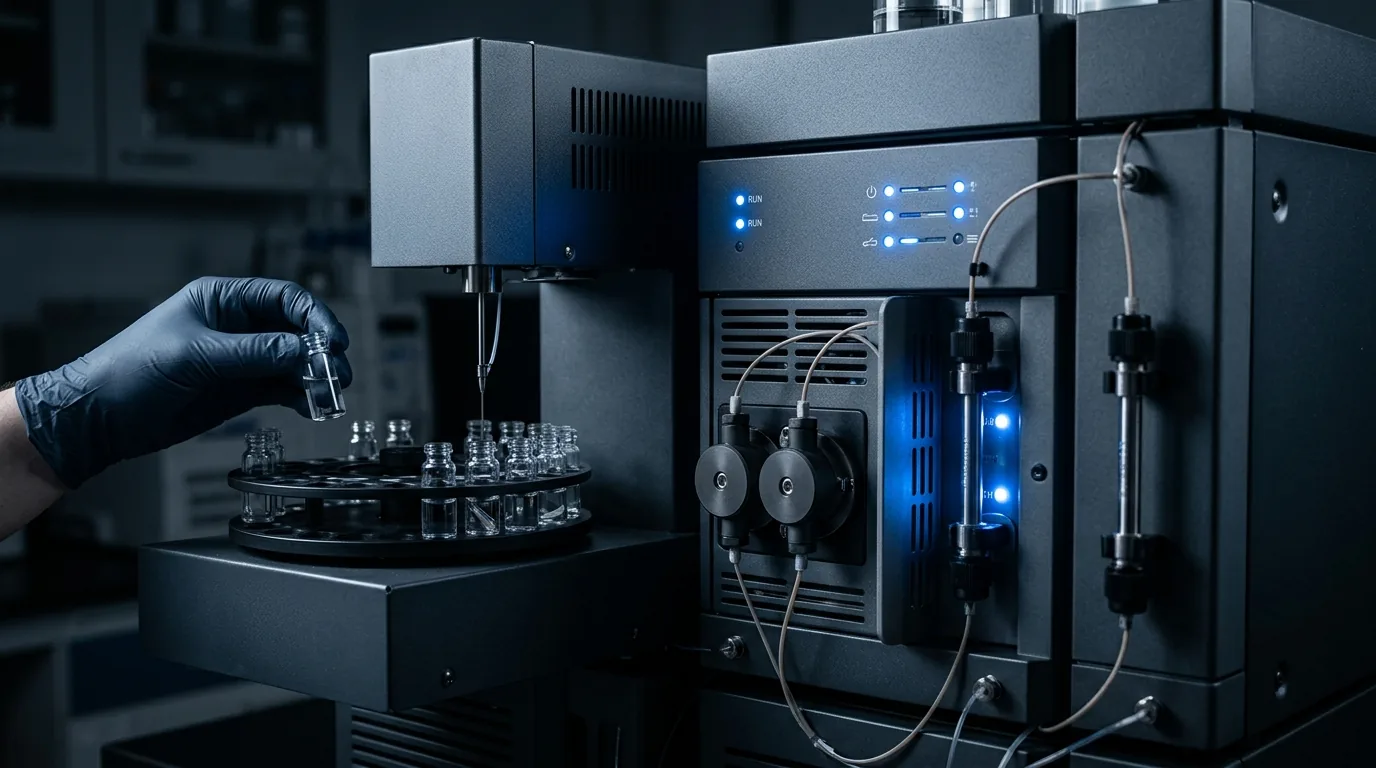
High-Performance Liquid Chromatography (HPLC) is the standard analytical method for determining peptide purity. The technique works by dissolving the peptide sample in a mobile phase (typically a water-acetonitrile gradient with 0.1% TFA) and passing it through a column packed with C18 reversed-phase stationary material.
Different peptide species interact with the column material at different strengths based on their hydrophobicity. The target peptide and its impurities separate as they travel through the column at different speeds. A UV detector (usually at 214 nm or 220 nm wavelength) measures the absorbance of each component as it exits the column, producing a chromatogram – a graph of signal intensity over time.
Reading an HPLC Chromatogram
An HPLC chromatogram shows peaks along a time axis. The tallest, most prominent peak represents the target peptide. Smaller peaks before and after it represent impurities. Purity is calculated by dividing the area under the main peak by the total area of all peaks, then multiplying by 100.
The retention time – the point on the time axis where the main peak appears – is characteristic of each peptide under specific column and gradient conditions. If the main peak appears at 12.5 minutes and accounts for 97.3% of total peak area, the peptide purity is reported as 97.3% by HPLC.
Purity Grades: 95%, 98%, and 99%+
Research peptide vendors typically offer several purity grades. Crude peptides (below 70%) are unprocessed synthesis output, rarely suitable for quantitative research. Standard grade (above 95%) is acceptable for most binding assays and cell culture work. High purity (above 98%) is recommended for in vivo studies and dose-response experiments. Ultra-high purity (above 99%) is used for reference standards, pharmacokinetic studies, and regulatory submissions.
Higher purity costs more because additional purification steps (preparative HPLC) are required, and each step reduces the total yield. A 99% pure batch may have only 30-40% of the original crude yield remaining after purification.
Common Sources of Peptide Impurities
Deletion peptides occur when one amino acid fails to couple during solid-phase synthesis, producing a sequence that is one residue shorter than intended. Truncated sequences result from premature chain termination. Oxidation products form when methionine or cysteine residues react with oxygen or peroxides. Racemization produces D-amino acid substitutions at specific positions. Diketopiperazine (DKP) forms when the first two residues cyclize prematurely.
These impurities may have similar but not identical biological activity, which is why purity directly affects the reproducibility of research results. A 90% pure sample contains 10% unknown bioactive contaminants that could confound experimental outcomes.
Finding Purity on a Certificate of Analysis
A Certificate of Analysis (COA) is the quality document that accompanies each peptide batch. The purity section typically lists the HPLC method (reversed-phase C18, gradient conditions), detection wavelength (214 nm or 220 nm), and the resulting purity percentage. Some COAs also include the actual chromatogram image.
When evaluating a COA, check that the HPLC conditions are stated – a purity number without method details is meaningless. Also verify that the batch number on the COA matches the batch number on your vial. Reputable vendors provide lot-specific COAs, not generic documents.
Why Purity Matters for Research Results
Impurities introduce uncontrolled variables into experiments. If a peptide sample is 90% pure, the effective concentration of the target peptide is 10% lower than calculated. More critically, the 10% impurity fraction may contain truncated sequences that act as partial agonists or antagonists, skewing dose-response curves and binding affinity measurements.
For quantitative research, purity directly affects data quality. Published studies increasingly require disclosure of peptide purity as part of methods sections, and peer reviewers flag results obtained with low-purity reagents as potentially unreliable.
References
For laboratory research use only. Not for human consumption. Always verify COA data independently.
References
Compare Verified Vendors
Browse COA-verified suppliers with exclusive discount codes and transparent pricing.