
Why Do Peptides Need to Be Refrigerated? Temperature Science Explained
Discover why peptides degrade at room temperature and how cold storage preserves their chemical integrity. Covers Arrhenius kinetics, storage guidelines for lyophilized and reconstituted peptides, and freezer best practices.
For laboratory research use only. Not for human consumption.
Research-Use Compliance Notice
All information in this article is provided exclusively for laboratory research purposes. Peptides discussed here are research chemicals and are not approved for human consumption or therapeutic use. Always follow institutional cold-chain protocols when storing research materials.
How Temperature Drives Peptide Degradation
Peptides are chains of amino acids connected by amide bonds. These bonds are susceptible to hydrolysis (cleavage by water), oxidation (reaction with oxygen or reactive oxygen species), and deamidation (loss of an amide group from asparagine or glutamine residues). All three of these degradation pathways are chemical reactions, and chemical reactions proceed faster at higher temperatures.
At room temperature (20–25 °C), the molecular kinetic energy is sufficient to drive measurable degradation over days to weeks for reconstituted peptides. Reducing the temperature to 2–8 °C (standard refrigerator) slows these reactions by a factor of 2–4 for every 10 °C reduction. Freezing at -20 °C or -80 °C reduces degradation rates by orders of magnitude, effectively halting most chemical breakdown pathways.
Arrhenius Kinetics: The Science Behind Cold Storage
The Arrhenius equation describes how reaction rates depend on temperature: k = A × exp(-Ea/RT), where k is the rate constant, A is the pre-exponential factor, Ea is the activation energy, R is the gas constant, and T is the absolute temperature in Kelvin. For typical peptide degradation reactions, the activation energy ranges from 60 to 120 kJ/mol.
This means that lowering the temperature from 25 °C (298 K) to 4 °C (277 K) reduces the degradation rate by approximately 3–5 fold. Dropping further to -20 °C (253 K) reduces it by approximately 20–50 fold compared to room temperature. At -80 °C (193 K), degradation essentially stops for most peptide sequences over practical storage timescales of months to years.
Storage Guidelines for Lyophilized (Dry) Peptides
Lyophilized (freeze-dried) peptides are the most stable form. In the absence of water, hydrolysis cannot occur, which eliminates the primary degradation pathway. Dry peptides stored at -20 °C with desiccant can remain stable for years. At 2–8 °C, lyophilized peptides are generally stable for 6–12 months. At room temperature, stability varies by sequence but is typically limited to weeks or a few months.
The key enemy of lyophilized peptides is moisture. Even small amounts of absorbed water can initiate degradation. Always store lyophilized vials with desiccant in sealed containers, and allow vials to reach room temperature before opening to prevent condensation from forming on the cold powder.
Storage Guidelines for Reconstituted Peptides
Once a peptide is dissolved in solution, degradation pathways become active. Reconstituted peptides in bacteriostatic water should be stored at 2–8 °C and used within 28 days. The benzyl alcohol preservative in bacteriostatic water prevents microbial growth but does not prevent chemical degradation. For longer storage, aliquot the solution and freeze at -20 °C or below.
Repeated freeze-thaw cycles are harmful to peptides in solution. Each cycle exposes the peptide to the freeze-concentration effect – as water crystallizes, the remaining liquid becomes a highly concentrated solution of peptide, salts, and buffer components. This concentrated environment accelerates aggregation and chemical modification. Limit freeze-thaw cycles to a maximum of 3–5 per aliquot.
Freezer Best Practices and Aliquoting
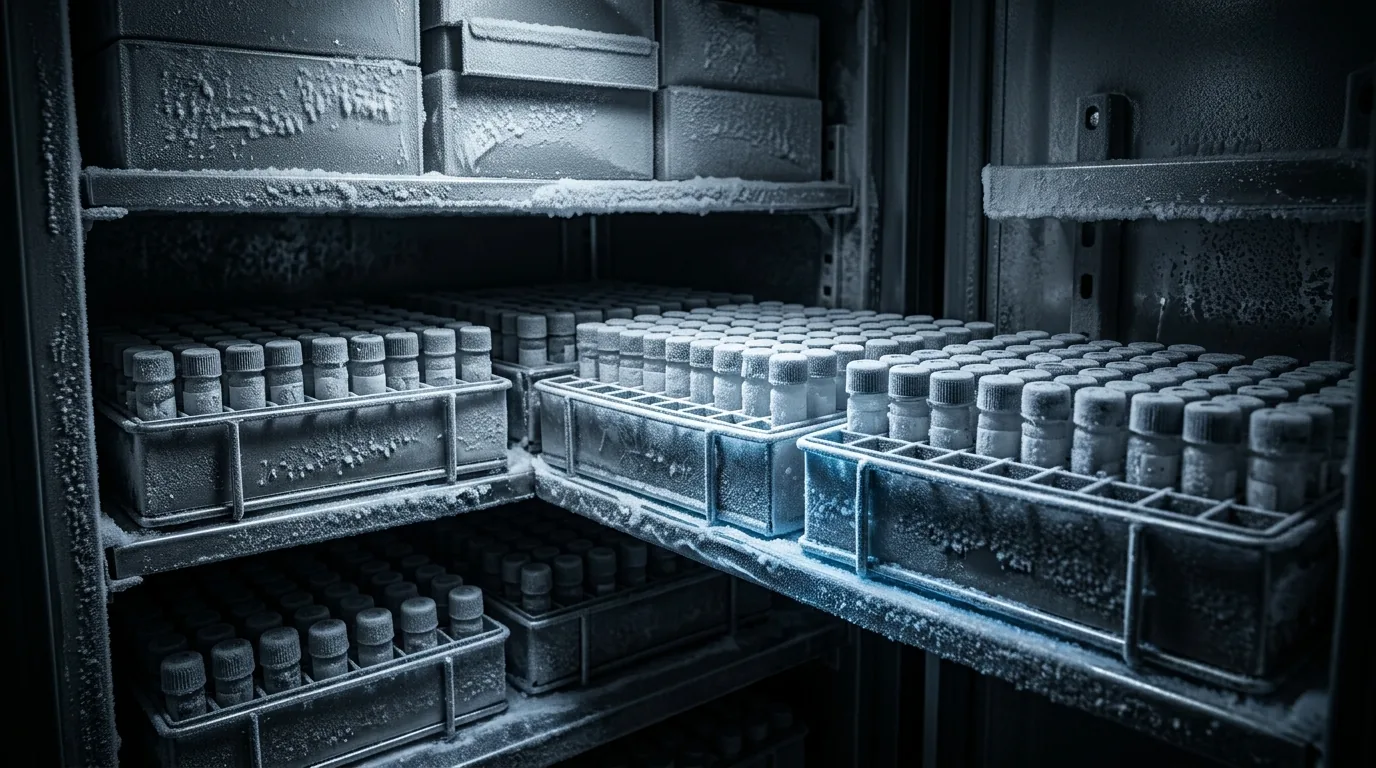
The single most effective strategy for preserving reconstituted peptides is aliquoting – dividing the solution into small, single-use portions immediately after reconstitution. Use sterile microcentrifuge tubes (0.5 mL or 1.5 mL), label each with the peptide name, concentration, date, and volume, then flash-freeze by placing tubes directly in a -20 °C or -80 °C freezer.
When you need peptide for an experiment, thaw only one aliquot. Allow it to reach room temperature gradually (do not heat), use what you need, and discard the remainder rather than refreezing. This approach eliminates freeze-thaw damage and ensures every experiment uses peptide of consistent quality.
Signs That a Peptide Has Degraded
Visual signs of degradation include cloudiness or turbidity (aggregation), color changes (oxidation – especially yellowing), and visible precipitate or particles. However, many degradation products are invisible to the naked eye. The most reliable way to detect degradation is analytical testing – HPLC purity analysis of the reconstituted solution compared to the original COA specification.
Functional degradation – reduced activity in bioassays – is often the first sign noticed by researchers. If experimental results suddenly become inconsistent or dose-response curves shift, peptide degradation should be the first hypothesis to investigate before blaming the experimental protocol.
Temperature Zones: Room Temp vs. Fridge vs. Freezer
Room temperature (20–25 °C): Acceptable only during active handling and reconstitution. Never store peptides here long-term. Refrigerator (2–8 °C): Standard short-term storage for reconstituted peptides (up to 28 days) and medium-term storage for lyophilized peptides (up to 12 months). Freezer -20 °C: Long-term storage for both lyophilized and aliquoted reconstituted peptides (up to 2 years for dry, 6 months for solution). Ultra-low freezer -80 °C: Archival storage for maximum shelf life – years for lyophilized, 12+ months for solution.
Always check vendor-specific storage recommendations, as certain peptide sequences may have unique stability profiles. Peptides containing methionine, cysteine, or tryptophan residues are particularly oxidation-sensitive and benefit from -80 °C storage with inert gas (nitrogen or argon) headspace.
References
For laboratory research use only. Not for human consumption. Store all research peptides according to manufacturer guidelines.
References
Compare Verified Vendors
Browse COA-verified suppliers with exclusive discount codes and transparent pricing.