
Acetyl-L-Carnitine (ALCAR): Chemical Profile & Research Applications
Chemical profile of Acetyl-L-Carnitine (ALCAR), the acetylated form of L-carnitine. MW 203.24 Da, CAS 3040-38-8. Analytical methods, stability data, and structural comparison with L-carnitine.
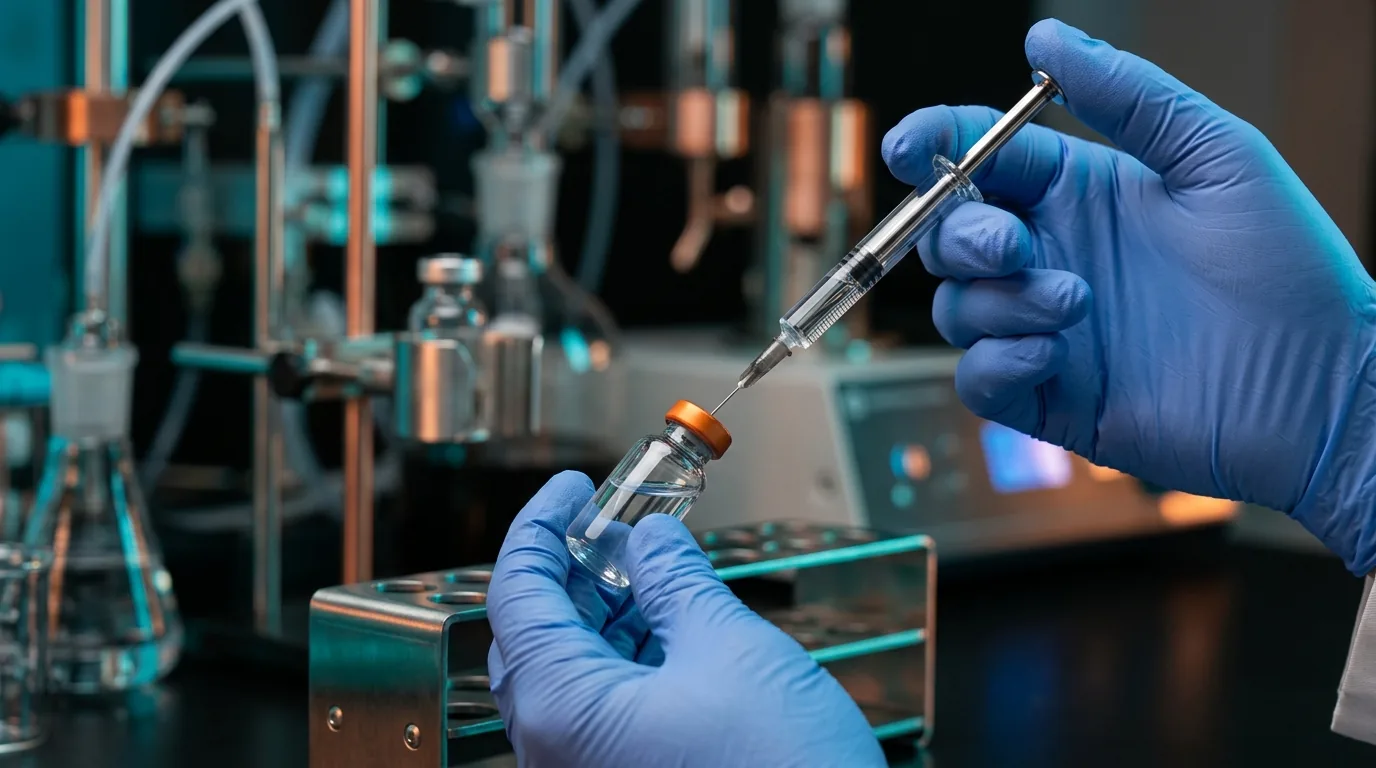
For laboratory research use only. Not for human consumption.
Last verified: March 2026 | Data accuracy confirmed by ChemVerify Editorial Team
TL;DR: Acetyl-L-Carnitine (ALCAR) is the acetylated ester of L-carnitine with MW 203.24 Da, molecular formula C9H17NO4, and CAS 3040-38-8. The acetyl group is linked via an ester bond at the 3-hydroxyl position, distinguishing it structurally and in chromatographic behavior from free L-carnitine (MW 161.20 Da). ALCAR Arginate (~357 Da) is a related derivative with an added arginine moiety.
Chemical Structure & Identification
Acetyl-L-Carnitine (ALCAR, also written as acetylcarnitine or ALC) is the acetyl ester of the naturally occurring quaternary ammonium compound L-carnitine. The molecule features a trimethylammonium group, a hydroxyl-bearing carbon chain, and a carboxylate group – with the acetyl moiety esterified at the C3 hydroxyl position. ALCAR exists as a zwitterion at physiological pH.
Identification Data
- IUPAC Name: (R)-3-(Acetyloxy)-4-(trimethylammonio)butanoate
- Molecular Formula: C9H17NO4
- Molecular Weight: 203.24 Da (free base, inner salt)
- CAS Number: 3040-38-8
- CAS (Hydrochloride salt): 5080-50-2 (MW 239.70 Da)
- Exact Mass: 203.1158 Da (monoisotopic)
- Chirality: (R)-configuration at C3 – only the L-isomer is biologically relevant
- Appearance: White crystalline powder (hygroscopic)
Acetyl Group & Ester Bond Chemistry
The defining structural feature of ALCAR is the acetyl group (CH3CO-) attached via an ester bond to the 3-hydroxyl position of the L-carnitine backbone. This ester bond is hydrolytically labile under acidic or basic conditions, meaning ALCAR can degrade to free L-carnitine and acetic acid. The acetyl group adds 42.04 Da to the molecular weight relative to L-carnitine (203.24 - 161.20 = 42.04 Da, corresponding to C2H2O). In aqueous solution, the ester bond stability is pH-dependent – optimal stability occurs between pH 3 and pH 5.
Ester Bond Hydrolysis
- Acid hydrolysis: Accelerated below pH 2, producing L-carnitine + acetic acid
- Base hydrolysis: Rapid above pH 8, saponification of the ester bond
- Optimal stability range: pH 3.0–5.0 in aqueous solution
- Thermal sensitivity: Hydrolysis rate doubles approximately every 10°C
- Enzymatic hydrolysis: Carnitine acetyltransferases catalyze reversible acetyl transfer
Comparison: ALCAR vs L-Carnitine vs ALCAR Arginate
The following table compares chemical properties only. No biological activity or health claims are made.
| Property | ALCAR | L-Carnitine | ALCAR Arginate |
|---|---|---|---|
| Molecular Weight | 203.24 Da | 161.20 Da | ~357 Da (estimated) |
| Molecular Formula | C9H17NO4 | C7H15NO3 | C15H30N4O5 (estimated) |
| CAS Number | 3040-38-8 | 541-15-1 | Proprietary |
| Acetyl Group | Yes (C3 ester) | No | Yes (C3 ester) |
| Arginine Moiety | No | No | Yes (salt/conjugate) |
| Solubility (water) | Freely soluble (>500 mg/mL) | Freely soluble (>2500 mg/mL) | Freely soluble |
| pKa (carboxyl) | ~3.8 | ~3.8 | ~3.8 (carnitine) + ~12.5 (arginine guanidinium) |
| Hygroscopicity | Moderate | High | Moderate |
| MW Difference vs L-Carnitine | +42.04 Da (acetyl) | Reference | +195.8 Da (acetyl + arginine) |
ALCAR Arginate (also called Acetyl-L-Carnitine Arginate dihydrochloride) is a proprietary form combining ALCAR with L-arginine. It has appeared in search queries and is included here for structural comparison purposes.
Solubility & Physicochemical Profile
ALCAR is freely soluble in water (>500 mg/mL at 25°C) and shows good solubility in methanol and ethanol. It is practically insoluble in non-polar organic solvents such as chloroform and diethyl ether. The compound is hygroscopic and should be stored in tightly sealed containers. In aqueous solution, ALCAR behaves as an inner salt (zwitterion) with a melting point of approximately 195–198°C (with decomposition for the hydrochloride salt).
Physicochemical Parameters
- Water solubility: >500 mg/mL (inner salt); >1000 mg/mL (HCl salt)
- Methanol solubility: ~200 mg/mL
- LogP: -3.24 (highly hydrophilic)
- pKa values: ~3.8 (carboxyl), ~14+ (quaternary amine – permanently charged)
- Melting point: 195–198°C (HCl salt, with decomposition)
- Optical rotation: [α]D20 = -27° to -31° (c = 1, H2O, HCl salt)
- UV absorption: Weak – no significant chromophore above 220 nm
Analytical Methods
Quantitative determination of ALCAR requires methods capable of distinguishing it from free L-carnitine (the primary hydrolysis product) and other acylcarnitine species. The lack of a strong UV chromophore above 220 nm makes direct UV detection challenging, favoring mass spectrometric or derivatization-based approaches.
Recommended Analytical Methods
- LC-MS/MS: HILIC or C18 column with ESI+ detection – m/z 204.1 → 85.0 (quantifier), 204.1 → 145.1 (qualifier). Gold standard for specificity and sensitivity
- RP-HPLC with UV: Requires ion-pair reagent (e.g., heptanesulfonic acid) or pre-column derivatization for adequate retention and detection at 210 nm
- HILIC-ELSD: Hydrophilic interaction chromatography with evaporative light scattering detection – suitable for purity assessment without derivatization
- Karl Fischer Titration: Water content determination for solid samples (specification typically ≤1.0%)
- Chiral HPLC: Crown ether or cyclodextrin columns to verify L-configuration and exclude D-isomer contamination
- Potentiometric Titration: Assay value determination (≥98.0% on dried basis for research grade)
Storage & Stability
Solid ALCAR (both inner salt and HCl salt) is relatively stable when stored under appropriate conditions. The primary degradation pathway is ester hydrolysis to L-carnitine and acetic acid, accelerated by moisture, elevated temperature, and extreme pH values. The hydrochloride salt form is generally preferred for long-term storage due to lower hygroscopicity compared to the inner salt.
Storage Recommendations
- Solid form: Store at 2–8°C, desiccated, protected from light – stable ≥36 months
- Room temperature storage: Acceptable for HCl salt (15–25°C) if sealed and desiccated – stable ≥24 months
- Aqueous solutions: Prepare fresh or store at 2–8°C, pH 3–5, use within 7 days
- Avoid: pH >7 in solution (rapid ester hydrolysis), high humidity, temperatures >30°C
- ICH stability: Follows ICH Q1A(R2) guidelines – accelerated stability at 40°C/75% RH for 6 months
- Degradation marker: Free L-carnitine content by LC-MS (should be <2% at release)
Frequently Asked Questions
What is the chemical difference between ALCAR and L-carnitine?
ALCAR has an acetyl group (CH3CO-) esterified at the 3-hydroxyl position of L-carnitine, adding 42.04 Da to the molecular weight (203.24 vs 161.20 Da). This ester bond changes the compound's chromatographic behavior, lipophilicity (slightly higher logP), and susceptibility to enzymatic processing. Analytically, they are readily distinguished by LC-MS: ALCAR appears at m/z 204.1 and L-carnitine at m/z 162.1.
What is ALCAR Arginate and how does it differ?
Acetyl-L-Carnitine Arginate (also known as ALCAR Arginate dihydrochloride) is a salt form combining ALCAR with L-arginine, resulting in an estimated MW of ~357 Da. It retains the acetylcarnitine core structure but includes the guanidinium-containing amino acid arginine as a counter-ion or conjugate. This form was developed as a proprietary derivative and differs from standard ALCAR in its salt composition and molecular weight.
Should I use ALCAR HCl or the inner salt form for research?
The hydrochloride salt (CAS 5080-50-2, MW 239.70 Da) is generally preferred for research applications because it is less hygroscopic, more stable in solid form, and easier to weigh accurately. The inner salt (zwitterion, CAS 3040-38-8, MW 203.24 Da) is more hygroscopic but avoids introducing chloride ions. For molar concentration calculations, remember to use the correct MW for the form you are using.
How can I tell if my ALCAR sample has degraded?
The primary degradation product is free L-carnitine from ester hydrolysis. LC-MS analysis showing increasing L-carnitine (m/z 162.1) relative to ALCAR (m/z 204.1) indicates degradation. A vinegar-like odor may also indicate acetic acid release from hydrolysis. For quantitative assessment, the ratio of free L-carnitine to total carnitine species should be <2% for fresh, high-quality material.
Why is ALCAR difficult to detect by UV?
ALCAR lacks a significant UV chromophore above 220 nm because it contains no aromatic rings, conjugated double bonds, or other strongly absorbing functional groups. Detection at 210 nm is possible but suffers from poor selectivity and sensitivity, as many solvents and buffer components also absorb at this wavelength. LC-MS/MS with electrospray ionization is the preferred detection method, offering both high sensitivity (low ng/mL) and specificity through characteristic fragmentation patterns.
Browse verified L-carnitine and amino acid derivative data on chemverify.com
Further Reading on ChemVerify
- Read more: Acetate vs Arginate Salt Forms in Peptides: Which Is Better? → https://www.chemverify.com/learn/acetate-vs-arginate-salt-peptides-comparison
- Read more: Peptide Aggregation: Why Peptides Clump and How to Prevent It → https://www.chemverify.com/learn/peptide-aggregation-clumping-prevention
- Read more: Peptide Degradation: Deamidation, Oxidation, and How to Prevent It → https://www.chemverify.com/learn/peptide-degradation-deamidation-oxidation-prevention
- Read more: Peptide Modifications: PEGylation, Lipidation, Cyclization, and D-Amino Acids → https://www.chemverify.com/learn/peptide-modifications-pegylation-lipidation-cyclization
References
Compare Verified Vendors
Browse COA-verified suppliers with exclusive discount codes and transparent pricing.
You Might Also Like
Continue Reading
Peptide Aggregation: Why Peptides Clump and How to Prevent It
Understanding peptide aggregation in research: hydrophobic clumping, amyloid formation, concentration and pH effects, co-solvents, gentle mixing, and filtration strategies.
Peptide Modifications: PEGylation, Lipidation, Cyclization, and D-Amino Acids
Advanced guide to peptide chemical modifications including PEG conjugation, fatty acid acylation, stapled peptides, head-to-tail cyclization, retro-inverso design, and non-natural amino acids.
Peptide Degradation: Deamidation, Oxidation, and How to Prevent It
Scientific guide to peptide degradation pathways including asparagine deamidation, methionine oxidation, disulfide scrambling, and evidence-based prevention strategies.
Acetate vs Arginate Salt Forms in Peptides: Which Is Better?
A comparative analysis of acetate and arginate counterion salt forms in synthetic peptides, covering their impact on solubility, stability, pH of reconstituted solutions, bioavailability, TFA contamination concerns, and how to identify salt form on a certificate of analysis.