
Peptide Degradation: Deamidation, Oxidation, and How to Prevent It
Scientific guide to peptide degradation pathways including asparagine deamidation, methionine oxidation, disulfide scrambling, and evidence-based prevention strategies.
For laboratory research use only. Not for human consumption.
Research Compliance Notice
This article discusses chemical degradation pathways of peptides in a laboratory context. It does not provide medical, therapeutic, or dosage guidance. All peptide handling information is intended for qualified research personnel.
Why Peptide Degradation Matters for Research
Peptide degradation represents one of the most significant challenges in peptide science, directly impacting the reproducibility and validity of research outcomes. Chemical instability causes peptides to lose their intended structure through multiple pathways, including deamidation, oxidation, hydrolysis, disulfide scrambling, and aggregation. Understanding these degradation mechanisms is essential for researchers working with synthetic peptides, as degraded material can produce misleading experimental results, altered binding affinities, and unintended biological activities in assay systems.
The rate and extent of degradation depend on the peptide primary sequence, solution pH, temperature, ionic strength, and the presence of catalytic metal ions or reactive oxygen species. Published data indicate that certain sequence motifs are particularly susceptible: Asn-Gly sequences deamidate orders of magnitude faster than Asn-Leu, and exposed Met residues oxidize rapidly in the presence of even trace peroxide contamination.
Asparagine and Glutamine Deamidation
Deamidation is the most common non-enzymatic degradation pathway for peptides containing asparagine (Asn) or glutamine (Gln) residues. The mechanism proceeds through a cyclic succinimide intermediate: the backbone nitrogen of the residue C-terminal to Asn attacks the Asn side chain amide carbonyl, forming a five-membered succinimide ring with loss of ammonia. This intermediate then hydrolyzes to yield a mixture of aspartate (Asp) and isoaspartate (isoAsp) products, typically in an approximate 1:3 ratio favoring the iso-form.
The rate of deamidation is highly sequence-dependent. The identity of the residue immediately following Asn (the n+1 position) is the strongest determinant: Asn-Gly sequences deamidate with half-lives as short as 1-2 days at pH 7.4 and 37 degrees Celsius, while bulky hydrophobic residues at n+1 (Asn-Val, Asn-Ile) slow the rate by 50-fold or more. Elevated pH accelerates deamidation because the reaction is base-catalyzed. Glutamine deamidation follows an analogous mechanism through a six-membered glutarimide intermediate but proceeds 10-100 times more slowly than the corresponding Asn reaction.
The isoAsp product introduces a beta-linkage into the peptide backbone, adding an extra methylene group to the main chain. This structural alteration can dramatically affect peptide conformation, receptor binding, and biological activity. For research peptides, deamidation represents a critical quality attribute that must be monitored during storage.
Methionine and Tryptophan Oxidation
Oxidative degradation primarily affects methionine (Met) and tryptophan (Trp) residues, though cysteine, histidine, and tyrosine can also be oxidized under aggressive conditions. Methionine oxidation to methionine sulfoxide is the most prevalent reaction, proceeding readily in the presence of hydrogen peroxide, dissolved oxygen, metal-catalyzed radical species, or even peroxide contaminants leached from plastic storage containers.
The Met to Met(O) conversion adds 16 Da to the peptide mass, making it readily detectable by mass spectrometry. The sulfoxide product introduces increased polarity and altered side chain geometry that can disrupt hydrophobic packing interactions critical for peptide folding and target binding. Under more severe oxidizing conditions, Met(O) can further oxidize to methionine sulfone (Met(O2), +32 Da), which is generally considered irreversible.
Tryptophan oxidation produces multiple products including kynurenine, N-formylkynurenine, hydroxytryptophan, and oxindolylalanine. These reactions are particularly accelerated by UV light exposure and are a major concern for peptides stored in clear glass vials or exposed to laboratory lighting. The Trp oxidation products are often fluorescent, providing a convenient qualitative indicator of degradation but complicating quantitative analysis.
Disulfide Bond Scrambling and Reduction
Peptides containing multiple cysteine residues are susceptible to disulfide bond scrambling, wherein the native disulfide pairing rearranges to form non-native connectivities. This process is catalyzed by free thiol groups (from partially reduced Cys residues or thiol-containing buffer components) and is accelerated at alkaline pH. For example, a peptide with two disulfide bonds (Cys1-Cys3, Cys2-Cys4) can scramble to alternative pairings (Cys1-Cys2, Cys3-Cys4 or Cys1-Cys4, Cys2-Cys3), each representing a distinct structural isomer with potentially different biological properties.
Complete disulfide reduction to free thiols can occur in the presence of reducing agents such as DTT, TCEP, or beta-mercaptoethanol, even at concentrations present as trace contaminants. Reduced Cys residues are themselves susceptible to further reactions including thiol-disulfide exchange, beta-elimination to dehydroalanine, and irreversible oxidation to cysteic acid. Maintaining an inert atmosphere (nitrogen or argon) during reconstitution and storage helps minimize these pathways.
Backbone Hydrolysis and Fragmentation
Peptide bond hydrolysis, while thermodynamically favorable, is kinetically slow under physiological conditions in the absence of enzymatic catalysis. However, certain sequence motifs are prone to non-enzymatic cleavage. Asp-Pro bonds are particularly labile under acidic conditions (pH less than 4), with the aspartate side chain carboxyl group catalyzing intramolecular cleavage of the adjacent peptide bond. This Asp-Pro clipping can occur during peptide purification using acidic mobile phases or during storage in acidic formulations.
Aspartimide formation from Asp residues can also lead to backbone rearrangement and fragmentation. Additionally, peptides containing N-terminal Gln can undergo spontaneous cyclization to pyroglutamate with loss of ammonia, altering the peptide mass by -17 Da and removing the free alpha-amino group, which affects charge state and chromatographic behavior.
Aggregation and Fibril Formation
Peptide aggregation encompasses reversible self-association, irreversible amorphous aggregation, and ordered fibril formation. Hydrophobic peptide sequences are particularly prone to aggregation upon reconstitution in aqueous buffers, especially at concentrations above their critical aggregation concentration. Aggregation is accelerated by factors including elevated temperature, freeze-thaw cycling, mechanical agitation, and the presence of air-water interfaces.
Certain sequences adopt cross-beta-sheet structures that nucleate amyloid-like fibril formation. While this is a well-known phenomenon for amyloid-beta and IAPP fragments, many synthetic research peptides with hydrophobic stretches can exhibit similar behavior. Aggregated peptide material may exhibit altered apparent purity by HPLC (as aggregates may not dissolve in the mobile phase), reduced biological activity in assays, and inconsistent dose-response relationships.
Prevention Strategies: Formulation and Storage
Effective prevention of peptide degradation requires a multi-faceted approach addressing each vulnerability. For deamidation: store lyophilized peptides at pH below 6 in the solid state; avoid extended exposure to neutral or basic pH in solution; use buffers such as acetate (pH 4-5) or succinate (pH 5-6) for short-term solution stability. For oxidation: include antioxidants such as methionine (0.1-1 mM as a sacrificial scavenger) or EDTA (0.01-0.1 mM to chelate catalytic metals); store under inert gas headspace; use amber vials to prevent photo-oxidation; avoid rubber stoppers that may leach peroxides.
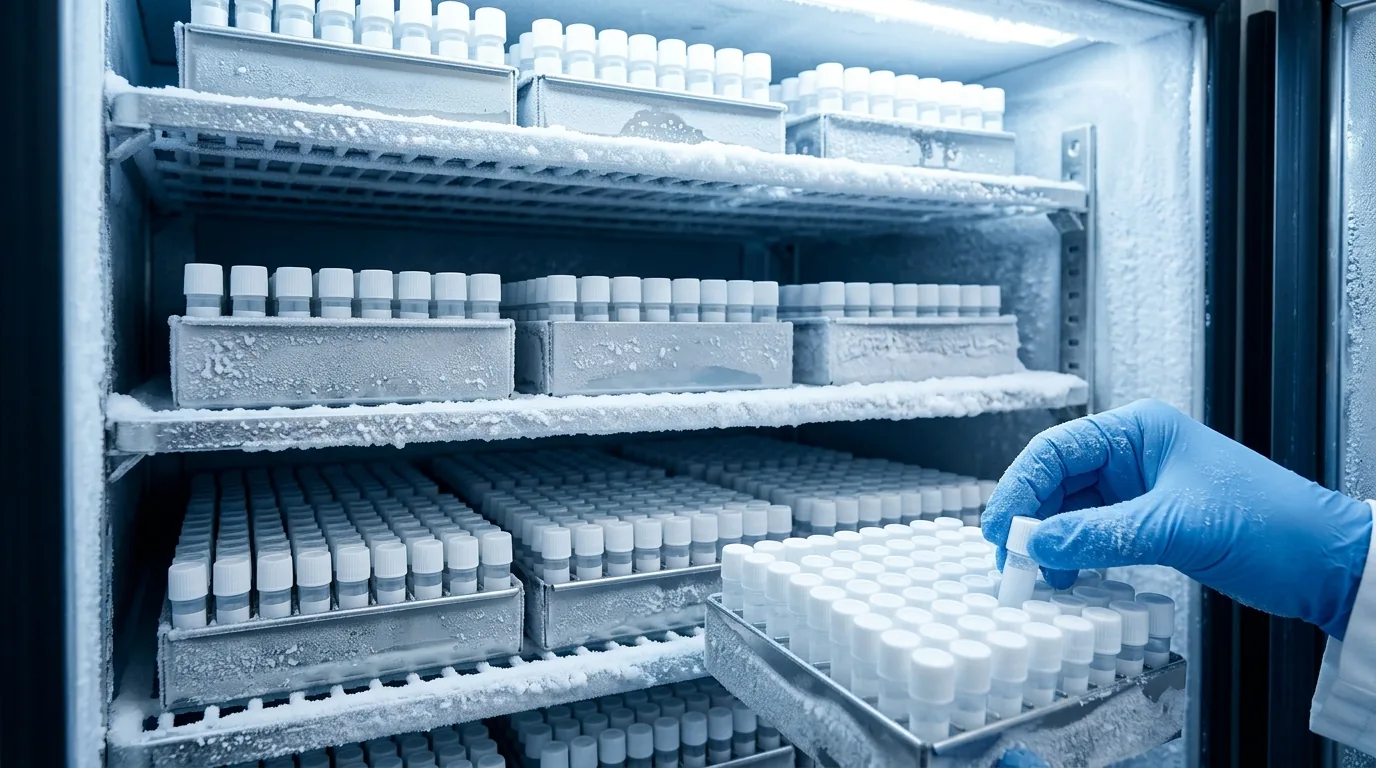
For disulfide-containing peptides: maintain slightly acidic pH (4-6) to minimize thiol-disulfide exchange; degas solutions and store under argon; avoid reducing agents in buffers. General storage best practices include maintaining lyophilized peptides at -20 degrees Celsius or below with desiccant, reconstituting in the minimum required volume immediately before use, preparing single-use aliquots to avoid repeated freeze-thaw cycles, and using low-bind polypropylene tubes to minimize surface adsorption losses.
Analytical Detection by Mass Spectrometry
Mass spectrometry is the primary analytical technique for detecting and characterizing peptide degradation products. Deamidation produces a +1 Da mass shift (Asn to Asp/isoAsp), which requires high-resolution instruments (QTOF, Orbitrap) operating at resolving powers above 20,000 to distinguish from the natural 13C isotope envelope. LC-MS/MS with electron transfer dissociation (ETD) fragmentation can differentiate Asp from isoAsp based on diagnostic fragment ions.
Oxidation products are more readily detected: Met(O) at +16 Da and Met(O2) at +32 Da are unambiguous on most MS platforms. Tryptophan oxidation products show +4 Da (kynurenine), +16 Da (hydroxytryptophan), or +32 Da (N-formylkynurenine), distinguishable by chromatographic separation and MS/MS fragmentation patterns. Disulfide scrambling is assessed by peptide mapping under non-reducing conditions, comparing retention times and masses of disulfide-linked fragments against reference standards.
For routine quality control, reversed-phase HPLC with UV detection (214 nm) provides a practical screening method, as most degradation products exhibit altered hydrophobicity and elute at different retention times than the intact peptide. Integration of degradant peaks relative to the main peak provides a degradation percentage that can be trended over time to establish stability profiles.
Quality Control Implications for Research Peptides
Researchers should request certificates of analysis that report not only initial purity but also identify known degradation products by retention time and mass. Stability-indicating analytical methods that resolve the parent peptide from its primary degradants are essential for meaningful purity specifications. When receiving research peptides, immediate inspection of the lyophilized material (which should be a white to off-white powder without discoloration) and verification of molecular weight by MS upon reconstitution provide a first-line quality check.
Establishing a retention sample stored under recommended conditions allows retrospective analysis if experimental results suggest peptide degradation may have confounded study outcomes. This practice is particularly important for long-term studies where peptide solutions may be stored for days or weeks between uses.
Further Reading on ChemVerify
- Read more: Acetate vs Arginate Salt Forms in Peptides: Which Is Better? → https://www.chemverify.com/learn/acetate-vs-arginate-salt-peptides-comparison
- Read more: Peptide Aggregation: Why Peptides Clump and How to Prevent It → https://www.chemverify.com/learn/peptide-aggregation-clumping-prevention
- Read more: Acetyl-L-Carnitine (ALCAR): Chemical Profile & Research Applications → https://www.chemverify.com/learn/acetyl-l-carnitine-research-guide
- Read more: Peptide Modifications: PEGylation, Lipidation, Cyclization, and D-Amino Acids → https://www.chemverify.com/learn/peptide-modifications-pegylation-lipidation-cyclization
References
Compare Verified Vendors
Browse COA-verified suppliers with exclusive discount codes and transparent pricing.
Continue Reading
Acetate vs Arginate Salt Forms in Peptides: Which Is Better?
A comparative analysis of acetate and arginate counterion salt forms in synthetic peptides, covering their impact on solubility, stability, pH of reconstituted solutions, bioavailability, TFA contamination concerns, and how to identify salt form on a certificate of analysis.
Disulfide Bond Formation in Synthetic Peptides: Chemistry, Methods, and Verification
Technical guide to disulfide bond formation in research peptides – cysteine oxidation chemistry, regioselective strategies for multiple disulfide bonds, orthogonal protection schemes, and analytical verification methods.
Peptide Sequence Notation: One-Letter Codes, Three-Letter Codes, and Modifications
Complete guide to peptide sequence notation systems – IUPAC one-letter and three-letter amino acid codes, N-terminal and C-terminal modifications, non-standard amino acids, and reading sequences on Certificates of Analysis.
Peptide Aggregation: Why Peptides Clump and How to Prevent It
Understanding peptide aggregation in research: hydrophobic clumping, amyloid formation, concentration and pH effects, co-solvents, gentle mixing, and filtration strategies.