
AOD-9604 vs. HGH Fragment 176-191: Structural Comparison
Structural comparison of AOD-9604 (modified HGH fragment with N-terminal tyrosine, MW ~1815 Da) and native HGH Fragment 176-191 (16 amino acids, MW ~1817 Da). Analyzes the tyrosine modification, disulfide bond implications, mass spectrometric differentiation, and stability differences between these closely related growth hormone-derived peptides.
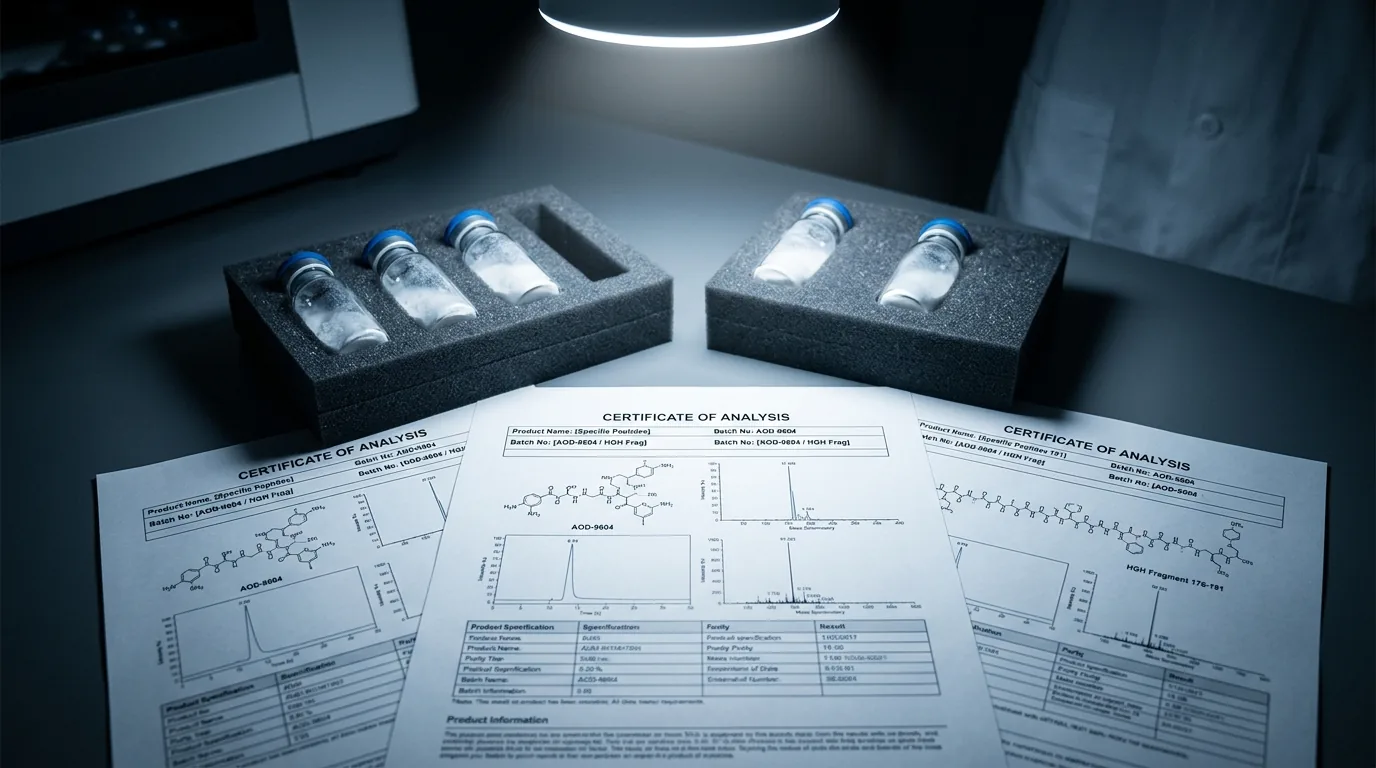
For laboratory research use only. Not for human consumption.
TL;DR: AOD-9604 and HGH Fragment 176-191 are closely related peptides derived from the C-terminal region of human growth hormone. HGH Fragment 176-191 is the native 16-amino-acid sequence (Tyr-Leu-Arg-Ile-Val-Gln-Cys-Arg-Ser-Val-Glu-Gly-Ser-Cys-Gly-Phe, MW ~1817 Da) with an intramolecular disulfide bond. AOD-9604 adds a tyrosine residue to the N-terminus of a modified version of this fragment (MW ~1815 Da). Despite near-identical masses, they can be differentiated by peptide mapping and targeted MS/MS fragmentation.
Last verified: March 2026 | Data accuracy confirmed by ChemVerify Editorial Team
Introduction: Two Closely Related GH-Derived Fragments
AOD-9604 and HGH Fragment 176-191 are both derived from the C-terminal tail of human growth hormone (hGH, 191 amino acids, MW ~22,124 Da). HGH Fragment 176-191 corresponds to the native amino acid sequence spanning positions 176-191 of hGH. AOD-9604 (Anti-Obesity Drug-9604) is a modified version developed at Monash University that incorporates an additional N-terminal tyrosine and sequence modifications to the native fragment. Both peptides are of significant research interest, but their structural similarities create challenges in analytical identification. This comparison details the precise structural differences, their physicochemical consequences, and methods for reliable differentiation in research settings.
Sequence Comparison and Structural Origins
HGH Fragment 176-191 has the native hGH sequence: H-Tyr176-Leu-Arg-Ile-Val-Gln-Cys-Arg-Ser-Val-Glu-Gly-Ser-Cys-Gly-Phe191-OH. This 16-residue peptide contains two cysteine residues (positions 182 and 189 in full hGH numbering) capable of forming an intramolecular disulfide bond. The molecular formula is C78H125N19O23S2 (MW ~1816.97 Da, oxidized form with disulfide). AOD-9604 is formally designated as Tyr-hGH Fragment 177-191, meaning it corresponds to positions 177-191 of hGH (15 residues: Leu-Arg-Ile-Val-Gln-Cys-Arg-Ser-Val-Glu-Gly-Ser-Cys-Gly-Phe) with an additional tyrosine appended to the N-terminus, making it 16 residues total. Its MW is approximately 1815.08 Da. The subtle but critical difference: AOD-9604 starts at hGH position 177 (Leu) with an appended Tyr, while Fragment 176-191 starts at hGH position 176 (which is itself Tyr). The result is similar but non-identical sequences.
| Parameter | AOD-9604 | HGH Fragment 176-191 |
|---|---|---|
| hGH Positions Covered | 177-191 (+ N-terminal Tyr) | 176-191 (native) |
| Total Amino Acids | 16 | 16 |
| Sequence | Tyr-Leu-Arg-Ile-Val-Gln-Cys-Arg-Ser-Val-Glu-Gly-Ser-Cys-Gly-Phe | Tyr-Leu-Arg-Ile-Val-Gln-Cys-Arg-Ser-Val-Glu-Gly-Ser-Cys-Gly-Phe |
| Molecular Weight | ~1815 Da | ~1817 Da |
| Molecular Formula | C78H123N19O23S2 | C78H125N19O23S2 |
| Disulfide Bond | Cys(7)-Cys(14) intramolecular | Cys(7)-Cys(14) intramolecular |
| CAS Number | 221231-10-3 | 12629-01-5 (fragment) |
| C-terminal | Free acid (-OH) | Free acid (-OH) |
| Origin | Modified synthetic (Monash Univ.) | Native hGH sequence |
The N-Terminal Tyrosine Modification in AOD-9604
The N-terminal tyrosine in AOD-9604 merits detailed examination. In HGH Fragment 176-191, the N-terminal Tyr IS the native residue at position 176 of hGH. In AOD-9604, the N-terminal Tyr is an ADDED residue preceding the Leu177 start point – effectively creating the same sequence through a different derivation pathway. Published literature from the Monash University group describes AOD-9604 as hGH(177-191) with an added N-terminal tyrosine, noting this modification was designed to facilitate radioiodination studies (125I-labeling of Tyr) and maintain the structural conformation of the native C-terminal loop. Tyrosine provides a convenient handle for 125-iodine labeling via electrophilic aromatic substitution at the 3-position, producing monoiodotyrosine without disrupting peptide backbone integrity. The phenolic hydroxyl group (pKa ~10.1) of the added Tyr also contributes to the UV absorption profile at 280 nm (epsilon approximately 1490 M-1 cm-1 per Tyr residue), though both peptides contain a native Phe at the C-terminus with minimal 280 nm absorption.
Disulfide Bond Chemistry and Implications
Both peptides contain two cysteine residues capable of forming an intramolecular disulfide bond (Cys-Cys loop spanning 7 residues in the linear sequence). In the oxidized (disulfide-bonded) form, the peptide adopts a constrained loop conformation that mirrors the C-terminal loop structure of intact hGH. This loop is stabilized by the disulfide bridge between Cys182 and Cys189 (hGH numbering). The reduced (free thiol) form has a linear, flexible structure. Both oxidized and reduced forms are commercially available, but the oxidized form is considered the physiologically relevant conformation. Analytical assessment of disulfide bond integrity is critical for quality control. Ellman's reagent (DTNB, 5,5'-dithio-bis-2-nitrobenzoic acid) quantifies free thiol content – intact disulfide shows no reaction, while reduced cysteines produce the yellow TNB2- anion (epsilon 14,150 M-1 cm-1 at 412 nm). RP-HPLC can resolve oxidized and reduced forms due to the conformational change affecting hydrophobic surface exposure, with the oxidized (loop) form typically eluting earlier than the extended reduced form on C18 columns.
Physicochemical Properties
The physicochemical profiles of these peptides are remarkably similar, as expected from their near-identical sequences. Both have isoelectric points of approximately 8.0-8.5, driven by two Arg residues contributing positive charges and one Glu providing a negative charge. Both are soluble in aqueous buffers at acidic to neutral pH (1-5 mg/mL in 0.1% acetic acid), with decreased solubility near the pI. DMSO stock solutions at 10-50 mM are stable and provide an alternative for hydrophobic solvent-compatible assays. The mass difference between AOD-9604 (~1815 Da) and Fragment 176-191 (~1817 Da) is approximately 2 Da in the oxidized form, attributable to minor sequence composition differences in the hydrogen count. This 2 Da difference is within the mass accuracy of many MALDI-TOF instruments, making high-resolution ESI-QTOF or Orbitrap MS necessary for mass-based differentiation. Both peptides show similar RP-HPLC retention times on C18 columns (within 0.5-1.0 minutes under standard gradients), further complicating chromatographic distinction without orthogonal confirmation.
| Property | AOD-9604 | HGH Fragment 176-191 |
|---|---|---|
| Isoelectric Point (pI) | ~8.0-8.5 | ~8.0-8.5 |
| Aqueous Solubility | 1-5 mg/mL (0.1% AcOH) | 1-5 mg/mL (0.1% AcOH) |
| UV Absorption (280 nm) | Yes (Tyr + Phe) | Yes (Tyr + Phe) |
| HPLC Retention (C18) | Similar (within 1 min) | Similar (within 1 min) |
| Disulfide Bond | Intramolecular (oxidized form) | Intramolecular (oxidized form) |
| Net Charge (pH 7.0) | Positive (+1 to +2) | Positive (+1 to +2) |
| GRAVY Score | Slightly negative (hydrophilic) | Slightly negative (hydrophilic) |
Analytical Differentiation Methods
Given the near-identical masses and similar chromatographic behavior, distinguishing AOD-9604 from HGH Fragment 176-191 requires targeted analytical strategies. The most reliable approach is tandem mass spectrometry (MS/MS) peptide sequencing. CID or HCD fragmentation of the [M+2H]2+ precursor ions produces b- and y-ion series that reveal sequence differences. Specifically, the b1 ion (N-terminal fragment) differs if the tyrosine originates from position 176 versus being an added residue – although in practice, b1 ions are often poorly detected. More diagnostically useful are tryptic peptide mapping experiments: trypsin cleaves at Arg residues, producing distinct fragment peptides whose masses can be matched against theoretical digests of each sequence. Edman degradation, while less commonly used, provides unambiguous N-terminal sequencing. For routine QC, a combination of RP-HPLC purity (USP <621>), intact mass by high-resolution MS (mass accuracy <5 ppm), and amino acid analysis provides sufficient identification confidence.
Stability and Storage Protocols
Both peptides exhibit similar stability profiles consistent with cysteine-containing peptides. Lyophilized material should be stored at -20 degrees C or below with desiccant, where both maintain >95% purity for 18-24 months per ICH Q1A(R2) guidelines. The primary degradation concern is disulfide bond scrambling and oxidation. In solution, cysteine residues are susceptible to oxidation by dissolved oxygen, leading to intermolecular disulfide-linked dimers and higher-order aggregates. Solutions should be degassed with nitrogen or argon before use and stored under inert atmosphere. Reconstituted solutions at 1 mg/mL in 0.1% acetic acid retain >90% monomer content for 7-14 days at 2-8 degrees C. At room temperature, measurable dimerization occurs within 48-72 hours. Methionine oxidation is a secondary concern if Met residues are present in the fragment. Repeated freeze-thaw cycling accelerates aggregation and should be avoided – single-use aliquots are strongly recommended.
Frequently Asked Questions
What is the exact sequence difference between AOD-9604 and HGH Fragment 176-191?
HGH Fragment 176-191 is the native 16-residue sequence from hGH positions 176-191 starting with Tyr176. AOD-9604 covers hGH positions 177-191 (15 residues starting with Leu177) with an additional N-terminal tyrosine appended, resulting in a functionally similar but derivationally distinct 16-residue peptide.
Why was a tyrosine added to the N-terminus of AOD-9604?
The added tyrosine facilitates radioiodination (125I labeling via electrophilic aromatic substitution) for binding and distribution studies. The phenolic hydroxyl provides a selective site for monoiodination without disrupting the peptide backbone.
Can MALDI-TOF distinguish these two peptides?
Standard MALDI-TOF instruments typically achieve mass accuracy of 50-200 ppm, insufficient to reliably resolve the ~2 Da mass difference between these peptides. High-resolution ESI-QTOF or Orbitrap MS (mass accuracy <5 ppm) is required for mass-based differentiation.
How is disulfide bond integrity verified?
Ellman's reagent (DTNB) quantifies free thiols – intact disulfide bonds show no reaction. RP-HPLC resolves oxidized (loop, earlier elution) from reduced (extended, later elution) forms. The mass difference between oxidized and reduced forms is 2 Da (loss of 2H upon disulfide formation).
What causes dimerization in solution?
Dissolved oxygen oxidizes free cysteine thiols, promoting intermolecular disulfide bond formation between two peptide molecules. This produces covalent dimers (~3630-3634 Da) detectable by SEC or non-reducing SDS-PAGE. Degassing solutions with inert gas prevents this.
Need verified disulfide bond integrity data? Browse our batch-specific Certificate of Analysis reports for independent HPLC, mass spectrometry, and Ellman's assay results on growth hormone-derived peptide fragments.
Compounds Referenced in This Article
Explore detailed chemical profiles and research guides for compounds discussed in this article:
- AOD 9604: Complete Research Guide → /learn/aod-9604
- HGH Fragment 176-191: Complete Research Guide → /learn/hgh-fragment-176-191
Further Reading on ChemVerify
- Read more: HGH Fragment 176-191: Complete Research Guide & Chemical Profile → https://www.chemverify.com/learn/hgh-fragment-176-191
- Read more: MK-677 vs. Ipamorelin: Oral GHS vs. Injectable GHRP Comparison → https://www.chemverify.com/learn/mk-677-vs-ipamorelin
- Read more: BPC-157 Acetate vs. Arginine Salt: Counterion Comparison → https://www.chemverify.com/learn/bpc-157-acetate-vs-arginine
- Read more: AOD 9604: Complete Research Guide & Chemical Profile → https://www.chemverify.com/learn/aod-9604
References
Compare Verified Vendors
Browse COA-verified suppliers with exclusive discount codes and transparent pricing.
You Might Also Like
Continue Reading
HGH Fragment 176-191: Complete Research Guide & Chemical Profile
Comprehensive research guide on HGH Fragment 176-191, covering chemical properties, mechanism of action, and laboratory applications for peptide research.
MK-677 vs. Ipamorelin: Oral GHS vs. Injectable GHRP Comparison
Comprehensive structural and analytical comparison of MK-677 (Ibutamoren), a non-peptide ghrelin mimetic with oral bioavailability (~528 Da), versus Ipamorelin, an injectable pentapeptide GHRP (~711 Da). Covers molecular architecture, stability profiles, bioavailability differences, and chromatographic detection methods for research applications.
Semaglutide vs. Tirzepatide: Molecular Structure & Research Profile
Molecular comparison of semaglutide and tirzepatide research peptides – GLP-1 receptor binding, amino acid sequences, acylation chemistry, and analytical characterization methods.
Semax vs. Selank: Nootropic Peptide Structural Comparison
Structural comparison of Semax (ACTH 4-7 analog) and Selank (tuftsin analog) research peptides – amino acid sequences, molecular weight, stability, and analytical characterization.