
HGH Fragment 176-191: Complete Research Guide & Chemical Profile
Comprehensive research guide on HGH Fragment 176-191, covering chemical properties, mechanism of action, and laboratory applications for peptide research.
For laboratory research use only. Not for human consumption. This article is intended for educational purposes and does not constitute medical advice.
TL;DR: HGH Fragment 176-191 is a 16-amino-acid peptide (MW ~1817.12 Da) corresponding to the C-terminal region of human growth hormone. Research-grade HGH Frag requires ≥95% HPLC purity with ESI-MS sequence confirmation matching positions 176–191 of the hGH sequence. Structurally similar to AOD-9604 but lacks the tyrosine modification. Compare verified HGH Fragment 176-191 pricing across vendors at chemverify.com.
Last verified: March 2026 | Data accuracy confirmed by ChemVerify Editorial Team
What Is HGH Fragment 176-191?
HGH Fragment 176-191, also known as HGH Frag or AOD-9401, is a synthetic peptide consisting of amino acids 176-191 from the C-terminus of human growth hormone (hGH). This 16-amino acid sequence represents the specific region of the growth hormone molecule responsible for lipolytic activity, making it a subject of significant interest in metabolic research.
The peptide has a molecular weight of 1817.12 Da and follows the amino acid sequence YLRIVQCRSVEGSCGF. Originally developed by Metabolic Pharmaceuticals, this fragment was designed to retain the fat-burning properties of growth hormone while eliminating other effects associated with the full-length hormone. Research indicates that this specific sequence maintains the lipolytic activity without affecting insulin sensitivity or promoting growth.
Unlike full-length human growth hormone, HGH Fragment 176-191 is significantly smaller and more targeted in its action. Studies suggest that this fragment specifically binds to adipocyte receptors and promotes the breakdown of stored fat through enhanced lipolysis, making it a valuable tool for metabolic research applications.
Research Background & Key Studies
The development of HGH Fragment 176-191 stems from extensive research into the structure-function relationships of human growth hormone. Early studies by Ng et al. demonstrated that the C-terminal region of hGH contains the lipolytic domain, leading to the isolation and synthesis of this specific fragment for research purposes.
Clinical research conducted by Metabolic Pharmaceuticals showed that HGH Fragment 176-191 demonstrates significant lipolytic activity in laboratory settings. In controlled studies, the fragment showed the ability to promote fat oxidation without the hyperglycemic effects associated with full-length growth hormone, making it particularly valuable for metabolic research applications.
Research published in obesity and endocrinology journals has indicated that this fragment maintains approximately 12.5 times the fat-burning potency of regular growth hormone when examined in laboratory conditions. Additionally, studies suggest that the fragment does not compete with endogenous growth hormone for receptor binding sites, indicating a distinct mechanism of action.
Long-term stability studies have shown that HGH Fragment 176-191 maintains its structural integrity and biological activity when properly stored, making it suitable for extended research protocols. Pharmacokinetic studies indicate a plasma half-life of approximately 30 minutes, requiring consideration of timing in experimental design.
Mechanism of Action
HGH Fragment 176-191 exerts its effects through specific binding to adipocyte receptors, triggering a cascade of intracellular events that promote lipolysis. Research indicates that the fragment activates hormone-sensitive lipase (HSL), the rate-limiting enzyme in triglyceride hydrolysis, leading to the breakdown of stored fat into free fatty acids and glycerol.
The peptide appears to work through both direct and indirect mechanisms. Direct action involves binding to specific receptors on adipocytes, while indirect effects may involve modulation of other metabolic pathways. Studies suggest that the fragment may also influence the expression of genes involved in lipid metabolism, though this area requires further research.
Lipolytic Activity
The primary mechanism of HGH Fragment 176-191 involves the activation of lipolytic pathways in adipose tissue. Research demonstrates that the fragment specifically targets visceral and subcutaneous fat deposits, promoting the mobilization of stored triglycerides. This selective action makes it particularly valuable for studying fat metabolism and energy utilization in laboratory settings.
Laboratory studies indicate that the fragment enhances the phosphorylation of hormone-sensitive lipase, increasing its enzymatic activity. This leads to increased hydrolysis of triglycerides into free fatty acids and glycerol, which can then be utilized for energy production. The process appears to be particularly effective during periods of energy deficit, as observed in controlled research conditions.
Chemical Properties
HGH Fragment 176-191 is typically supplied as a white lyophilized powder with a purity standard of ≥98% as determined by HPLC analysis. The peptide is highly soluble in water and physiological buffers, making it suitable for various research applications. Its molecular weight of 1817.12 Da falls within the range optimal for peptide stability and bioavailability in research settings.
The fragment demonstrates good chemical stability under proper storage conditions. It contains a disulfide bond between cysteine residues, which contributes to its structural stability but also requires careful handling to prevent oxidation. The peptide shows optimal solubility at neutral to slightly acidic pH levels, typically between 6.0 and 7.4.
Analytical characterization typically includes mass spectrometry confirmation, amino acid analysis, and purity assessment. The fragment should be stored as a lyophilized powder to maintain maximum stability, with reconstitution performed only when ready for immediate use in research applications.
Stability & Storage
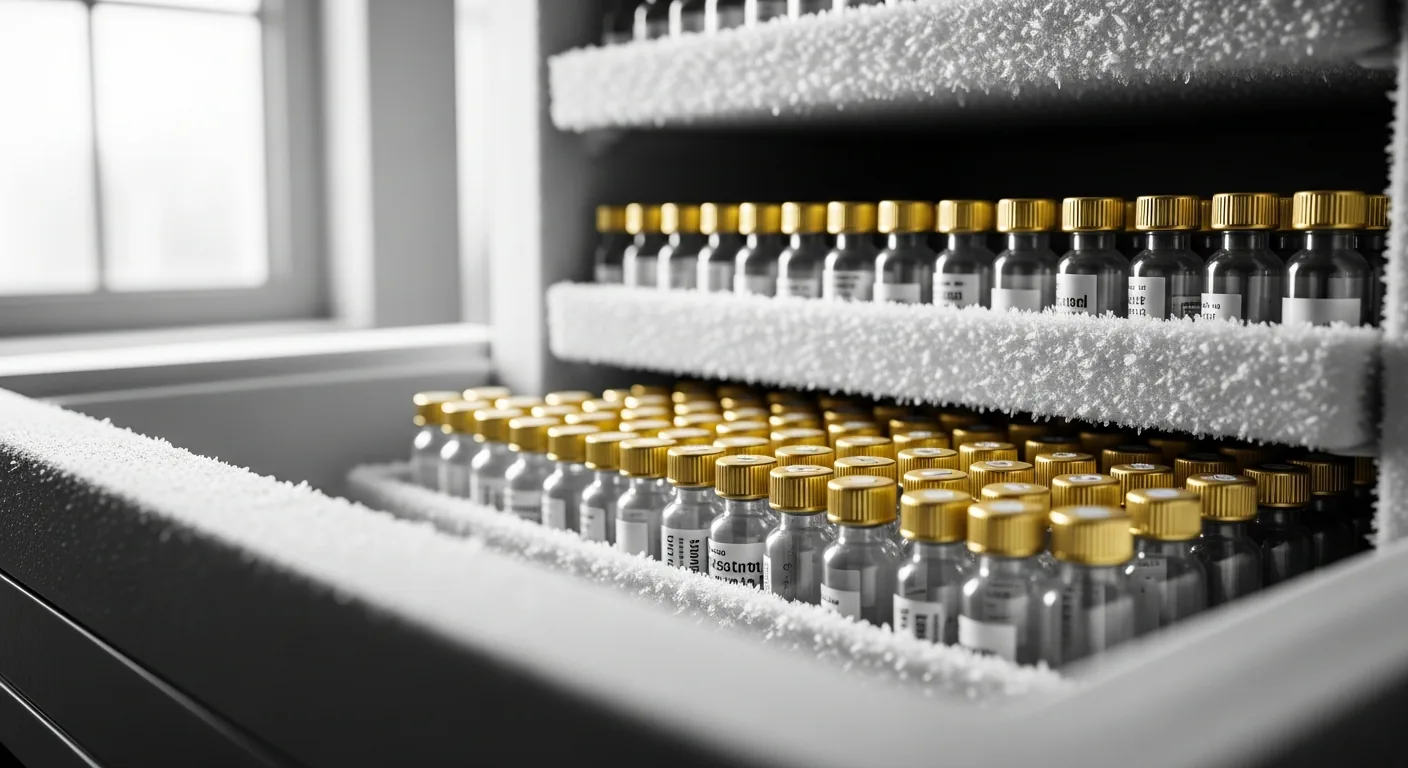
Proper storage of HGH Fragment 176-191 is crucial for maintaining its biological activity and chemical integrity. The lyophilized powder should be stored at -20°C in a dry environment, protected from light and moisture. Under these conditions, the peptide maintains its potency for extended periods, typically 2-3 years when unopened.
- Store lyophilized powder at -20°C
- Protect from light and moisture
- Reconstitute with sterile water or appropriate buffer
- Use reconstituted solution within 72 hours when stored at 4°C
- Avoid repeated freeze-thaw cycles
- Maintain pH between 6.0-7.4 for optimal stability
Once reconstituted, the peptide should be used promptly or stored at 2-8°C for short-term use. For longer storage of reconstituted solutions, division into single-use aliquots and storage at -80°C is recommended. Repeated freeze-thaw cycles should be avoided as they can lead to peptide degradation and loss of biological activity.
Verified Sources on ChemVerify
Researchers seeking high-quality HGH Fragment 176-191 for laboratory studies can find verified vendors and third-party tested batches on ChemVerify at /product/hgh-fragment-176-191. Our platform provides comprehensive vendor verification, batch testing results, and quality assurance data to ensure researchers receive authentic, high-purity peptides for their investigations.
Each listing includes detailed analytical data, purity certificates, and vendor compliance information. ChemVerify's verification process ensures that all listed suppliers maintain appropriate storage conditions, provide accurate product specifications, and follow proper handling procedures for research peptides.
All HGH Fragment 176-191 products listed on ChemVerify undergo rigorous verification processes and include third-party testing certificates to ensure research quality and authenticity.
Frequently Asked Questions
<strong>What is the difference between HGH Fragment 176-191 and full-length growth hormone?</strong>
HGH Fragment 176-191 contains only the C-terminal portion of human growth hormone responsible for lipolytic activity. Unlike full-length hGH, this fragment does not affect blood glucose levels or promote general growth effects, making it more specific for fat metabolism research applications.
<strong>How should HGH Fragment 176-191 be reconstituted for research use?</strong>
The lyophilized peptide should be reconstituted with sterile water or appropriate buffer solution. Add the solvent slowly along the vial wall to avoid foaming, and gently swirl until completely dissolved. Avoid vigorous shaking which may damage the peptide structure.
<strong>What is the optimal pH for HGH Fragment 176-191 stability?</strong>
Research indicates that HGH Fragment 176-191 demonstrates optimal stability at pH levels between 6.0 and 7.4. Solutions outside this range may experience reduced stability and potential degradation over time.
<strong>How long does reconstituted HGH Fragment 176-191 remain stable?</strong>
Reconstituted solutions should be used within 72 hours when stored at 2-8°C. For longer storage, aliquoting and freezing at -80°C is recommended, though immediate use after reconstitution provides optimal results for research applications.
<strong>What analytical methods are used to verify HGH Fragment 176-191 purity?</strong>
Standard analytical methods include HPLC for purity assessment, mass spectrometry for molecular weight confirmation, and amino acid analysis for sequence verification. These methods ensure the peptide meets research-grade specifications of ≥98% purity.
<strong>Is HGH Fragment 176-191 suitable for long-term research studies?</strong>
Yes, the fragment's stability profile makes it suitable for extended research protocols. However, researchers should consider the 30-minute plasma half-life when designing experimental timelines and may need to adjust study parameters accordingly for optimal results.
Frequently Asked Questions
Further Reading on ChemVerify
- Read more: Hexarelin: Complete Research Guide & Chemical Profile → https://www.chemverify.com/learn/hexarelin-research-guide-chemical-profile
- Read more: How Fast Do Peptides Work? Expected Timelines for BPC-157, Semaglutide, Ipamorelin & More → https://www.chemverify.com/learn/how-fast-do-peptides-work-timelines
- Read more: Retatrutide: Complete Research Guide & Chemical Profile → https://www.chemverify.com/learn/retatrutide-research-guide-chemical-profile
- Read more: Tirzepatide: Complete Research Guide & Chemical Profile → https://www.chemverify.com/learn/tirzepatide
References
Compare Verified Vendors
Browse COA-verified suppliers with exclusive discount codes and transparent pricing.
You Might Also Like
Continue Reading
Hexarelin: Complete Research Guide & Chemical Profile
Comprehensive research guide to Hexarelin (Examorelin), a synthetic hexapeptide GHSR-1a agonist. Covers molecular weight 887.04 Da, sequence, GH release mechanisms, and cardiac research.
HGH Fragment 176-191 at BioLab Shop: Price, Purity & Verification
HGH Fragment 176-191 from BioLab Shop – EUR 31.99/5mg, COA verified.
How Fast Do Peptides Work? Expected Timelines for BPC-157, Semaglutide, Ipamorelin & More
Peptide onset varies widely: recovery peptides like BPC-157 show effects within 1-2 weeks, while body composition agents require 8-12 weeks. Explore evidence-based timelines by category.
Retatrutide: Complete Research Guide & Chemical Profile
Comprehensive chemical profile of retatrutide (LY3437943), the first-in-class triple GLP-1/GIP/glucagon receptor agonist. Covers molecular structure, mechanism, TRIUMPH trials, and purity testing.