
Certificate of Analysis Peptides: Complete Guide for Research Quality
Learn how to read and verify certificate of analysis peptides for research. Essential guide covering COA components, quality standards, and verification methods.
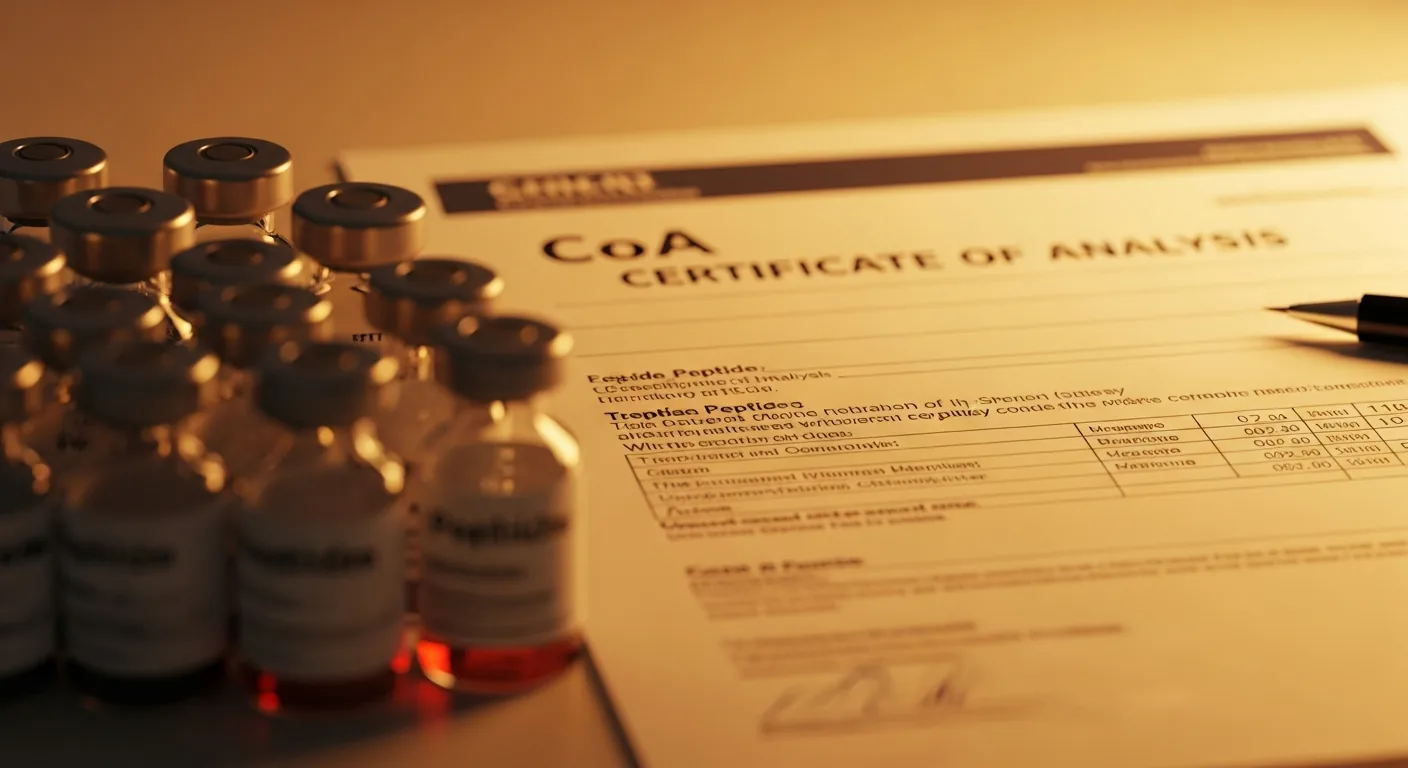
A certificate of analysis peptides serves as the cornerstone of research quality assurance, providing critical verification that peptide compounds meet specified purity and identity standards. For researchers working with peptides like BPC-157, TB-500, or Semaglutide, understanding how to properly evaluate these documents is essential for ensuring experimental validity and safety protocols.
TL;DR: A Certificate of Analysis (CoA) is the primary quality document for research peptides. It should include HPLC purity data, mass spectrometry confirmation, amino acid analysis, and batch-specific details. Learn to read, interpret, and cross-verify CoA data to ensure your research materials meet analytical standards.
Last verified: March 2026 | Data accuracy confirmed by ChemVerify Editorial Team
Certificate of analysis documents contain comprehensive analytical data that validates peptide quality, composition, and safety parameters. This documentation is particularly crucial when working with research peptides, as even minor impurities can significantly impact experimental outcomes and reproducibility.
What is a Certificate of Analysis for Peptides?
A certificate of analysis (COA) for peptides is a comprehensive quality control document that provides detailed analytical testing results for a specific peptide batch. This document serves as proof that the peptide has been tested and meets predetermined quality specifications before distribution to researchers.
The COA functions as a quality passport, containing critical information about peptide purity, identity confirmation, contaminant levels, and storage recommendations. Professional suppliers generate these documents through rigorous third-party analytical testing using advanced instrumentation and validated methodologies.
Every legitimate research peptide should come with a corresponding COA. If a supplier cannot provide this documentation, it raises serious questions about product quality and testing protocols.
Key Components of a Peptide COA
Professional certificate of analysis peptides documents contain several critical sections that researchers must understand to properly evaluate product quality. Each component provides specific insights into different aspects of peptide characteristics and purity levels.
- Product identification information including peptide name, sequence, and batch number
- Purity percentage determined through HPLC analysis
- Mass spectrometry data confirming molecular weight and identity
- Water content analysis and residual solvent testing
- Endotoxin levels for peptides intended for biological applications
- Storage conditions and expiration dating information
- Testing laboratory accreditation and analyst signatures
Purity Analysis Methods
High-performance liquid chromatography (HPLC) represents the gold standard for peptide purity determination in certificate of analysis documents. This analytical technique separates the target peptide from impurities, providing quantitative purity measurements typically expressed as percentages.
Research-grade peptides should demonstrate purity levels of 95% or higher through HPLC analysis. The chromatogram included in the COA shows peak separation and integration results, allowing researchers to evaluate the quality of the separation and identify potential impurities.
Identity Verification Tests
Mass spectrometry analysis confirms peptide identity by measuring exact molecular weight and fragmentation patterns. The COA should include both expected and observed molecular weights, with acceptable variance typically within 0.1% for research applications.
Additional identity confirmation may include amino acid analysis, which verifies the peptide sequence composition. This testing is particularly important for complex peptides like Tirzepatide or Tesamorelin, where sequence accuracy directly impacts biological activity.
How to Read and Interpret a Peptide COA
Reading certificate of analysis peptides documents requires systematic evaluation of each analytical section. Start by verifying that the product information matches your order specifications, including peptide name, sequence, and batch identification numbers.
Next, examine the testing dates to ensure analyses were performed recently and within acceptable timeframes. COA documents should include testing dates within 30 days of shipment for optimal reliability and accuracy.
- Verify product identification matches order specifications exactly
- Check that purity percentages meet your research requirements (typically ≥95%)
- Confirm molecular weight matches theoretical calculations within acceptable limits
- Review chromatogram data for peak shape and separation quality
- Validate testing laboratory credentials and accreditation status
- Ensure all required tests for your application are included
Understanding HPLC Chromatogram Data
The HPLC chromatogram section of certificate of analysis peptides provides visual representation of purity analysis results. The main peptide peak should be sharp, symmetric, and well-separated from impurity peaks, indicating effective purification and analysis.
Peak area integration determines purity percentages, with the target peptide typically representing the largest peak in the chromatogram. Smaller peaks indicate impurities, which should be minimal and well-characterized in high-quality preparations.
Mass Spectrometry Results Interpretation
Mass spectrometry data in the COA confirms peptide identity through precise molecular weight measurement. The observed mass should match theoretical calculations within instrument precision limits, typically ±0.5 Da for most analytical systems.
For peptides like Ipamorelin or CJC-1295, multiple charge states may appear in the mass spectrum, which is normal for longer peptide sequences. The COA should clearly identify the expected charge states and corresponding mass-to-charge ratios.
Quality Standards and Benchmarks
Professional certificate of analysis peptides should meet or exceed established quality benchmarks for research applications. These standards ensure consistency, reliability, and safety in experimental protocols across different research environments.
- Purity: ≥95% by HPLC analysis for research-grade applications
- Water content: <10% by Karl Fischer analysis
- Endotoxin levels: <10 EU/mg for cell culture applications
- Heavy metals: <10 ppm total heavy metal content
- Residual solvents: Within ICH guidelines for pharmaceutical applications
- Peptide content: 70-85% by amino acid analysis accounting for counterions
Research peptides like BPC-157 or TB-500 may have specific quality requirements based on their intended applications. Always verify that COA specifications align with your experimental needs.
Red Flags and Warning Signs in COAs
Identifying problematic certificate of analysis peptides documents is crucial for avoiding inferior products that could compromise research outcomes. Several warning signs indicate potential quality issues or fraudulent documentation that researchers should recognize immediately.
- Missing or incomplete testing data, particularly HPLC and mass spectrometry results
- Unrealistic purity claims (>99%) without supporting high-resolution analytical data
- Generic COAs that don't specify batch numbers or testing dates
- Poor quality chromatograms with baseline noise or poorly resolved peaks
- Missing laboratory accreditation information or analyst signatures
- Inconsistent molecular weight data or significant variance from theoretical values
- Absence of water content or residual solvent analysis
Be especially cautious of COAs that lack specific batch identification or use generic templates. Legitimate analytical testing produces unique results for each peptide batch.
Best Practices for COA Verification
Implementing systematic verification procedures for certificate of analysis peptides ensures consistent quality control across your research programs. These practices help maintain experimental integrity and reproducibility while minimizing risks associated with substandard materials.
Establish verification protocols before peptide procurement, including specific quality criteria and acceptance thresholds. Document your evaluation process and maintain records for regulatory compliance and quality assurance purposes.
- Cross-reference COA data with theoretical peptide properties and literature values
- Verify testing laboratory credentials and accreditation status independently
- Compare analytical methods with industry standards and best practices
- Validate batch numbers and testing dates against shipping documentation
- Request additional testing if COA data raises quality concerns
- Maintain COA archives for traceability and regulatory compliance
For critical applications involving peptides like Semaglutide or Oxytocin, consider requesting additional analytical testing or split-sample analysis through independent laboratories to verify COA accuracy and reliability.
Storage and Documentation Requirements
Proper storage and documentation of certificate of analysis peptides documents supports research integrity and regulatory compliance. These records serve as essential quality documentation for experimental validation and potential publication requirements.
Organize COA files systematically by peptide type, batch number, and receipt date to facilitate easy retrieval and cross-referencing. Digital storage systems should include backup procedures and access controls to prevent data loss or unauthorized modifications.
- Store COA documents in secure, accessible digital format with backup systems
- Link COA records to experimental protocols and data collection systems
- Maintain chain of custody documentation from receipt through disposal
- Archive COAs for minimum of 5 years or per institutional requirements
- Include COA information in research publications and regulatory submissions
- Implement periodic review procedures for expired or questionable materials
Many research institutions require COA documentation for peptide purchases and usage tracking. Establish clear procedures that align with your institutional policies and regulatory requirements.
Understanding certificate of analysis peptides documentation is fundamental to maintaining research quality and experimental reproducibility. These documents provide critical quality assurance information that enables researchers to make informed decisions about peptide selection and usage protocols. By implementing systematic COA evaluation procedures, researchers can ensure optimal experimental outcomes while maintaining the highest standards of scientific rigor.
Frequently Asked Questions
What should a legitimate peptide CoA include?
A complete CoA should contain: peptide name and sequence, batch/lot number, HPLC chromatogram with purity percentage, mass spectrometry data confirming molecular weight, appearance and solubility information, storage conditions, and the date of analysis.
How do I verify a CoA is authentic?
Cross-reference the batch number with the vendor, check that the molecular weight matches the known value for the peptide sequence, verify HPLC retention times are reasonable, and look for consistent formatting. Third-party verification services can independently confirm analytical results.
What purity level should researchers look for?
Research-grade peptides typically require ≥95% HPLC purity. For sensitive assays like receptor binding studies, ≥98% may be necessary. The acceptable threshold depends on your specific experimental requirements and tolerance for impurities.
Can a CoA be fabricated?
Unfortunately, yes. Red flags include generic templates without batch-specific data, missing or blurred chromatograms, purity values always showing exactly 99%, and CoAs that cannot be verified through the vendor. Independent third-party testing is the strongest safeguard against fraudulent documentation.
Compounds Referenced in This Article
Explore detailed chemical profiles and research guides for compounds discussed in this article:
- BPC-157: Complete Research Guide → /learn/bpc-157
- CJC-1295: Complete Research Guide → /learn/cjc-1295-no-dac
- Ipamorelin: Complete Research Guide → /learn/ipamorelin
- Oxytocin: Complete Research Guide → /learn/oxytocin
- Semaglutide: Complete Research Guide → /learn/semaglutide
- TB-500: Complete Research Guide → /learn/tb-500
- Tesamorelin: Complete Research Guide → /learn/tesamorelin
- Tirzepatide: Complete Research Guide → /learn/tirzepatide
Further Reading on ChemVerify
- Read more: AI-Guided High-Throughput Screening Accelerates Antimicrobial Peptide-Mimicking Polymer Discovery → https://www.chemverify.com/learn/ai-guided-antimicrobial-peptide-polymer-discovery
- Read more: Re-Engineering Insulin for Oral Delivery: Structural Modifications and Formulation Advances → https://www.chemverify.com/learn/insulin-oral-delivery-peptide-engineering
- Read more: Cyclic Lipopeptides: Biosurfactant Peptides as Next-Generation Drug Delivery Modulators → https://www.chemverify.com/learn/cyclic-lipopeptides-drug-delivery-modulators
- Read more: Microneedle-Delivered Peptide Decoy Receptors Show Promise in Psoriasis Treatment → https://www.chemverify.com/learn/microneedle-peptide-decoy-receptors-psoriasis
- Read more: GLP-1 Receptor Agonists Demonstrate Cardiorenal Protection in Chronic Kidney Disease: Meta-Analysis → https://www.chemverify.com/learn/glp1-receptor-agonists-cardiorenal-protection-ckd
References
Compare Verified Vendors
Browse COA-verified suppliers with exclusive discount codes and transparent pricing.
You Might Also Like
Continue Reading
What Is a Peptide? A Clear, Scientific Explanation
A foundational explanation of peptide chemistry covering amino acid building blocks, peptide bond formation, size-based classification, naturally occurring examples, and modern solid-phase synthesis techniques.
AI-Guided High-Throughput Screening Accelerates Antimicrobial Peptide-Mimicking Polymer Discovery
Researchers at Zhejiang University combined machine learning with automated high-throughput synthesis to efficiently discover antimicrobial polymers that mimic the action of natural antimicrobial peptides, screening over 13,000 candidates to find top performers.
Re-Engineering Insulin for Oral Delivery: Structural Modifications and Formulation Advances
A comprehensive 2026 review examines cutting-edge strategies to overcome the challenges of oral insulin delivery, including PEGylation, lipidation, cyclization, and nanocarrier technologies that enhance peptide stability and bioavailability.
Cyclic Lipopeptides: Biosurfactant Peptides as Next-Generation Drug Delivery Modulators
A 2026 review explores how cyclic lipopeptides – peptide-based biosurfactants produced via microbial fermentation – serve dual roles as both structural building blocks and bioactive compounds in advanced nanocarrier delivery systems.