
GHRP-6: Complete Research Guide & Chemical Profile
Comprehensive chemical profile of GHRP-6 (Growth Hormone Releasing Peptide-6), a synthetic hexapeptide ghrelin mimetic. Covers His-D-Trp-Ala-Trp-D-Phe-Lys sequence, GHSR-1a mechanism, and purity testing.
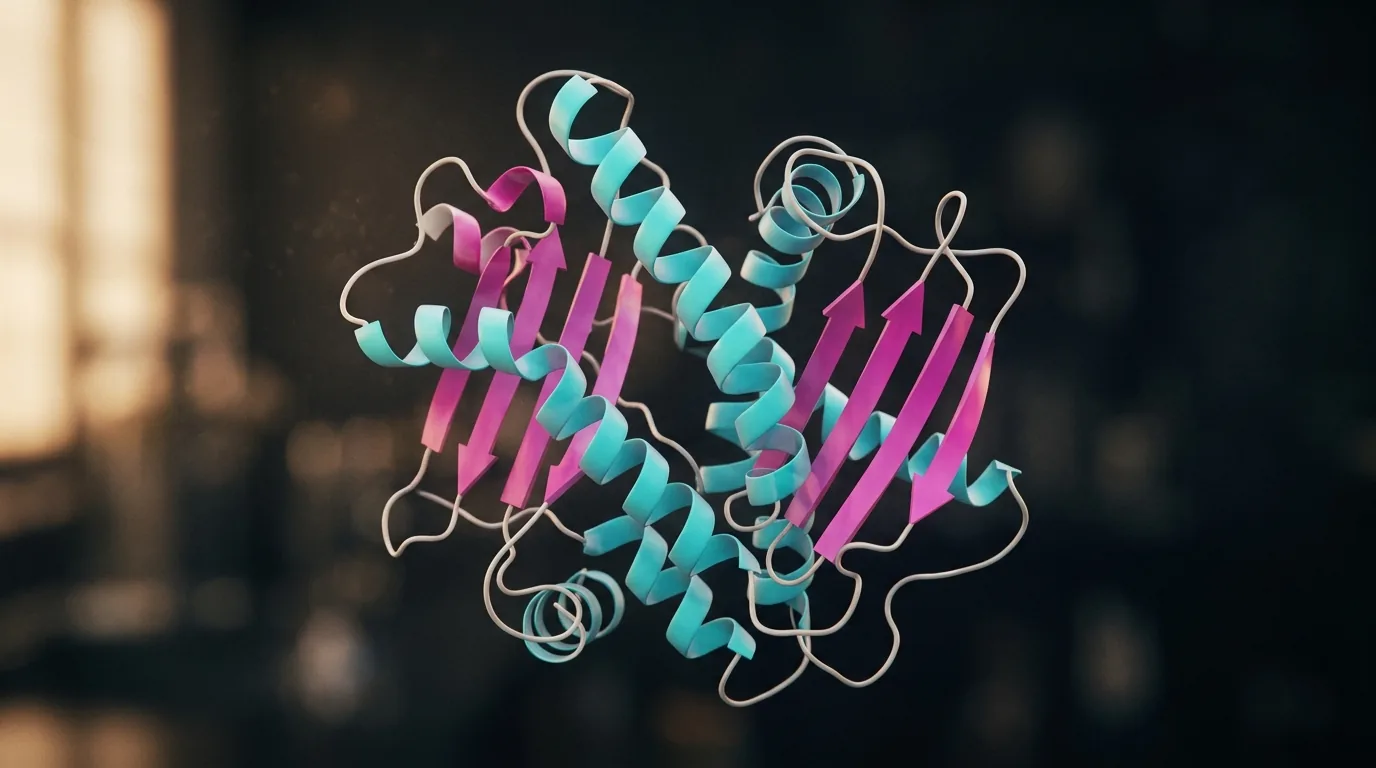
For laboratory research use only. Not for human consumption.
Last verified: April 2026 | Data accuracy confirmed by ChemVerify Editorial Team
Chemical Identity & Classification
GHRP-6 (Growth Hormone Releasing Peptide-6) is a synthetic hexapeptide growth hormone secretagogue that stimulates growth hormone (GH) release through activation of the growth hormone secretagogue receptor type 1a (GHS-R1a, also known as the ghrelin receptor). First characterized by Cyril Y. Bowers in 1984, GHRP-6 was the first synthetic peptide demonstrated to specifically and dose-dependently release GH both in vitro and in vivo through a mechanism entirely distinct from growth hormone releasing hormone (GHRH).
- Common Name: GHRP-6 (Growth Hormone Releasing Peptide-6)
- CAS Registry Number: 87616-84-0
- Molecular Formula: C₄₆H₅₆N₁₂O₆
- Molecular Weight: 873.01 Da
- Amino Acid Sequence: His-D-Trp-Ala-Trp-D-Phe-Lys-NH₂
- Peptide Length: 6 amino acid residues (hexapeptide)
- Classification: Synthetic growth hormone secretagogue, ghrelin receptor (GHS-R1a) agonist
- Origin: Met-enkephalin analogue series, structure-activity optimization
Molecular Structure & Amino Acid Sequence
GHRP-6 is a linear hexapeptide with the sequence His-D-Trp-Ala-Trp-D-Phe-Lys-NH₂. The molecule incorporates two D-amino acids (D-tryptophan at position 2 and D-phenylalanine at position 5), which are critical for both biological activity and proteolytic resistance. The C-terminus is amidated (-NH₂), which enhances metabolic stability and receptor binding affinity compared to the free acid form.
The D-amino acid substitutions are a hallmark of the GHRP class. These unnatural stereoisomers were introduced during structure-activity relationship (SAR) optimization of the original met-enkephalin scaffold. While the parent enkephalin sequence has opioid receptor activity, the specific D-amino acid substitutions in GHRP-6 abolished opioid activity entirely and introduced potent growth hormone-releasing activity through the ghrelin receptor – a completely different receptor system.
- Position 1 – His (L-Histidine): Imidazole side chain contributes to receptor binding through hydrogen bonding
- Position 2 – D-Trp (D-Tryptophan): Critical D-amino acid; the indole ring system is essential for GHSR-1a binding. L-Trp substitution abolishes GH-releasing activity
- Position 3 – Ala (L-Alanine): Small, hydrophobic spacer residue
- Position 4 – Trp (L-Tryptophan): Second tryptophan residue; contributes to the aromatic pharmacophore required for receptor activation
- Position 5 – D-Phe (D-Phenylalanine): Critical D-amino acid; phenyl ring engages the hydrophobic binding pocket of GHSR-1a
- Position 6 – Lys (L-Lysine): Positively charged epsilon-amino group; contributes to receptor binding through electrostatic interactions. C-terminal amidation (-NH₂) is essential for full potency
Mechanism of Action
GHRP-6 stimulates growth hormone release through activation of the growth hormone secretagogue receptor type 1a (GHS-R1a), a G-protein-coupled receptor primarily expressed in the anterior pituitary somatotrophs and the hypothalamic arcuate nucleus. The GHS-R1a receptor is the same receptor that binds the endogenous ligand ghrelin (discovered in 1999, fifteen years after GHRP-6 was first characterized).
Upon binding GHS-R1a, GHRP-6 activates the Gq/11 signaling pathway, leading to phospholipase C (PLC) activation, inositol trisphosphate (IP₃) generation, and intracellular calcium release from the endoplasmic reticulum. The resulting calcium elevation triggers GH vesicle exocytosis from somatotrophs. This mechanism is entirely independent of the GHRH/Gs/cAMP pathway, which is why GHRP-6 and GHRH produce synergistic (rather than additive) GH release when co-administered.
- Primary Target: GHS-R1a (ghrelin receptor) – Gq/11-coupled GPCR
- Signaling: PLC → IP₃ → Ca²⁺ release → GH vesicle exocytosis
- Synergy with GHRH: GHRP-6 (Gq/Ca²⁺) + GHRH (Gs/cAMP) activate independent pathways, producing synergistic GH release
- Secondary Effects: Stimulates appetite (via hypothalamic GHSR-1a), increases cortisol and prolactin secretion (at higher concentrations), modulates gastric motility
GHSR-1a Receptor Pharmacology
GHRP-6 is a potent but non-selective growth hormone secretagogue. While its primary target is the GHS-R1a receptor, it also stimulates the release of ACTH, cortisol, and prolactin at pharmacologically relevant concentrations. This multi-hormone stimulation profile distinguishes GHRP-6 from more selective secretagogues such as ipamorelin, which activates GH release with minimal effects on ACTH or cortisol.
The GHS-R1a receptor exhibits high constitutive activity – it signals at approximately 50% of maximal even without ligand binding. GHRP-6 acts as a full agonist, driving receptor signaling beyond the constitutive baseline. The receptor is expressed in multiple tissues beyond the pituitary, including the hypothalamus (appetite regulation), hippocampus (neuroprotection), myocardium (cardioprotection), and liver (metabolic regulation), providing the basis for diverse research applications.
Research Applications
GHRP-6 has been a foundational research tool in growth hormone biology since the 1980s and continues to be actively investigated. Key research areas include:
- GH Axis Physiology: Investigating the pulsatile GH secretion pattern and the interplay between GHRH, somatostatin, and ghrelin/GHRP signaling in the hypothalamic-pituitary axis.
- Ghrelin Receptor Biology: GHRP-6 predates the discovery of ghrelin (1999) and remains a key tool compound for studying GHS-R1a receptor pharmacology, constitutive activity, and signaling bias.
- Cytoprotection Research: In preclinical models, GHRP-6 has demonstrated significant cytoprotective effects. In CCl₄-induced liver fibrosis models, GHRP-6 reduced fibrotic tissue accumulation by more than 75% and decreased cirrhotic nodules by up to 60%.
- Appetite and Energy Balance: Studying GHRP-6-induced appetite stimulation through hypothalamic GHS-R1a activation – a property shared with endogenous ghrelin but absent in more selective secretagogues like ipamorelin.
- Cardioprotection: Investigating GHRP-6-mediated cardioprotective effects in ischemia-reperfusion models through myocardial GHS-R1a activation.
- Wound Healing: Exploring the effects of GH-axis stimulation on tissue repair, collagen synthesis, and angiogenesis in preclinical wound models.
Pharmacokinetic Properties
As a small hexapeptide without lipid modification or PEGylation, GHRP-6 has a rapid pharmacokinetic profile characterized by fast absorption, short half-life, and rapid clearance. This short-acting profile makes it suitable for studying acute GH pulse dynamics but limits its utility for sustained GH elevation.
- Half-life: Approximately 15-30 minutes (rapid clearance)
- Onset of Action: GH elevation detectable within 5-15 minutes after subcutaneous or intravenous administration
- Peak GH Response: 15-60 minutes post-administration
- Duration of GH Elevation: Approximately 3-4 hours before return to baseline
- Metabolism: Rapid proteolytic degradation by serum and tissue peptidases
- Bioavailability: Subcutaneous bioavailability approximately 40-60%; oral bioavailability negligible due to gastrointestinal proteolysis
Comparative Profile: GHRP-6 vs. Related Secretagogues
GHRP-6 belongs to the classical hexapeptide growth hormone secretagogue family. Understanding its position relative to other GHRPs is essential for selecting the appropriate tool compound for specific research applications.
- GHRP-6 vs. GHRP-2: GHRP-2 (pralmorelin) is more potent per unit dose and shows somewhat less appetite stimulation. GHRP-2 has D-2-Nal (D-2-naphthylalanine) at position 2 instead of D-Trp, conferring enhanced receptor binding. GHRP-6 produces stronger appetite stimulation via hypothalamic GHSR-1a.
- GHRP-6 vs. Hexarelin: Hexarelin is the most potent hexapeptide GHRP but also stimulates ACTH, cortisol, and prolactin more than GHRP-6. GHRP-6 occupies an intermediate position in terms of selectivity.
- GHRP-6 vs. Ipamorelin: Ipamorelin is the most GH-selective secretagogue with minimal ACTH/cortisol stimulation. GHRP-6 is less selective but more potent for studying multi-hormone release patterns from the pituitary.
- GHRP-6 vs. MK-677 (Ibutamoren): MK-677 is an orally active non-peptide GHS-R1a agonist with a much longer half-life (~6 hours). GHRP-6 is peptide-based, requires injection, and has a short half-life (~20 min).
Storage & Handling Guidelines
GHRP-6 is a relatively small, stable peptide, but proper storage remains essential for maintaining chemical integrity and biological activity in research settings.
- Lyophilized Powder: Store at -20°C. Stable for 36+ months when kept dry and sealed. Can tolerate short-term storage at 2-8°C (weeks) without significant degradation.
- Reconstituted Solution: Store at 2-8°C. Use within 21-28 days when reconstituted in bacteriostatic water. In sterile water, use within 7-14 days.
- Reconstitution Vehicle: Bacteriostatic water (0.9% benzyl alcohol) preferred for multi-use. Sterile water for single-use preparations.
- Light Sensitivity: Moderate – the two tryptophan residues are susceptible to photo-oxidation. Store in amber vials.
- pH Stability: Stable across pH 3.0-7.0. Optimal stability at pH 4.5-5.5.
- Avoid Repeated Freeze-Thaw: Aliquot reconstituted solutions into single-use volumes. Each freeze-thaw cycle increases the risk of oxidation and aggregation.
Purity Verification Methods
GHRP-6 is a well-characterized hexapeptide that is straightforward to analyze using standard peptide analytical techniques. Its small size (6 residues, 873 Da) allows for complete characterization with routine methods.
- RP-HPLC (C18 Column): Standard C18 column with 100-120 Å pore size. GHRP-6 is small enough for standard small-pore columns. Gradient: 10-60% acetonitrile/water with 0.1% TFA over 20 minutes. UV detection at 220 nm and 280 nm (Trp absorbance). Purity threshold: ≥95%.
- Mass Spectrometry: ESI-MS or MALDI-TOF to confirm molecular weight of 873.01 Da. Expected [M+H]⁺ = 874.02. The molecular weight is diagnostic and should match within ±0.5 Da on standard instruments.
- Amino Acid Analysis: Verify amino acid composition – should show His:Trp:Ala:Phe:Lys in a 1:2:1:1:1 ratio. Note that D-amino acids co-elute with L-forms in standard AAA; chiral amino acid analysis is needed to confirm D-Trp and D-Phe.
- Chiral Analysis: Marfey's method or chiral HPLC to confirm D-Trp at position 2 and D-Phe at position 5. Enantiomeric impurities (L-Trp, L-Phe substitution) would reduce biological activity.
- Sequence Confirmation: MS/MS fragmentation (CID) of the intact hexapeptide provides a complete b- and y-ion series for sequence verification.
- CoA Verification: Supplier CoA should include HPLC chromatogram, MS spectrum, net peptide content, and appearance description.
Current Research Status
GHRP-6 is not approved for any therapeutic indication and is classified as a research compound. It remains one of the most widely cited growth hormone secretagogues in the scientific literature, with a research history spanning over four decades. The peptide was instrumental in the identification and characterization of the GHS-R1a receptor (Howard et al., 1996) and the subsequent discovery of ghrelin (Kojima et al., 1999) as the endogenous GHS-R1a ligand.
Current research continues to explore GHRP-6's cytoprotective properties, particularly in liver fibrosis models, where preclinical results have demonstrated significant anti-fibrotic effects through mechanisms involving reduction of pro-fibrotic gene expression and induction of anti-fibrotic factors. GHRP-6 also remains a standard reference compound in GH secretagogue pharmacology studies and is used as a comparator in the development of next-generation ghrelin receptor agonists.
For laboratory research use only. Not for human consumption. All information presented is for scientific reference and does not constitute medical advice.
Further Reading on ChemVerify
- Read more: Peptide Cycling: How Long to Research and When to Pause → https://www.chemverify.com/learn/peptide-cycling-research-duration-pause
- Read more: Tesamorelin: Complete Research Guide & Chemical Profile → https://www.chemverify.com/learn/tesamorelin
- Read more: Growth Hormone Secretagogues Explained: How Ipamorelin, CJC-1295 and GHRP-6 Work → https://www.chemverify.com/learn/growth-hormone-secretagogues-explained-ipamorelin-cjc1295
- Read more: Ipamorelin: Complete Research Guide & Chemical Profile → https://www.chemverify.com/learn/ipamorelin
References
Compare Verified Vendors
Browse COA-verified suppliers with exclusive discount codes and transparent pricing.
You Might Also Like
Continue Reading
Peptide Cycling: How Long to Research and When to Pause
Understand peptide cycling protocols in research. Covers receptor desensitization, typical cycle lengths by peptide category, on/off schedules from literature, and biomarker monitoring.
Growth Hormone Secretagogues Explained: How Ipamorelin, CJC-1295 and GHRP-6 Work
A detailed biochemical explanation of growth hormone secretagogues including ipamorelin, CJC-1295, and GHRP-6 – covering GHSR and GHRH receptor mechanisms, pulsatile GH release, selectivity profiles, and synergistic stacking.
Tesamorelin: Complete Research Guide & Chemical Profile
Comprehensive guide to Tesamorelin peptide research: chemical properties, mechanism of action, and laboratory applications. Find verified sources for research.
Ipamorelin: Complete Research Guide & Chemical Profile
Comprehensive guide to Ipamorelin (NNC 26-0161), a selective growth hormone secretagogue. Explore its chemical properties, research applications, and mechanism of action.