
Tesamorelin: Complete Research Guide & Chemical Profile
Comprehensive guide to Tesamorelin peptide research: chemical properties, mechanism of action, and laboratory applications. Find verified sources for research.
For laboratory research use only. Not for human consumption. This article is intended for educational purposes and does not constitute medical advice.
TL;DR: Tesamorelin is a 44-amino-acid synthetic GHRH analog (MW ~5135.83 Da) consisting of human GHRH(1-44) with a trans-3-hexenoic acid modification at the N-terminus. Research-grade tesamorelin requires ≥95% HPLC purity with MALDI-TOF mass confirmation. The hexenoic acid cap enhances metabolic stability versus native GHRH. Compare verified tesamorelin pricing across vendors at chemverify.com.
Last verified: March 2026 | Data accuracy confirmed by ChemVerify Editorial Team
What Is Tesamorelin?
Tesamorelin is a synthetic analog of growth hormone-releasing hormone (GHRH) that has garnered significant attention in laboratory research settings. This peptide compound consists of the first 44 amino acids of human GHRH with a trans-3-hexenoyl group attached to the N-terminal tyrosine residue, enhancing its stability and biological activity.
The molecular structure of Tesamorelin is characterized by its specific amino acid sequence: Trans-3-Hexenoyl-[Tyr1]hGHRF(1-44)NH2. With a molecular weight of 5135.9 g/mol, this peptide represents a sophisticated modification of the naturally occurring GHRH sequence designed to improve pharmacokinetic properties in research applications.
Also known by its commercial designation Egrifta, Tesamorelin has been extensively studied for its role in growth hormone regulation and metabolic research. The peptide's unique structural modifications distinguish it from other GHRH analogs, making it a valuable tool in endocrinological and metabolic research studies.
Research Background & Key Studies
The development of Tesamorelin emerged from extensive research into growth hormone-releasing hormone analogs and their potential applications in addressing metabolic disorders. Initial studies focused on understanding how synthetic GHRH variants could maintain biological activity while offering improved stability profiles compared to native GHRH.
Pivotal research has demonstrated Tesamorelin's efficacy in laboratory models studying visceral adiposity reduction. Clinical trials have shown that the peptide can significantly reduce visceral adipose tissue in research subjects with HIV-associated lipodystrophy, with studies reporting reductions of up to 15-18% in visceral fat over treatment periods.
Research published in the Journal of Clinical Endocrinology & Metabolism has indicated that Tesamorelin treatment in laboratory settings leads to sustained increases in insulin-like growth factor-1 (IGF-1) levels. These findings have important implications for metabolic research, particularly in understanding the growth hormone axis and its effects on body composition.
Studies have also investigated Tesamorelin's effects on glucose metabolism and insulin sensitivity. Research suggests that the peptide may influence glucose homeostasis through its modulation of growth hormone release, though the precise mechanisms continue to be elucidated in ongoing laboratory investigations.
Mechanism of Action
Tesamorelin exerts its biological effects through selective binding to growth hormone-releasing hormone receptors (GHRH-R) located on somatotroph cells in the anterior pituitary gland. Upon binding, the peptide triggers a cascade of intracellular signaling events that ultimately lead to the synthesis and release of growth hormone.
The trans-3-hexenoyl modification at the N-terminal end of Tesamorelin serves a dual purpose in its mechanism of action. This lipophilic group enhances the peptide's resistance to enzymatic degradation by dipeptidyl peptidase-4 (DPP-4), significantly extending its half-life from minutes to approximately 26-38 minutes in laboratory conditions.
Once growth hormone is released in response to Tesamorelin stimulation, it binds to growth hormone receptors throughout the body, initiating the production of IGF-1 primarily in the liver. This IGF-1 then mediates many of the downstream metabolic effects observed in research studies, including alterations in lipid metabolism and body composition.
Research indicates that Tesamorelin's mechanism involves activation of the cyclic adenosine monophosphate (cAMP) signaling pathway. This activation leads to increased transcription of growth hormone genes and subsequent protein synthesis, demonstrating the peptide's ability to modulate gene expression at the cellular level.
Chemical Properties
The chemical characteristics of Tesamorelin make it particularly suitable for laboratory research applications. Its molecular formula and specific structural modifications contribute to enhanced stability and bioactivity compared to native GHRH sequences.
Storage and Stability
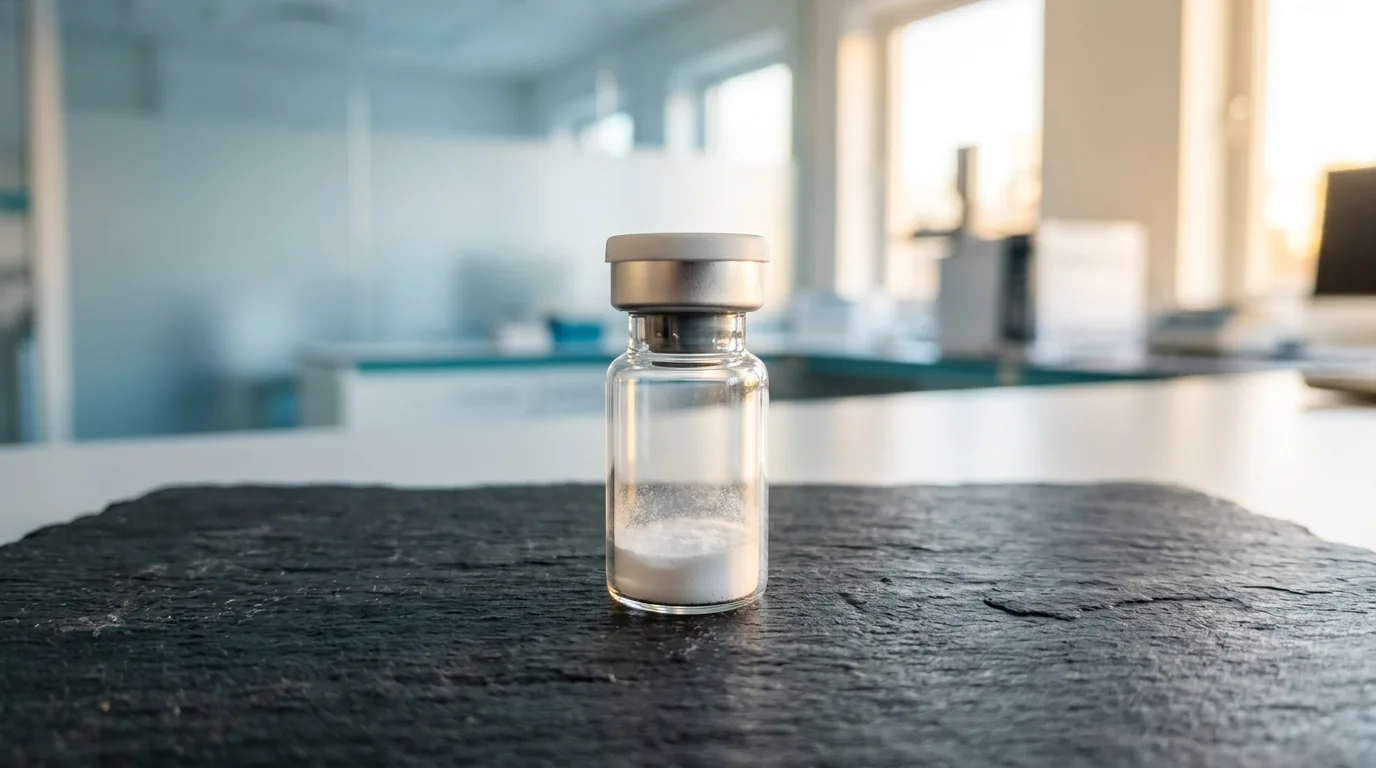
Tesamorelin demonstrates optimal stability when stored as a lyophilized powder at temperatures between 2-8°C. In this form, the peptide maintains its integrity for extended periods, making it suitable for long-term research studies. Once reconstituted, solutions should be used promptly and stored under refrigerated conditions.
The peptide shows sensitivity to extreme pH conditions and should be maintained in neutral to slightly acidic environments for optimal stability. Research protocols typically employ pH ranges between 6.0-7.4 to preserve the peptide's structural integrity during experimental procedures.
Purity Specifications
High-quality Tesamorelin for research applications typically meets purity standards of ≥98.0% as determined by high-performance liquid chromatography (HPLC) analysis. This level of purity ensures consistent results in laboratory studies and minimizes potential interference from impurities.
Quality control measures for research-grade Tesamorelin include mass spectrometry verification, amino acid analysis, and bacterial endotoxin testing. These analytical methods confirm the peptide's identity, purity, and safety for laboratory use.
Verified Sources on ChemVerify
Researchers seeking high-quality Tesamorelin for their studies can find verified vendors and third-party tested batches through ChemVerify's comprehensive database. The platform provides detailed information about peptide purity, analytical certificates, and vendor reliability to ensure research integrity.
ChemVerify's verification process includes independent third-party testing of peptide samples, vendor background checks, and ongoing quality monitoring. This systematic approach helps researchers identify trustworthy sources for Tesamorelin and other research peptides.
Visit /product/tesamorelin on ChemVerify to access the complete database of verified suppliers, view recent analytical reports, and compare pricing from multiple vendors. The platform's user reviews and ratings system provides additional insights into vendor performance and product quality.
Frequently Asked Questions
**What distinguishes Tesamorelin from other GHRH analogs in research applications?**
Tesamorelin's unique trans-3-hexenoyl modification provides enhanced enzymatic stability compared to other GHRH analogs. This modification extends its half-life to 26-38 minutes, making it particularly valuable for sustained research protocols studying growth hormone dynamics.
**How should Tesamorelin be prepared for laboratory experiments?**
Research-grade Tesamorelin typically arrives as a lyophilized powder requiring reconstitution with sterile water or appropriate buffer solutions. Preparation should follow established laboratory protocols, maintaining sterile conditions and appropriate pH ranges for optimal peptide stability.
**What analytical methods are used to verify Tesamorelin purity?**
Standard analytical verification includes HPLC for purity determination, mass spectrometry for molecular weight confirmation, and amino acid analysis for sequence verification. Additional testing may include bacterial endotoxin assays and moisture content analysis.
**What is the typical shelf life of Tesamorelin in research settings?**
When stored properly as a lyophilized powder at 2-8°C, Tesamorelin typically maintains stability for 2-3 years. Once reconstituted, solutions should be used within days and stored under refrigerated conditions to preserve peptide integrity.
**Are there specific handling precautions for Tesamorelin in laboratory environments?**
Standard laboratory safety protocols should be followed when handling Tesamorelin, including use of appropriate personal protective equipment and maintenance of sterile conditions. The peptide should be protected from extreme temperatures and direct light during storage and handling.
**How does Tesamorelin's mechanism differ from direct growth hormone supplementation in research models?**
Unlike direct growth hormone administration, Tesamorelin works through the natural GHRH pathway, stimulating endogenous growth hormone release. This approach may provide more physiological patterns of growth hormone secretion in research models, offering insights into natural regulatory mechanisms.
Frequently Asked Questions
Compounds Referenced in This Article
Explore detailed chemical profiles and research guides for compounds discussed in this article:
- GHRP-6: Complete Research Guide → /learn/ghrp-6-research-guide-chemical-profile
- Ipamorelin: Complete Research Guide → /learn/ipamorelin
Further Reading on ChemVerify
- Read more: RFK Jr. Signals Reversal of Peptide Ban: 14 of 19 Restricted Compounds May Return → https://www.chemverify.com/learn/rfk-jr-signals-reversal-of-peptide-ban-14-of-19-restricted-compounds-may-return
- Read more: Peptide Combinations: Compatibility Research & Evidence Assessment → https://www.chemverify.com/learn/peptide-combinations
- Read more: Complete Peptide Solubility Guide: Solutions for Research Success → https://www.chemverify.com/learn/complete-peptide-solubility-guide-solutions-for-research-success
- Read more: Amino Acid Analysis for Peptides: Complete Guide to Verification Methods → https://www.chemverify.com/learn/amino-acid-analysis-for-peptides-complete-guide-to-verification-methods
- Read more: GMP Peptide Manufacturing: Standards and Quality Control Guidelines → https://www.chemverify.com/learn/gmp-peptide-manufacturing-standards-and-quality-control-guidelines
References
Compare Verified Vendors
Browse COA-verified suppliers with exclusive discount codes and transparent pricing.
You Might Also Like
Continue Reading
Tesamorelin at Helus Lab: Price, Purity & Verification
Tesamorelin from Helus Lab – EUR 34.99/10mg, COA verified.
RFK Jr. Signals Reversal of Peptide Ban: 14 of 19 Restricted Compounds May Return
Health Secretary RFK Jr. announces potential reversal of FDA peptide restrictions, with 14 compounds possibly returning to legal compounding pharmacies within weeks.
Peptide Combinations: Compatibility Research & Evidence Assessment
A critical analysis of peptide combination research, examining the theoretical basis for multi-peptide protocols, pH and storage compatibility considerations, and the significant lack of dedicated combination RCT evidence in the published literature.
Tesamorelin at Licensed Peptides: Price, Purity & Verification
Tesamorelin from Licensed Peptides – USD 144.49/10mg, COA verified.