
Melanotan II vs. PT-141: MSH Analog Structural Comparison
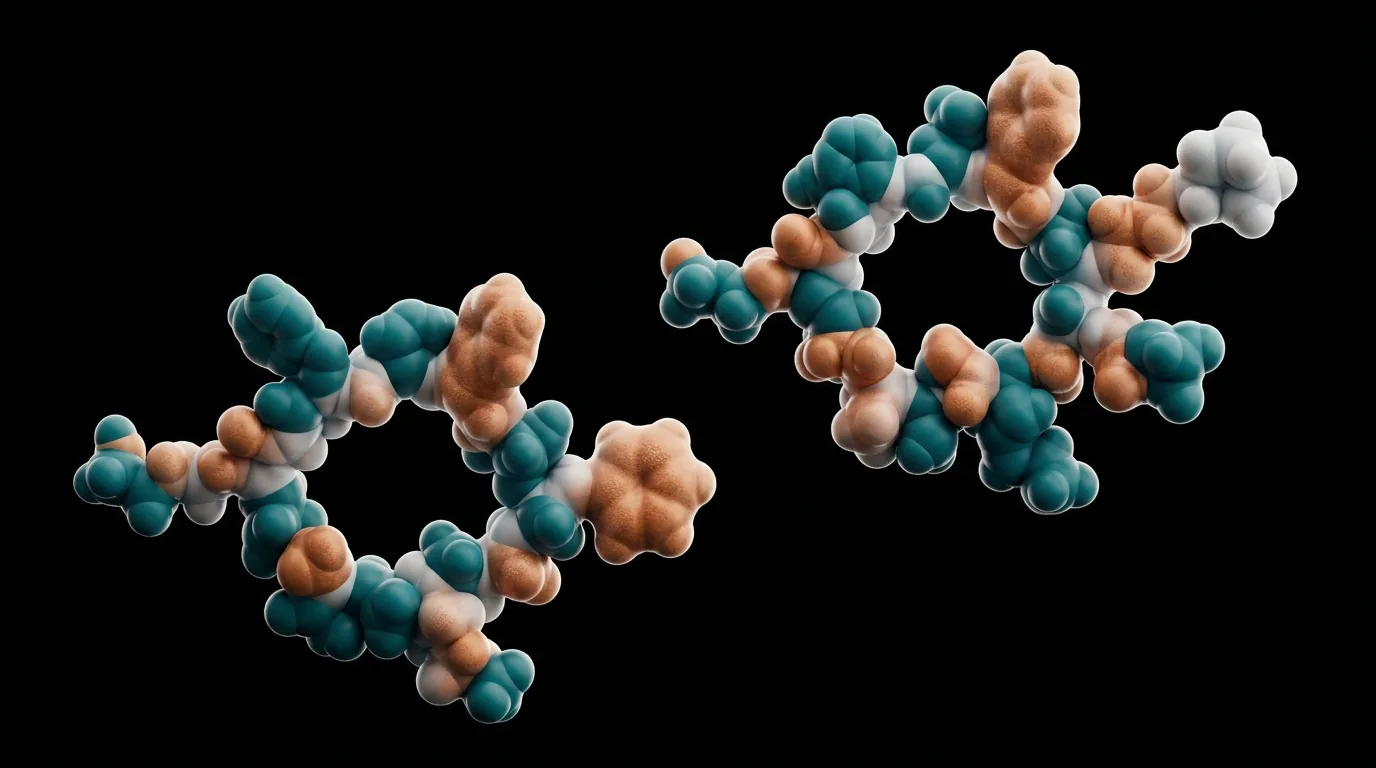
Structural comparison of Melanotan II and PT-141 (bremelanotide) research peptides – cyclic vs linear structure, melanocortin receptor selectivity, molecular weight, and purity analysis.
For laboratory research use only. Not for human consumption.
TL;DR: Melanotan II is a cyclic 7-amino-acid peptide (MW ~1024 Da) that acts as a non-selective melanocortin receptor agonist. PT-141 (Bremelanotide) is a linear 7-amino-acid metabolite of Melanotan II (MW ~1025 Da) with greater MC3R/MC4R selectivity. The key structural difference: Melanotan II is cyclic (lactam bridge), PT-141 is linear with a free N-terminal acid. This affects stability, receptor selectivity, and HPLC behavior.
Last verified: March 2026 | Data accuracy confirmed by ChemVerify Editorial Team
Introduction to Melanotan II and PT-141
Melanotan II (MT-II) and PT-141 (bremelanotide) are both synthetic analogs of alpha-melanocyte-stimulating hormone (alpha-MSH), a 13-amino acid endogenous peptide involved in melanocortin signaling. While structurally related – PT-141 is a metabolite derived from Melanotan II – the two peptides differ fundamentally in their molecular architecture: Melanotan II is a cyclic heptapeptide containing a lactam bridge, while PT-141 is a linear heptapeptide lacking this cyclization.
This article provides a structural and analytical comparison of these two research peptides. It covers amino acid sequences, molecular weight, conformational differences, melanocortin receptor binding profiles, and analytical methods for purity verification. No pharmacological, clinical, or dosage information is included.
Shared Origin: Alpha-MSH Structural Analogs
Both Melanotan II and PT-141 trace their structural lineage to alpha-MSH (Ac-Ser-Tyr-Ser-Met-Glu-His-Phe-Arg-Trp-Gly-Lys-Pro-Val-NH2), a tridecapeptide derived from proopiomelanocortin (POMC). The core pharmacophore of alpha-MSH resides in the central tetrapeptide sequence His-Phe-Arg-Trp (positions 6-9), which is conserved in both Melanotan II and PT-141.
The development pathway proceeded from alpha-MSH to NDP-alpha-MSH (Nle4, D-Phe7 substitutions for increased potency and stability), then to Melanotan II (cyclic, truncated analog), and finally to PT-141 (linear metabolite of MT-II identified via metabolic studies). Understanding this structural evolution is essential for interpreting the physicochemical differences between the two compounds.
Melanotan II: Chemical Structure and Properties
Melanotan II is a cyclic heptapeptide with the sequence Ac-Nle-c[Asp-His-D-Phe-Arg-Trp-Lys]-NH2. The cyclization occurs through a lactam bridge between the side chains of Asp and Lys, forming a 23-membered ring. This constrains the backbone conformation and reduces the entropic penalty of receptor binding.
- Amino acid sequence: Ac-Nle-c[Asp-His-D-Phe-Arg-Trp-Lys]-NH2
- Molecular weight: ~1024.18 Da
- Molecular formula: C50H69N15O9
- Number of amino acids: 7 (with N-terminal acetylation and C-terminal amidation)
- Cyclization: Lactam bridge between Asp (side chain carboxyl) and Lys (side chain amino)
- Ring size: 23-membered macrocyclic lactam
- Key modifications from alpha-MSH: Nle4 replaces Met4 (oxidation resistance), D-Phe7 replaces L-Phe7 (increased potency), truncation to 7 residues, cyclization via Asp-Lys lactam
- Contains D-Phe (non-natural stereochemistry at position 7)
- N-terminal: acetylated; C-terminal: amidated
PT-141 (Bremelanotide): Chemical Structure and Properties
PT-141 (bremelanotide) is a linear heptapeptide with the sequence Ac-Nle-Asp-His-D-Phe-Arg-Trp-Lys-OH. It was identified as a primary metabolite of Melanotan II, formed by hydrolytic cleavage of the lactam bridge between Asp and Lys. The resulting linear peptide retains the same amino acid sequence but lacks the conformational constraint imposed by the macrocyclic ring.
- Amino acid sequence: Ac-Nle-Asp-His-D-Phe-Arg-Trp-Lys-OH
- Molecular weight: ~1025.18 Da (one water molecule heavier due to ring opening)
- Molecular formula: C50H71N15O10
- Number of amino acids: 7 (with N-terminal acetylation, free C-terminal acid)
- Cyclization: None – linear peptide
- Key difference from MT-II: Lactam bridge hydrolyzed; C-terminus is free acid (-OH) rather than amide (-NH2)
- Contains D-Phe (same non-natural stereochemistry as MT-II)
- N-terminal: acetylated; C-terminal: free carboxylic acid
Cyclic vs. Linear: Key Structural Differences
The fundamental structural distinction between Melanotan II and PT-141 is the presence or absence of the intramolecular lactam bridge. This single modification has significant consequences for the three-dimensional structure, conformational flexibility, and physicochemical properties of the two peptides.
- Conformational rigidity: MT-II is conformationally constrained by the 23-membered lactam ring, which pre-organizes the pharmacophore (His-D-Phe-Arg-Trp) into a defined spatial arrangement. PT-141 is conformationally flexible, sampling a broader ensemble of backbone conformations in solution.
- Molecular weight: Despite ring opening adding one water molecule, the MW difference is minimal (~1 Da). MT-II: ~1024.18 Da; PT-141: ~1025.18 Da.
- C-terminal chemistry: MT-II has a C-terminal amide (-CONH2); PT-141 has a C-terminal free acid (-COOH). This affects charge state at physiological pH (PT-141 has one additional negative charge).
- Isoelectric point: MT-II pI is approximately 8.5; PT-141 pI is approximately 7.8 (shifted lower by the free C-terminal carboxylate).
- Hydrodynamic radius: The cyclic structure of MT-II gives it a more compact shape compared to the extended linear conformation of PT-141.
- Chromatographic behavior: MT-II and PT-141 are separable by RP-HPLC. MT-II typically has a slightly longer retention time due to the more compact, hydrophobic surface exposed by the cyclic conformation.
Melanocortin Receptor Selectivity Profiles
Both Melanotan II and PT-141 interact with the melanocortin receptor family (MC1R through MC5R), a group of five G-protein-coupled receptors (GPCRs) with distinct tissue distributions and signaling roles. The structural differences between the cyclic and linear analogs result in different receptor selectivity profiles, as determined by competitive binding assays and functional cAMP accumulation studies.
- MC1R (melanocyte differentiation): Both MT-II and PT-141 bind MC1R with nanomolar affinity. MT-II shows slightly higher affinity due to conformational pre-organization.
- MC2R (adrenal cortex, ACTH receptor): Neither MT-II nor PT-141 shows significant binding at MC2R. This receptor requires the full ACTH sequence for activation.
- MC3R (energy homeostasis, CNS): MT-II is a potent agonist at MC3R. PT-141 retains agonist activity but with reduced potency (approximately 3-5 fold lower affinity than MT-II in reported binding studies).
- MC4R (energy homeostasis, CNS): Both peptides are potent MC4R agonists. PT-141 shows relatively preserved affinity at MC4R compared to MT-II, making it functionally more MC4R-selective than the parent cyclic peptide.
- MC5R (exocrine glands, sebaceous function): MT-II binds MC5R with moderate affinity. PT-141 shows reduced MC5R binding relative to MT-II.
- Summary: MT-II is a non-selective melanocortin receptor agonist (MC1R, MC3R, MC4R, MC5R). PT-141 shows a more MC4R-preferring selectivity profile due to loss of the conformational constraint.
Analytical Characterization Methods
Distinguishing Melanotan II from PT-141 analytically is straightforward despite their nearly identical molecular weights, because the cyclic and linear forms exhibit different chromatographic behavior and fragmentation patterns.
- RP-HPLC: Analysis on a C18 column (4.6 x 250 mm, 5 um) with water/acetonitrile gradient containing 0.1% TFA. MT-II and PT-141 are baseline-resolved with typical retention time difference of 2-4 minutes. MT-II elutes later due to the more compact hydrophobic surface. Purity specification: 98% or greater for research-grade material.
- ESI-MS: MT-II produces [M+H]+ at m/z 1024.5 and [M+2H]2+ at m/z 512.8. PT-141 produces [M+H]+ at m/z 1025.5 and [M+2H]2+ at m/z 513.3. The 1 Da mass difference (water addition) is resolvable on most research-grade mass spectrometers.
- MS/MS fragmentation: Tandem mass spectrometry provides definitive differentiation. MT-II shows a characteristic loss of the intact lactam ring fragment, while PT-141 produces a linear b/y ion series typical of linear peptides. This is the gold standard for identity confirmation.
- Circular dichroism (CD): MT-II shows a distinct CD spectrum reflecting its constrained cyclic structure, with characteristic minima at approximately 200 nm and 220 nm. PT-141 shows a more random coil-like spectrum with less defined secondary structure features.
- Amino acid analysis: Both peptides yield identical amino acid compositions after acid hydrolysis (Nle, Asp, His, Phe, Arg, Trp, Lys in 1:1:1:1:1:1:1 ratio). AAA alone cannot distinguish the two – chromatographic or mass spectrometric methods are required.
Stability Comparison: Cyclic vs. Linear Peptides
Cyclic peptides are generally more resistant to enzymatic degradation than their linear counterparts because the constrained backbone is less accessible to exopeptidases and many endopeptidases. This principle applies to the MT-II/PT-141 comparison.
- Enzymatic stability: MT-II is more resistant to serum protease degradation than PT-141. The lactam bridge protects the Asp-His and Trp-Lys bonds from endopeptidase cleavage. PT-141, lacking this protection, is more susceptible to trypsin-like cleavage at the Arg-Trp and Lys C-terminal bonds.
- Chemical stability in solution: Both peptides contain a Trp residue susceptible to oxidation (Trp to oxindolylalanine or N-formylkynurenine). The Nle residue (replacing Met) eliminates the methionine oxidation pathway present in native alpha-MSH. Overall chemical stability in solution is similar for both peptides.
- Lyophilized stability: Both peptides are stable for 24+ months as lyophilized powders at -20 degrees C. No significant difference in solid-state stability between the cyclic and linear forms.
- Reconstituted solution stability: MT-II solutions are stable for 4-6 weeks at 2-8 degrees C. PT-141 solutions should be used within 2-4 weeks at 2-8 degrees C due to higher susceptibility to enzymatic degradation if trace proteases are present.
- pH stability: Both peptides are most stable at pH 4-6. At alkaline pH (above 8), the lactam bridge of MT-II can undergo slow hydrolysis, converting it to PT-141. This is a potential concern for long-term storage of MT-II in basic buffers.
Storage Conditions and Handling
- Lyophilized powder: Store both MT-II and PT-141 at -20 degrees C in sealed vials with desiccant. Protect from light (Trp residue is photosensitive). Stable for 24+ months.
- Reconstitution: Both peptides dissolve readily in sterile water or bacteriostatic water. Recommended concentration: 1-5 mg/mL. Gentle swirling is sufficient – do not vortex aggressively.
- Solution storage: Store at 2-8 degrees C. MT-II: use within 4-6 weeks. PT-141: use within 2-4 weeks. Aliquot into single-use volumes before freezing.
- Light protection: Both peptides contain Trp, which undergoes photodegradation under UV light. Use amber vials or wrap in aluminum foil during storage.
- Buffer considerations: Avoid alkaline buffers (pH above 8) for long-term MT-II storage to prevent lactam hydrolysis. Acetate buffer (pH 4-5) or water (pH 5-7) are recommended.
- Container selection: Use low-binding polypropylene tubes. Both peptides may adsorb to glass surfaces due to the hydrophobic Trp and D-Phe residues.
Price Comparison via ChemVerify
ChemVerify provides real-time price comparisons for both Melanotan II and PT-141 across verified research peptide vendors. Both peptides are available in standard research quantities (5 mg, 10 mg). MT-II is generally more widely available and competitively priced than PT-141, which may carry a slight premium due to additional purification steps required to ensure the absence of residual cyclic form.
Use ChemVerify to compare prices, verify vendor CoAs, and check batch-specific purity data for both peptides. The platform allows filtering by purity grade, quantity, vendor location, and shipping options to find the optimal source for your research.
Frequently Asked Questions
What is the structural relationship between Melanotan II and PT-141?
PT-141 is a metabolite of Melanotan II – specifically, it is the linear fragment produced when the cyclic lactam bridge of Melanotan II is cleaved. Both share the same core heptapeptide sequence, but Melanotan II has a cyclic structure via a lactam bond between Asp and Lys residues, while PT-141 is the open-chain form with a free N-terminal carboxylic acid group.
Why does cyclization matter for melanocortin receptor selectivity?
The cyclic structure of Melanotan II constrains the peptide backbone into a specific conformation that binds broadly across MC1R–MC5R melanocortin receptor subtypes. PT-141's linear structure allows greater conformational flexibility, which paradoxically increases selectivity for MC3R and MC4R while reducing activity at MC1R (the pigmentation receptor). This structural difference explains their divergent research profiles.
How can I differentiate Melanotan II from PT-141 analytically?
Despite near-identical molecular weights (~1024 vs. ~1025 Da), the cyclic vs. linear structures produce different RP-HPLC retention times – Melanotan II is typically more hydrophobic and elutes later. MS/MS fragmentation patterns are definitive: Melanotan II shows characteristic cyclic fragment ions, while PT-141 produces linear fragmentation. Both should be verified against reference standards.
Which peptide is more stable in solution?
Melanotan II's cyclic structure confers greater stability against enzymatic degradation and thermal denaturation compared to the linear PT-141. Cyclic peptides generally have longer shelf lives in solution because the constrained backbone is less accessible to exo- and endopeptidases. However, both should be stored lyophilized at −20°C for long-term stability and reconstituted only immediately before use.
Compounds Referenced in This Article
Explore detailed chemical profiles and research guides for compounds discussed in this article:
- Melanotan 2: Complete Research Guide → /learn/melanotan-2
- PT-141: Complete Research Guide → /learn/pt-141
Further Reading on ChemVerify
- Read more: Melanotan 2: Complete Research Guide & Chemical Profile → https://www.chemverify.com/learn/melanotan-2
- Read more: MK-677 vs. Ipamorelin: Oral GHS vs. Injectable GHRP Comparison → https://www.chemverify.com/learn/mk-677-vs-ipamorelin
- Read more: Semax vs. Selank: Nootropic Peptide Structural Comparison → https://www.chemverify.com/learn/semax-vs-selank
- Read more: PT-141: Complete Research Guide & Chemical Profile → https://www.chemverify.com/learn/pt-141
References
Compare Verified Vendors
Browse COA-verified suppliers with exclusive discount codes and transparent pricing.
You Might Also Like
Continue Reading
Melanotan 2: Complete Research Guide & Chemical Profile
Comprehensive guide to Melanotan 2 (MT-2), a synthetic α-MSH analogue researched for melanogenesis stimulation. Includes chemical properties and research applications.
Melanotan 1 vs Melanotan 2: MSH Analogs Compared
Structural comparison of Melanotan I (afamelanotide, linear 13-aa α-MSH analog, ~1,646 Da) and Melanotan II (cyclic 7-aa lactam, ~1,024 Da). Covers receptor selectivity, stability, and chromatographic profiles.
MK-677 vs. Ipamorelin: Oral GHS vs. Injectable GHRP Comparison
Comprehensive structural and analytical comparison of MK-677 (Ibutamoren), a non-peptide ghrelin mimetic with oral bioavailability (~528 Da), versus Ipamorelin, an injectable pentapeptide GHRP (~711 Da). Covers molecular architecture, stability profiles, bioavailability differences, and chromatographic detection methods for research applications.
Semax vs. Selank: Nootropic Peptide Structural Comparison
Structural comparison of Semax (ACTH 4-7 analog) and Selank (tuftsin analog) research peptides – amino acid sequences, molecular weight, stability, and analytical characterization.