
Can You Mix Multiple Peptides in One Syringe? Compatibility Guide
A laboratory compatibility guide covering which research peptides can be combined in a single reconstitution vessel, pH stability concerns, common pairings like BPC-157 and TB-500, and critical incompatibilities to avoid.
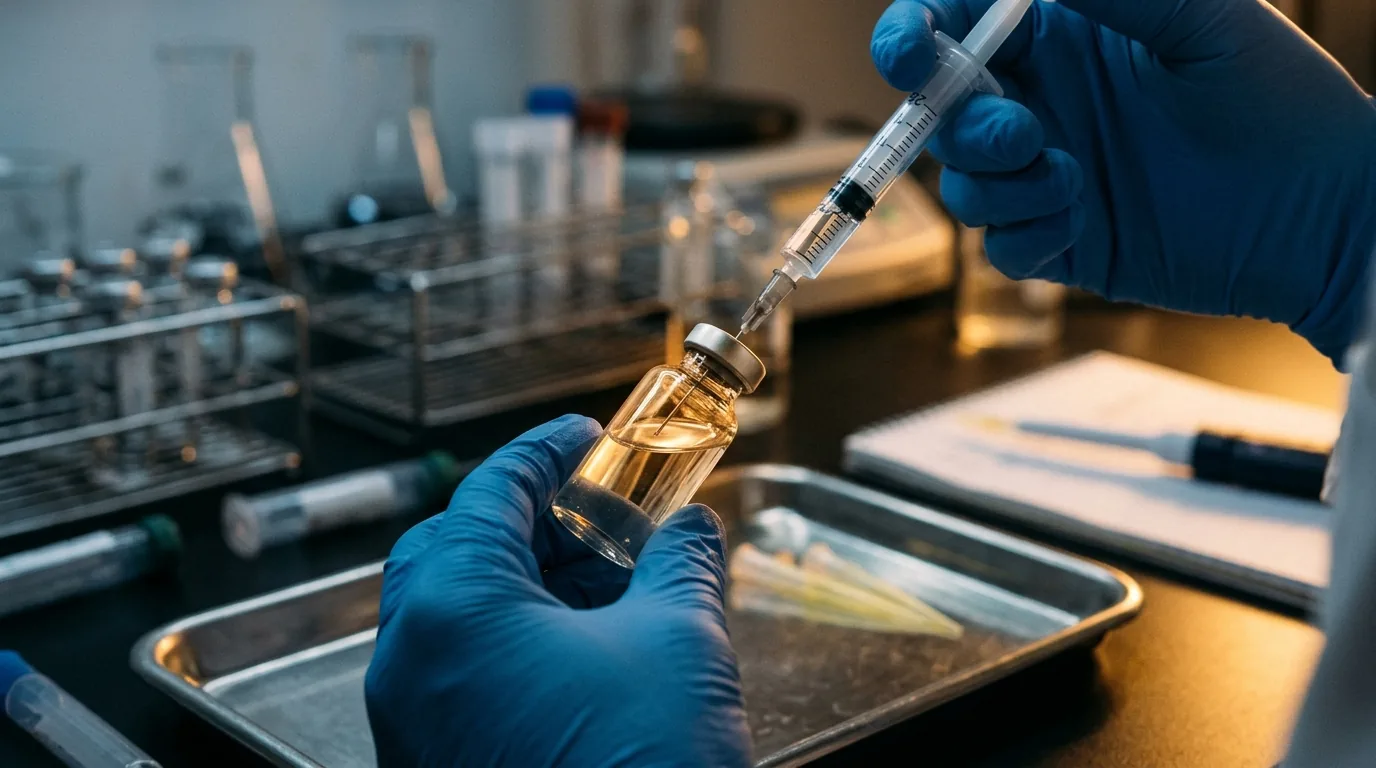
For laboratory research use only. Not for human consumption.
Peptide Mixing Compatibility: The Core Question
Mixing multiple peptides in a single reconstitution vessel is a common laboratory practice, but not all peptides are chemically compatible in solution. Whether two or more peptides can coexist in the same aqueous environment depends on their individual isoelectric points, preferred pH ranges, solubility profiles, and potential for intermolecular interactions such as aggregation or degradation. Understanding these factors before combining peptides prevents wasted reagents, compromised experimental results, and misattributed biological activity.
The short answer is that many peptides can be safely combined, particularly those sharing similar pH optima and solvent requirements. However, certain combinations produce precipitation, accelerated degradation, or altered tertiary structures that render one or both compounds inactive. This guide provides a systematic framework for evaluating peptide compatibility in research settings.
Why Researchers Combine Peptides
Combining peptides in a single vessel serves several practical research purposes. It reduces the number of individual preparations required during multi-compound experimental protocols, minimizes the total volume of solvent administered in in vivo models, and simplifies dosing logistics in time-course studies. In pharmacological research, co-administration is often necessary to study synergistic or additive effects between compounds acting on complementary pathways.
However, convenience must never override chemical compatibility. A peptide mixture that appears visually clear may still contain degradation products, aggregated species, or altered conformations that compromise experimental validity. Analytical verification of both identity and purity after mixing is the only reliable way to confirm that combined peptides retain their intended chemical properties.
pH and Solubility Factors in Peptide Mixing
The single most important variable in peptide mixing compatibility is pH. Each peptide has an isoelectric point (pI) – the pH at which its net charge is zero and solubility is typically at its minimum. Mixing two peptides with divergent optimal pH ranges forces at least one compound into a suboptimal environment, increasing the risk of precipitation or conformational instability.
- Acidic peptides (pI < 5): Require low-pH reconstitution buffers, typically 0.1% acetic acid or dilute HCl. Examples include many growth hormone-releasing peptides.
- Basic peptides (pI > 8): Dissolve best in slightly alkaline or neutral solutions. Some require ammonium bicarbonate or dilute NaOH.
- Neutral peptides (pI 5-8): Generally compatible with bacteriostatic water or sterile water at physiological pH ranges.
- Hydrophobic peptides: May require organic co-solvents such as DMSO or acetonitrile for initial dissolution before aqueous dilution.
When combining peptides, the resulting solution pH must fall within the acceptable range for all compounds present. If peptide A requires pH 3-4 and peptide B requires pH 6-7, they are fundamentally incompatible in a single aqueous preparation without pH-adjusting buffers that may introduce additional variables into the experiment.
Always measure the pH of your reconstituted peptide solution using calibrated pH strips or a micro-electrode. Visual clarity alone does not confirm chemical compatibility or structural integrity.
Common Compatible Peptide Combinations
Several peptide combinations have been widely used in research settings with documented compatibility. These pairings share similar pH optima, solvent requirements, and do not exhibit significant intermolecular interactions at standard research concentrations.
- BPC-157 + TB-500: Both peptides are soluble in bacteriostatic water at slightly acidic to neutral pH (5.0-7.0). This is one of the most commonly reported combinations in tissue repair research. Both maintain stability in the same aqueous environment for short-term use.
- Ipamorelin + CJC-1295 (no DAC): Both growth hormone secretagogues are compatible in bacteriostatic water at pH 5.5-7.0. Their complementary mechanisms – GHSR and GHRH-R activation respectively – make this a frequent research pairing.
- GHRP-6 + CJC-1295 (no DAC): Similar to the ipamorelin combination, GHRP-6 shares compatible solubility parameters with CJC-1295 in standard reconstitution media.
- GHRP-2 + GHRP-6: Both ghrelin mimetics have overlapping pH and solubility profiles, making co-reconstitution straightforward.
- BPC-157 + GHK-Cu: Compatible at slightly acidic pH. GHK-Cu is a copper-binding tripeptide with good aqueous solubility that does not interfere with BPC-157 stability at standard concentrations.
It is essential to note that compatibility data is concentration-dependent. Two peptides that coexist at micromolar concentrations may interact problematically at millimolar levels. Always verify compatibility at the specific concentrations relevant to your experimental protocol.
Incompatible Pairings: What Not to Mix
Certain peptide combinations should be avoided due to chemical incompatibility, pH conflicts, or known interaction effects. Mixing incompatible peptides can result in visible precipitation, invisible degradation, or the formation of inactive aggregates.
- Peptides requiring acidic vs. alkaline reconstitution: Any combination where optimal pH ranges do not overlap by at least 1.5 pH units should be considered incompatible.
- Metal-binding peptides with oxidation-sensitive peptides: Copper-containing compounds like GHK-Cu can catalyze oxidation of methionine or cysteine residues in co-dissolved peptides. Evaluate redox interactions before combining.
- Large peptides with small peptides at high concentrations: Large peptides (>5 kDa) may form aggregates that entrap smaller co-dissolved peptides, altering their effective concentration and bioavailability.
- Peptides with opposing ionic charges at working pH: Strongly cationic and strongly anionic peptides may form insoluble electrostatic complexes when mixed.
- Melanotan II with most other peptides: MT-II has distinct solubility requirements and tends to form aggregates in multi-peptide solutions, potentially precipitating co-dissolved compounds.
If you observe any turbidity, cloudiness, or particulate matter after combining peptides, the mixture should be discarded. Precipitation indicates chemical incompatibility that cannot be reversed by additional mixing or heating.
Reconstitution Order and Technique
When preparing multi-peptide solutions, the order of addition matters. Improper technique can create local pH extremes or high-concentration zones that trigger aggregation before full dissolution occurs.
- Step 1: Reconstitute each peptide individually in its optimal solvent to confirm complete dissolution and visual clarity.
- Step 2: Verify pH of each individual solution using calibrated measurement tools.
- Step 3: Add the smaller-volume peptide solution to the larger-volume solution slowly, with gentle swirling. Never vortex peptide solutions vigorously.
- Step 4: Check the final pH of the combined solution. Adjust only if necessary and only with compatible buffer systems.
- Step 5: Inspect for turbidity, precipitation, or color changes immediately and after 30 minutes at room temperature.
- Step 6: If using the combined solution over multiple days, perform visual inspection before each use and store at 2-8 degrees Celsius.
The general rule is to add the more concentrated solution to the more dilute one, and to add acidic solutions to neutral solutions rather than the reverse. Rapid pH shifts during mixing create transient conditions that can denature sensitive peptides even if the final pH is acceptable.
Stability Considerations After Mixing
Even compatible peptides have reduced stability in mixed solutions compared to individual preparations. The presence of additional molecular species increases the probability of intermolecular interactions over time, and degradation products from one peptide may catalyze degradation of the other.
- Short-term stability (24-48 hours): Most compatible combinations maintain acceptable stability when refrigerated at 2-8 degrees Celsius.
- Medium-term stability (1-2 weeks): Stability decreases significantly. Analytical verification via HPLC is recommended before use.
- Long-term storage: Mixed peptide solutions should not be stored beyond 2 weeks. Prepare fresh combinations from individually stored lyophilized stocks.
- Freeze-thaw cycles: Mixed solutions are more susceptible to freeze-thaw damage than individual peptide preparations. Aliquot into single-use volumes when possible.
Temperature excursions are particularly damaging to mixed peptide preparations. A brief exposure to room temperature that would be tolerable for a single-peptide solution may accelerate degradation in a multi-peptide mixture due to synergistic destabilization effects.
Practical Laboratory Tips
Successful peptide mixing in the laboratory requires attention to detail and a systematic approach. The following practical guidelines summarize best practices drawn from published reconstitution protocols and analytical chemistry principles.
- Always reconstitute and test peptides individually before attempting to combine them.
- Use the minimum number of peptides per vessel – combining two is substantially simpler than combining three or more.
- Maintain a laboratory notebook recording pH measurements, visual observations, concentrations, and timestamps for each mixed preparation.
- When in doubt, do not mix. Separate administrations or preparations eliminate compatibility uncertainty entirely.
- Request certificates of analysis for each peptide lot and verify that reported purity values are consistent with your analytical observations.
- Consider using independent verification services to confirm that mixed peptide preparations retain the expected identity and purity profiles.
Peptide mixing is a practical technique that can streamline research workflows, but it introduces chemical variables that must be systematically evaluated. By understanding pH compatibility, following proper reconstitution technique, and verifying stability through analytical testing, researchers can confidently combine peptides where the chemistry permits – and avoid costly errors where it does not.
Compounds Referenced in This Article
Explore detailed chemical profiles and research guides for compounds discussed in this article:
- BPC-157: Complete Research Guide → /learn/bpc-157
- CJC-1295: Complete Research Guide → /learn/cjc-1295-no-dac
- GHK-Cu: Complete Research Guide → /learn/ghk-cu
- GHRP-6: Complete Research Guide → /learn/ghrp-6-research-guide-chemical-profile
- Ipamorelin: Complete Research Guide → /learn/ipamorelin
- Melanotan 2: Complete Research Guide → /learn/melanotan-2
- TB-500: Complete Research Guide → /learn/tb-500
Further Reading on ChemVerify
- Read more: Local vs Subcutaneous Administration for BPC-157 and TB-500: What Research Shows → https://www.chemverify.com/learn/local-vs-subcutaneous-bpc157-tb500-research
- Read more: Peptide Cold Chain Interrupted: What Happens When Cooling Breaks → https://www.chemverify.com/learn/peptide-cold-chain-interrupted-what-happens
- Read more: Peptide Stacking: Which Peptides Can Be Combined for Research? → https://www.chemverify.com/learn/peptide-stacking-combinations-research-guide
- Read more: Subcutaneous vs Intramuscular Injection: Which Method for Which Peptide? → https://www.chemverify.com/learn/subcutaneous-vs-intramuscular-injection-peptides
References
Compare Verified Vendors
Browse COA-verified suppliers with exclusive discount codes and transparent pricing.
Continue Reading
Local vs Subcutaneous Administration for BPC-157 and TB-500: What Research Shows
Compare local perilesional vs systemic subcutaneous injection for BPC-157 and TB-500. Covers animal study evidence, oral BPC-157 research, systemic distribution, and practical research considerations.
Peptide Solubility Guide: Choosing the Right Solvent for Your Research
Practical laboratory guide for dissolving research peptides. Covers solvent selection based on peptide charge and hydrophobicity, pH effects, co-solvent strategies, and troubleshooting insoluble peptides.
Peptide Cold Chain Interrupted: What Happens When Cooling Breaks
Discover what happens when the peptide cold chain breaks during shipping. Learn temperature excursion limits, lyophilized vs reconstituted stability, visual degradation signs, and when to discard.
Peptide Stacking: Which Peptides Can Be Combined for Research?
Comprehensive guide to peptide stacking in research: synergistic combinations like BPC-157+TB-500 and Ipamorelin+CJC-1295, antagonistic pairs, timing protocols, and reconstitution.