
Oxytocin: Complete Research Guide & Chemical Profile
Comprehensive guide to Oxytocin (OXT) peptide: molecular structure, research applications, mechanism of action, and chemical properties for laboratory use.
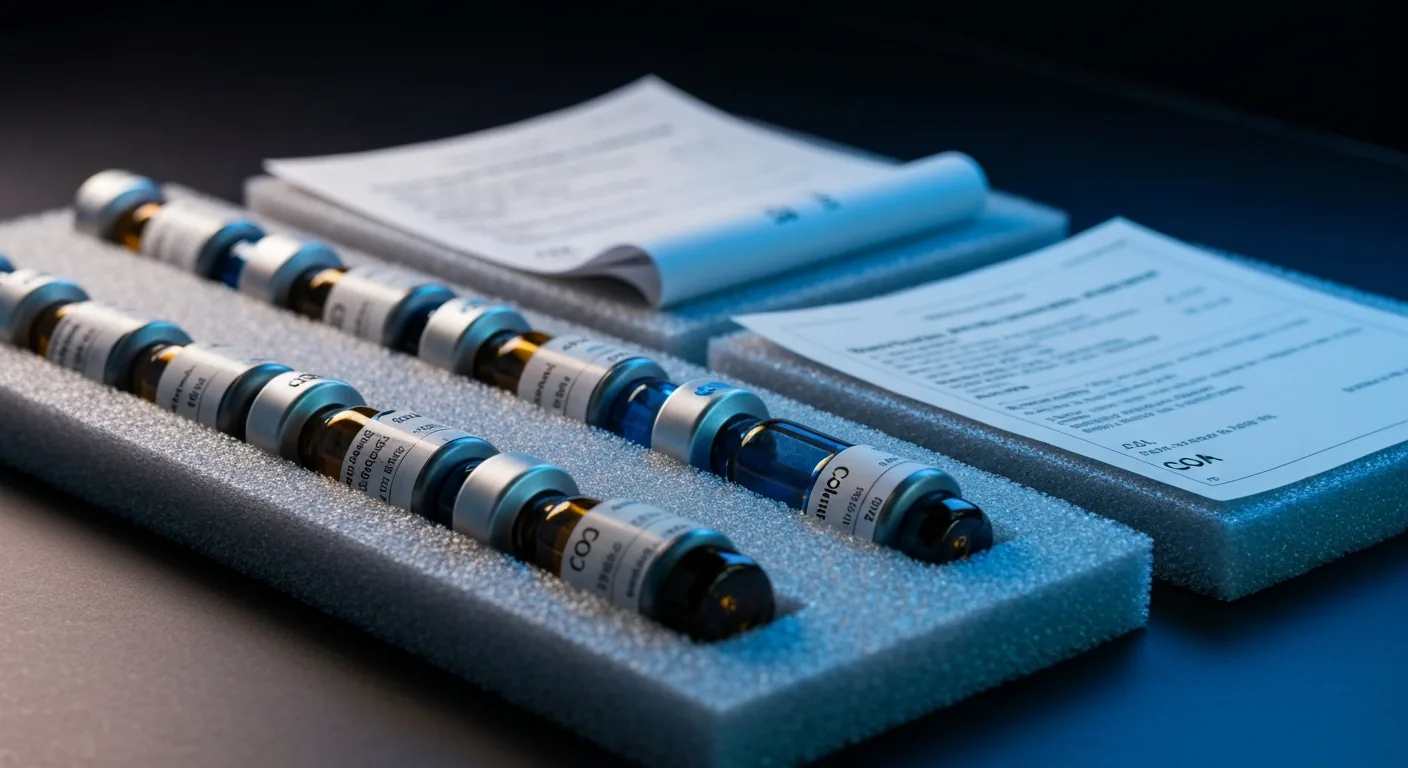
For laboratory research use only. Not for human consumption. This article is intended for educational purposes and does not constitute medical advice.
TL;DR: Oxytocin is a 9-amino-acid cyclic neuropeptide hormone (MW ~1007.19 Da) with a disulfide bridge between Cys1 and Cys6 forming a 20-membered ring. Research-grade oxytocin requires ≥95% HPLC purity with ESI-MS confirmation of intact disulfide bond. Biological activity depends on correct cyclization – linear oxytocin is biologically inactive. Compare verified oxytocin pricing across vendors at chemverify.com.
Last verified: March 2026 | Data accuracy confirmed by ChemVerify Editorial Team
What Is Oxytocin?
Oxytocin (OXT) is a cyclic nonapeptide hormone naturally produced in the hypothalamus and released by the posterior pituitary gland. This research peptide consists of nine amino acids arranged in a specific sequence: Cys-Tyr-Ile-Gln-Asn-Cys-Pro-Leu-Gly-NH2, with a molecular weight of 1007.19 Da.
The peptide features a distinctive cyclic structure formed by a disulfide bond between two cysteine residues at positions 1 and 6. This cyclic configuration is crucial for its biological activity and receptor binding affinity. Oxytocin is also known by its synonyms OXT and Pitocin, the latter being its synthetic pharmaceutical form.
Research-grade oxytocin is typically synthesized using solid-phase peptide synthesis techniques and maintained at purity standards of ≥98%. Laboratory studies focus on its role as a neuromodulator and its involvement in various physiological processes including social bonding, neuroendocrine regulation, and cellular signaling pathways.
Research Background & Key Studies
Oxytocin research spans several decades, with foundational studies establishing its role in mammalian physiology and behavior. Early research by Vincent du Vigneaud in the 1950s led to the first synthesis of oxytocin, earning him the Nobel Prize in Chemistry in 1955 for this groundbreaking work.
Contemporary research has expanded beyond traditional applications to explore oxytocin's role in social neuroscience. Studies published in journals such as Nature and Science have demonstrated its involvement in trust, empathy, and social recognition in laboratory animal models. Research suggests that oxytocin modulates neural circuits associated with social behavior through its action on specific brain regions.
Neurobiological studies indicate that oxytocin influences synaptic plasticity and neurotransmitter release in laboratory settings. Research has shown that the peptide affects dopaminergic and GABAergic signaling pathways, contributing to its complex neuromodulatory effects observed in experimental models.
Recent investigations have focused on oxytocin's potential applications in understanding autism spectrum disorders, social anxiety, and bonding behaviors in research contexts. These studies utilize controlled laboratory environments to examine the peptide's effects on cellular and behavioral outcomes.
Mechanism of Action
Oxytocin exerts its effects primarily through binding to oxytocin receptors (OXTR), which are G-protein coupled receptors distributed throughout various tissues. Upon binding, the peptide activates intracellular signaling cascades involving phospholipase C, resulting in increased intracellular calcium levels and protein kinase C activation.
In neuronal tissues, research indicates that oxytocin modulates neurotransmitter release and synaptic transmission. The peptide influences both excitatory and inhibitory neurotransmission, with studies showing effects on GABA, dopamine, and serotonin systems in laboratory models.
The peptide's short half-life of approximately 3-5 minutes necessitates careful timing considerations in research protocols. Laboratory studies demonstrate that oxytocin is rapidly metabolized by peptidases, particularly leucine aminopeptidase and placental oxytocinase, which cleave specific peptide bonds.
Research has identified that oxytocin's effects extend beyond receptor-mediated mechanisms. Studies suggest the peptide may influence gene expression through epigenetic modifications and can modulate the activity of various ion channels, contributing to its diverse physiological effects observed in experimental settings.
Chemical Properties
Research-grade oxytocin exhibits specific chemical characteristics that are crucial for laboratory applications. The peptide maintains high purity standards of ≥98%, as determined by high-performance liquid chromatography (HPLC) analysis, ensuring consistent results in experimental protocols.
The molecular formula of oxytocin is C43H66N12O12S2, with an exact molecular weight of 1007.19 Da. This cyclic nonapeptide contains two cysteine residues that form an intramolecular disulfide bond, creating a six-membered ring structure essential for biological activity.
Storage & Stability
Proper storage conditions are essential for maintaining oxytocin's stability in laboratory settings. Research indicates that lyophilized oxytocin remains stable when stored at -20°C to -80°C in a dry environment protected from light. Under these conditions, the peptide maintains its structural integrity for extended periods.
Once reconstituted, aqueous solutions of oxytocin demonstrate limited stability at room temperature. Laboratory studies show that reconstituted peptide solutions should be stored at 4°C and used within 48-72 hours to prevent degradation. For longer-term storage of solutions, freezing at -20°C in small aliquots is recommended.
Solubility & Handling
Oxytocin demonstrates good solubility in aqueous solutions, typically dissolving readily in sterile water, phosphate-buffered saline (PBS), or other physiological buffers used in research applications. The peptide's solubility facilitates its use in various in vitro and in vivo experimental protocols.
Laboratory handling procedures should account for oxytocin's sensitivity to pH extremes and temperature fluctuations. Research protocols typically maintain pH between 3.5 and 8.0 for optimal stability, with neutral pH conditions being preferred for most applications.
Verified Sources on ChemVerify
ChemVerify provides researchers with access to verified suppliers of high-quality oxytocin for laboratory use. Our platform features third-party tested batches with detailed certificates of analysis, ensuring researchers can access peptides that meet strict purity and quality standards.
Users can find comprehensive vendor information, batch-specific test results, and comparative pricing for oxytocin on ChemVerify at /product/oxytocin. Our verification process includes analysis of purity, identity confirmation, and contaminant screening to support reliable research outcomes.
The platform's audit system tracks supplier performance and maintains updated information on availability, shipping conditions, and quality metrics. This enables researchers to make informed decisions when selecting oxytocin sources for their specific laboratory requirements.
Frequently Asked Questions
**What is the optimal storage temperature for oxytocin in laboratory settings?**
Research indicates that lyophilized oxytocin should be stored at -20°C to -80°C in a dry, dark environment. Reconstituted solutions should be kept at 4°C and used within 48-72 hours, or frozen at -20°C in aliquots for longer-term storage.
**How does oxytocin's short half-life affect research protocols?**
With a half-life of approximately 3-5 minutes, oxytocin requires careful timing considerations in experimental designs. Researchers must account for rapid metabolic clearance when planning in vivo studies and may need to consider continuous infusion or repeated administration protocols depending on study objectives.
**What receptor systems does oxytocin interact with in laboratory studies?**
Oxytocin primarily binds to oxytocin receptors (OXTR), which are G-protein coupled receptors. Research has also identified cross-reactivity with vasopressin receptors at higher concentrations, which should be considered when designing experimental protocols and interpreting results.
**What are the key considerations for oxytocin solubility in research applications?**
Oxytocin dissolves readily in aqueous solutions and physiological buffers. For optimal stability, maintain pH between 3.5-8.0, with neutral conditions preferred. The peptide is sensitive to extreme pH and temperature, so gentle reconstitution techniques should be employed.
**How is oxytocin's purity verified in research-grade preparations?**
Research-grade oxytocin purity is typically determined using HPLC analysis, mass spectrometry, and amino acid analysis. Quality suppliers provide certificates of analysis showing ≥98% purity, along with identity confirmation and contaminant screening results.
**What cellular signaling pathways does oxytocin modulate in laboratory studies?**
Research demonstrates that oxytocin activates phospholipase C signaling, leading to increased intracellular calcium and protein kinase C activation. Studies also show modulation of cAMP pathways and effects on various neurotransmitter systems including GABA, dopamine, and serotonin in experimental models.
Frequently Asked Questions
Further Reading on ChemVerify
- Read more: Hexarelin: Complete Research Guide & Chemical Profile → https://www.chemverify.com/learn/hexarelin-research-guide-chemical-profile
- Read more: How Fast Do Peptides Work? Expected Timelines for BPC-157, Semaglutide, Ipamorelin & More → https://www.chemverify.com/learn/how-fast-do-peptides-work-timelines
- Read more: Retatrutide: Complete Research Guide & Chemical Profile → https://www.chemverify.com/learn/retatrutide-research-guide-chemical-profile
- Read more: Tirzepatide: Complete Research Guide & Chemical Profile → https://www.chemverify.com/learn/tirzepatide
References
Compare Verified Vendors
Browse COA-verified suppliers with exclusive discount codes and transparent pricing.
Continue Reading
Hexarelin: Complete Research Guide & Chemical Profile
Comprehensive research guide to Hexarelin (Examorelin), a synthetic hexapeptide GHSR-1a agonist. Covers molecular weight 887.04 Da, sequence, GH release mechanisms, and cardiac research.
Oxytocin at Licensed Peptides: Price, Purity & Verification
Oxytocin from Licensed Peptides – USD 84.99/10mg, COA verified.
Oxytocin at Beyond Peptides: Price, Purity & Verification
Oxytocin from Beyond Peptides – EUR 45.49/10mg, COA verified.
How Fast Do Peptides Work? Expected Timelines for BPC-157, Semaglutide, Ipamorelin & More
Peptide onset varies widely: recovery peptides like BPC-157 show effects within 1-2 weeks, while body composition agents require 8-12 weeks. Explore evidence-based timelines by category.