
Peptide Purity vs Net Peptide Content (NPC): The Critical Difference Explained
Peptide purity (HPLC %) and net peptide content (NPC) measure different things. A 98% pure peptide may contain only 65% actual peptide by weight. Learn to read COAs and calculate real dosing.
For laboratory research use only. Not for human consumption.
Purity vs. NPC: Why the Distinction Matters
Peptide purity and net peptide content (NPC) are two fundamentally different measurements that are frequently confused, leading to significant dosing errors in research protocols. Purity, measured by HPLC, tells you what percentage of the peptide-related material is the target sequence versus synthesis byproducts. Net peptide content tells you what percentage of the total powder weight is actually peptide versus non-peptide components like counterions, water, and residual salts [1]. A peptide with 98% HPLC purity may have an NPC of only 60-80%, meaning a vial labeled as 10 mg contains just 6-8 mg of actual peptide.
Confusing these two values is one of the most common and consequential errors in peptide research. Researchers who assume the labeled weight equals the peptide weight may systematically underdose by 20-40%, potentially invalidating dose-response studies, producing false-negative results, or creating irreproducible findings across laboratories [2].
What Is Peptide Purity (HPLC %)?
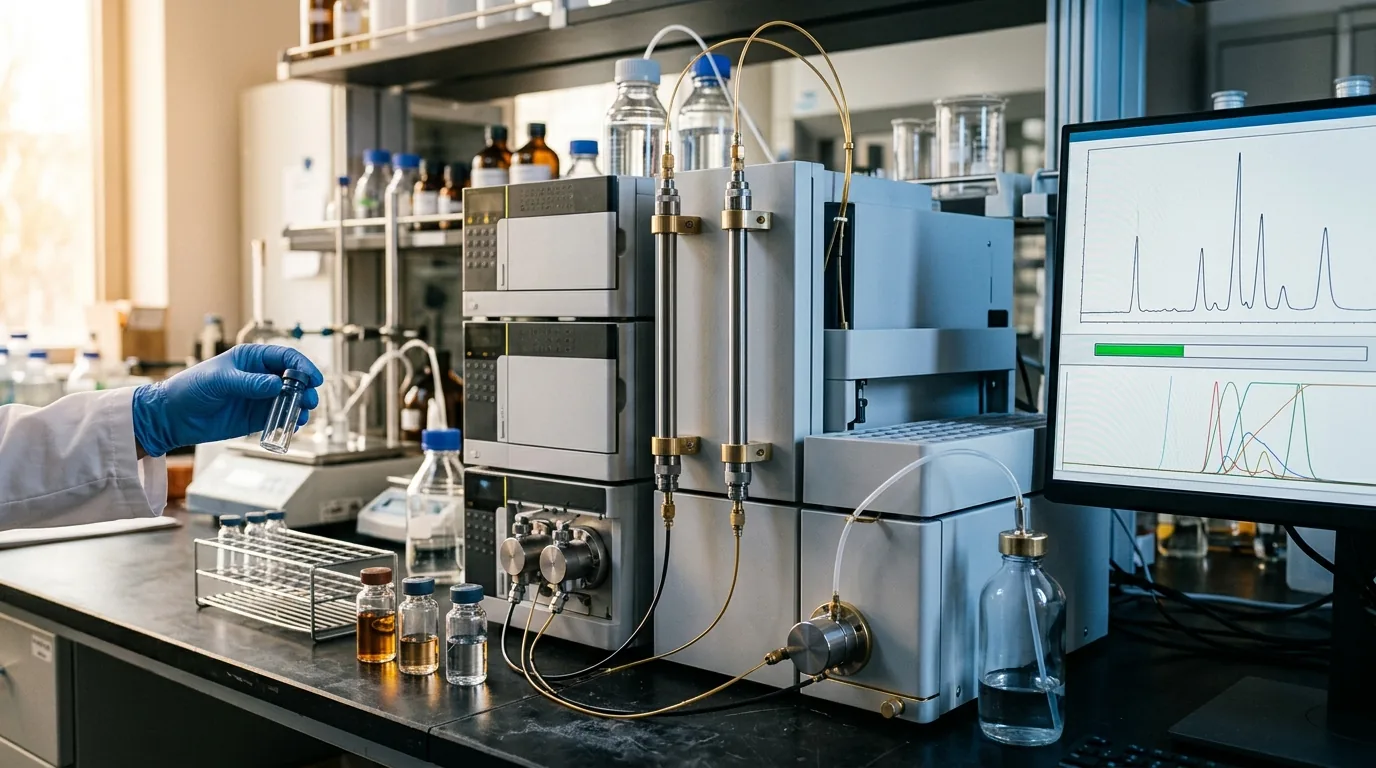
Peptide purity refers to the proportion of the desired target peptide sequence relative to all peptide-related species in the sample. It is measured by reversed-phase high-performance liquid chromatography (RP-HPLC), which separates molecules based on hydrophobicity:
- HPLC purity is expressed as a percentage of the total peptide-related peak area (e.g., 98.5% means 98.5% of all peptide material detected is the target sequence)
- The remaining 1.5% consists of synthesis-related impurities: deletion sequences, truncated fragments, oxidized species, and other side products from solid-phase peptide synthesis (SPPS)
- HPLC purity does NOT account for non-peptide material such as water, counterions (TFA, acetate, chloride), or residual solvents [3]
- Higher purity (>95%) is generally preferred for research to ensure consistent bioactivity, but even 95% pure peptides may contain significant non-peptide mass
- Purity can also be assessed by mass spectrometry (MS), which confirms molecular weight and sequence identity but is complementary to HPLC rather than a replacement
HPLC purity answers the question: Of all the peptide material in this vial, what fraction is the correct target sequence? It does NOT answer: How much of the total powder weight is peptide?
What Is Net Peptide Content (NPC)?
Net peptide content (NPC) represents the actual mass of peptide material as a percentage of the total powder weight in the vial. It accounts for all non-peptide components that contribute to the total weight:
- NPC is typically determined by amino acid analysis (AAA), nitrogen content analysis, or UV spectrophotometry at 205-220 nm
- NPC values for lyophilized peptides typically range from 50% to 85%, meaning 15-50% of the powder weight is non-peptide material [4]
- The non-peptide fraction includes: counterions from purification (TFA salts are the most common, contributing 10-30% of total weight), residual moisture (2-10%), residual solvents from lyophilization, and inorganic salts
- NPC is a critical value for accurate mass-based dosing calculations in research protocols
- Unlike HPLC purity, NPC directly determines how much peptide you actually receive per milligram of powder
Why 98% Purity Does Not Mean 98% Peptide Content
This is the central misconception that leads to dosing errors. Here is why the two numbers diverge so dramatically:
Consider a vial labeled as 10 mg of a peptide with 98% HPLC purity and 70% NPC. The 98% purity means that of all the peptide material present, 98% is the correct target sequence. But the 70% NPC means only 7 mg of the 10 mg total powder is peptide material of any kind. The remaining 3 mg is counterions, water, and salts. Of that 7 mg of peptide material, 98% (6.86 mg) is the target sequence, and 2% (0.14 mg) is synthesis impurities [5].
- Total powder in vial: 10.00 mg (what the label says)
- Peptide material (NPC 70%): 7.00 mg
- Target sequence (98% of 7.00 mg): 6.86 mg
- Synthesis impurities (2% of 7.00 mg): 0.14 mg
- Non-peptide material (counterions, water, salts): 3.00 mg
- Effective target peptide: 68.6% of the labeled weight – not 98%
The actual amount of target peptide in a vial equals: Labeled weight x NPC x HPLC purity. For a 10 mg vial with 70% NPC and 98% purity, this is 10 x 0.70 x 0.98 = 6.86 mg of target peptide.
What Makes Up the Non-Peptide Fraction?
Understanding the composition of the non-peptide fraction helps explain why NPC values vary so significantly between peptides and vendors:
- TFA counterions (trifluoroacetic acid): The most significant contributor, typically 10-30% of total weight. TFA is used as an ion-pairing agent in RP-HPLC purification and binds to basic amino acid residues (lysine, arginine, histidine, N-terminus). Peptides with more basic residues carry more TFA [6]
- Acetate counterions: Some manufacturers perform TFA-to-acetate salt exchange to reduce TFA content (relevant for cell culture applications where TFA is cytotoxic). Acetate salts are lighter than TFA salts, resulting in higher NPC
- Residual moisture: Lyophilized peptides typically retain 2-10% water by weight. Longer or more hydrophilic sequences tend to retain more moisture
- Residual solvents: Trace amounts of acetonitrile, DMSO, or other solvents from purification and lyophilization processes
- Inorganic salts: Sodium, potassium, or phosphate buffer salts from purification steps
How to Calculate Actual Peptide Amount
Researchers should use the following formula to determine the actual mass of target peptide in any vial:
- Formula: Actual peptide (mg) = Labeled weight (mg) x NPC (decimal) x HPLC purity (decimal)
- Example 1: 5 mg vial, NPC 75%, purity 99% → 5 x 0.75 x 0.99 = 3.71 mg actual target peptide
- Example 2: 10 mg vial, NPC 60%, purity 95% → 10 x 0.60 x 0.95 = 5.70 mg actual target peptide
- Example 3: 2 mg vial, NPC 82%, purity 98% → 2 x 0.82 x 0.98 = 1.61 mg actual target peptide
For reconstitution calculations, the concentration should be based on the actual peptide mass, not the labeled weight. If a protocol calls for a 1 mg/mL solution and the actual peptide content is 6.86 mg (from a 10 mg labeled vial), adding 6.86 mL of solvent produces the correct concentration [7].
Impact on Research Dosing Accuracy
Ignoring the NPC value in dosing calculations introduces systematic error into every experiment that depends on precise peptide concentrations:
- Dose-response curves: Using labeled weight instead of actual peptide content shifts the entire dose-response curve to the right, making the peptide appear less potent than it actually is
- EC50/IC50 determinations: Overestimating peptide concentration by 20-40% produces inflated potency values that are irreproducible by other laboratories using correctly calculated concentrations [2]
- Cross-laboratory reproducibility: Different vendors may supply the same peptide with NPC values ranging from 55% to 85%. Without NPC correction, the same labeled dose produces different actual doses
- Competitive binding assays: Incorrect peptide concentration calculations directly affect Ki and Kd values, potentially invalidating receptor characterization studies
- In vivo studies: Underdosing due to NPC ignorance may produce subtherapeutic effects, leading researchers to incorrectly conclude a peptide is inactive at a given dose
What to Look for on a Certificate of Analysis
A comprehensive Certificate of Analysis (COA) should report both purity and NPC values. Here is what to look for and what each line item means:
- HPLC purity (%): Should be >95% for research-grade peptides. Look for the chromatographic conditions (column type, gradient, detection wavelength) to assess reliability
- Net peptide content (%): The critical value for dosing. Should be reported as a percentage determined by AAA, nitrogen analysis, or UV quantification. If missing from the COA, contact the vendor
- Mass spectrometry (MS): Confirms molecular weight matches the target sequence. Look for [M+H]+ or [M+2H]2+ peaks within 0.1% of theoretical mass
- Amino acid analysis (AAA): The gold standard for NPC determination. Reports molar ratios of each amino acid and absolute peptide content
- Appearance: Should match expected physical form (typically white to off-white lyophilized powder)
- Counterion: TFA, acetate, or HCl – affects NPC and may affect biocompatibility in certain assays
- Water content (Karl Fischer): Reports residual moisture as a percentage. Complements NPC data [3]
- Lot/batch number: Essential for traceability and comparison across experiments
If a vendor COA reports HPLC purity but does NOT report net peptide content, this is a significant omission. Request the NPC value before calculating research doses. Reputable vendors provide this data routinely.
Common NPC Ranges by Peptide Type
NPC values vary based on the peptide sequence, counterion type, and lyophilization conditions. The following ranges represent typical values observed across multiple vendors:
- Short peptides (5-10 amino acids) with TFA counterion: 60-75% NPC typical
- Medium peptides (10-20 amino acids) with TFA counterion: 65-80% NPC typical
- Long peptides (20-40 amino acids) with TFA counterion: 55-70% NPC typical (more basic residues = more TFA binding = lower NPC)
- Acetate salt form (any length): typically 5-15% higher NPC than TFA form of the same peptide
- Highly basic peptides (multiple Arg, Lys residues): 50-65% NPC due to heavy TFA loading
- Cyclic peptides: 70-85% NPC typical (fewer free amino groups for counterion binding)
- GHK-Cu (copper complex): NPC calculation must account for copper ion mass in addition to standard counterions [4]
Key Takeaways
- Peptide purity (HPLC %) measures the proportion of correct target sequence among all peptide species – it ignores non-peptide mass
- Net peptide content (NPC) measures the total peptide mass as a percentage of powder weight – it accounts for counterions, water, and salts
- A 98% pure peptide with 70% NPC contains only 68.6% target peptide by weight, not 98%
- Actual peptide amount = Labeled weight x NPC x HPLC purity
- Ignoring NPC leads to systematic underdosing of 20-40% and undermines research reproducibility
- Always check the COA for both HPLC purity AND net peptide content before calculating research doses
- TFA counterions are the largest contributor to the non-peptide fraction, accounting for 10-30% of total powder weight
- Request NPC data from any vendor that does not include it on the standard COA
Compounds Referenced in This Article
Explore detailed chemical profiles and research guides for compounds discussed in this article:
- BPC-157: Complete Research Guide → /learn/bpc-157
- CJC-1295: Complete Research Guide → /learn/cjc-1295-no-dac
- GHK-Cu: Complete Research Guide → /learn/ghk-cu
- Ipamorelin: Complete Research Guide → /learn/ipamorelin
- Semaglutide: Complete Research Guide → /learn/semaglutide
- TB-500: Complete Research Guide → /learn/tb-500
Further Reading on ChemVerify
- Read more: HPLC Column Selection Guide for Peptide Analysis → https://www.chemverify.com/learn/hplc-column-selection-guide
- Read more: Research Peptide Vendor Verification: The Complete Quality Checklist → https://www.chemverify.com/learn/vendor-verification-checklist
- Read more: Forschungspeptide kaufen: Der wissenschaftliche Leitfaden 2026 → https://www.chemverify.com/learn/forschungspeptide-kaufen-leitfaden
- Read more: How to Read a Certificate of Analysis (CoA): A Step-by-Step Guide for Researchers → https://www.chemverify.com/learn/how-to-read-coa
References
Compare Verified Vendors
Browse COA-verified suppliers with exclusive discount codes and transparent pricing.
You Might Also Like
Continue Reading
Complete Guide to Peptide Purity Testing: HPLC, Mass Spectrometry & CoA Verification
Comprehensive scientific guide to peptide purity analysis methods including reverse-phase HPLC, mass spectrometry, amino acid analysis, and Certificate of Analysis interpretation for laboratory researchers.
HPLC Column Selection Guide for Peptide Analysis
Practical guide to selecting the optimal HPLC column for peptide analysis. Compares C18, C8, and C4 stationary phases, pore sizes, particle sizes, and gradient optimization strategies.
Research Peptide Vendor Verification: The Complete Quality Checklist
A systematic, evidence-based checklist for evaluating research peptide suppliers. Covers CoA verification, testing standards, transparency indicators, and warning signs of unreliable vendors.
Forschungspeptide kaufen: Der wissenschaftliche Leitfaden 2026
Scientific guide to purchasing research peptides with confidence. Covers vendor evaluation methodology, COA verification steps, red flags to avoid, purity standards, and how to use ChemVerify tools for independent quality verification before purchasing.