
What Is Bioavailability? Why Not All of Your Peptide Reaches the Target
Learn what bioavailability means for research peptides, why only a fraction reaches the target site, and which factors like route, metabolism, and formulation affect it.
For laboratory research use only. Not for human consumption.
What Bioavailability Means in Peptide Research
Bioavailability describes the fraction of an administered substance that reaches the systemic circulation in an unchanged, active form. For peptides, bioavailability is a critical pharmacokinetic parameter because it directly determines how much of the synthesized compound actually reaches its intended biological target. A peptide with 5% oral bioavailability means that 95% of the administered dose is lost before it can exert any effect [1].
Understanding bioavailability helps researchers interpret experimental results accurately. Differences in observed potency between studies may reflect bioavailability differences rather than true differences in receptor affinity or biological activity. This distinction is essential when comparing data across different administration protocols or formulations.
Absolute vs. Relative Bioavailability
Absolute bioavailability compares the systemic exposure from a given route of administration to intravenous (IV) administration, which is defined as 100% bioavailable since the entire dose enters the bloodstream directly. It is calculated as the ratio of the area under the plasma concentration–time curve (AUC) for the test route divided by the AUC for IV administration, corrected for dose [2].
Relative bioavailability compares two non-IV formulations or routes to each other. This metric is useful when comparing different peptide formulations – for example, whether a new nanoparticle-encapsulated version achieves higher systemic exposure than the same peptide in simple aqueous solution. Both metrics require careful pharmacokinetic sampling and analysis.
How Administration Route Affects Bioavailability
Intravenous administration bypasses all absorption barriers and provides 100% bioavailability by definition. Subcutaneous injection typically achieves 50–80% bioavailability for peptides, as absorption from the injection depot is generally efficient but some degradation occurs in the subcutaneous tissue. Intraperitoneal injection, common in animal research, provides variable bioavailability depending on the peptide and species [3].
Oral administration presents the greatest bioavailability challenge for peptides. The gastrointestinal tract contains proteolytic enzymes that rapidly degrade peptide bonds, and the intestinal epithelium presents a formidable absorption barrier for large, hydrophilic molecules. Oral bioavailability for unmodified peptides is typically below 2%, which is why most peptide research uses parenteral routes. Intranasal and transdermal routes offer intermediate bioavailability for certain peptides.
First-Pass Metabolism and Enzymatic Degradation
First-pass metabolism refers to the loss of a compound as it passes through the gut wall and liver before reaching systemic circulation. For orally administered peptides, first-pass effects are devastating – gastric acid denatures tertiary structure, pepsin and pancreatic proteases cleave peptide bonds, and brush-border peptidases on intestinal epithelial cells degrade fragments further [4].
Even after absorption, peptides face degradation by circulating proteases in the blood and by enzymes in the liver and kidneys. The plasma half-life of unmodified linear peptides is often measured in minutes rather than hours. This rapid degradation explains why researchers must consider both bioavailability and metabolic stability when designing experimental protocols.
Molecular Factors: Size, Charge, and Lipophilicity
Molecular weight is a primary determinant of peptide absorption. Peptides below approximately 500–700 Da can sometimes cross biological membranes via passive diffusion, but most research peptides exceed this threshold. Lipinski's Rule of Five, originally developed for small molecules, predicts poor oral absorption for compounds exceeding 500 Da – a threshold that nearly all peptides surpass [5].
Charge state affects membrane permeability. Peptides carrying multiple charges at physiological pH are poorly absorbed because charged species cannot easily cross the lipid bilayer. Lipophilicity, measured as logP, also influences absorption. Most peptides are too hydrophilic for efficient membrane crossing, though cyclic peptides and those with N-methylated amide bonds can achieve higher lipophilicity and improved passive permeability.
Formulation Strategies to Improve Bioavailability
Researchers have developed several strategies to improve peptide bioavailability. PEGylation – the covalent attachment of polyethylene glycol chains – increases molecular size to reduce renal clearance and shields the peptide from proteolytic degradation, extending plasma half-life from minutes to hours or even days. Lipidation, or attachment of fatty acid chains, promotes albumin binding and extends circulation time [6].
Nanoparticle encapsulation using PLGA, liposomes, or chitosan-based carriers can protect peptides from enzymatic degradation and enhance absorption across epithelial barriers. Permeation enhancers such as sodium caprate temporarily open tight junctions between intestinal cells, increasing paracellular transport. Each strategy involves trade-offs between improved bioavailability, manufacturing complexity, and potential effects on biological activity.
How Bioavailability Is Measured in Research
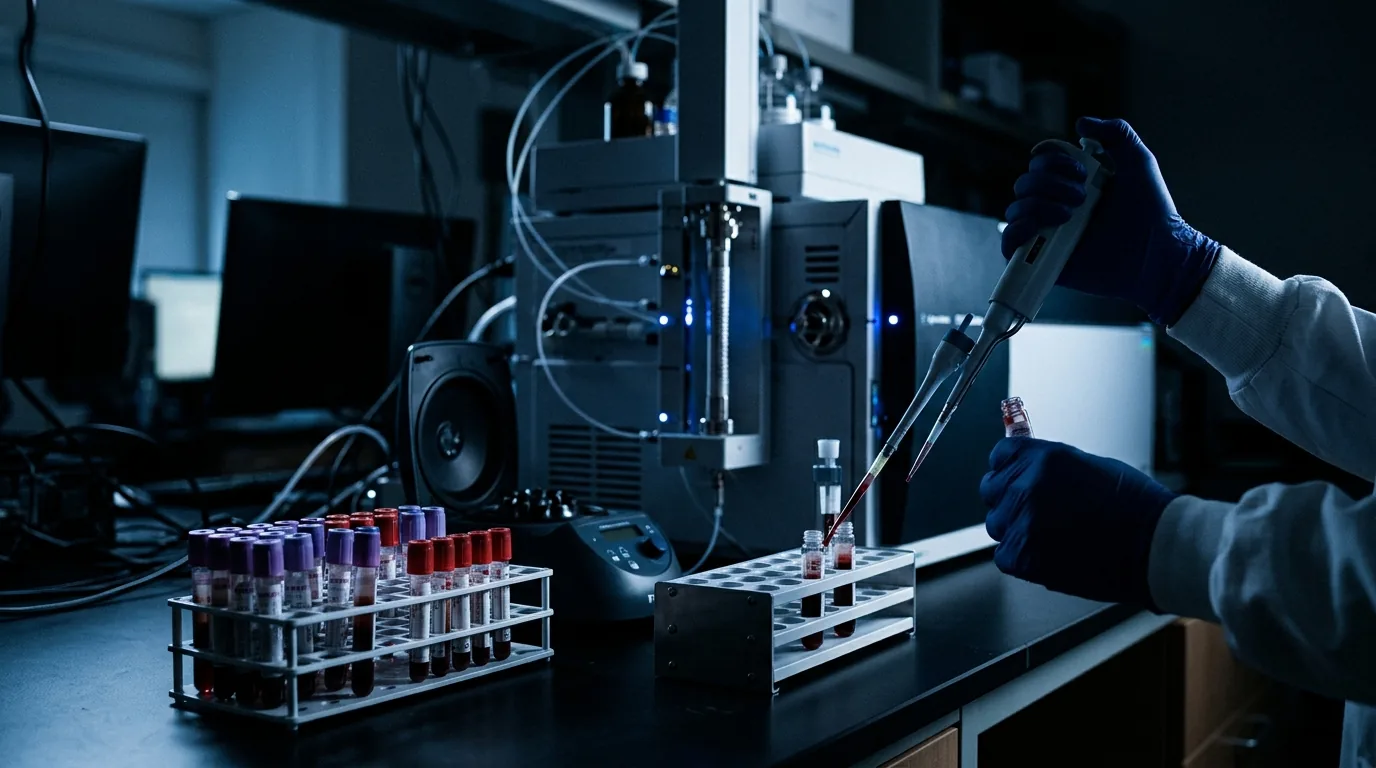
Bioavailability studies require measuring plasma peptide concentrations at multiple time points after administration. Liquid chromatography–tandem mass spectrometry (LC-MS/MS) is the standard analytical method, offering the sensitivity needed to quantify peptides at nanomolar or picomolar concentrations in biological matrices [7].
The area under the plasma concentration–time curve (AUC) is the primary metric. Non-compartmental analysis calculates AUC using the linear trapezoidal rule without assuming a specific pharmacokinetic model. Compartmental modeling fits concentration data to mathematical models (one-compartment, two-compartment) to estimate parameters such as volume of distribution, clearance, and half-life. Both approaches are used in peptide research.
Practical Implications for Peptide Researchers
When designing experiments, researchers must account for bioavailability differences between administration routes. A dose that produces a robust response via IV injection may show no effect when administered orally at the same dose. Pilot pharmacokinetic studies to characterize bioavailability for the specific peptide, route, species, and formulation being used are essential for accurate dose selection [8].
Reconstitution vehicle can also affect bioavailability. Bacteriostatic water, normal saline, and buffered solutions may produce different absorption profiles from the injection site. The pH of the reconstitution vehicle affects peptide solubility and aggregation state, both of which influence absorption kinetics. Documenting the exact reconstitution protocol is important for experimental reproducibility.
Key Takeaways
Bioavailability is the fraction of administered peptide reaching systemic circulation intact. IV administration provides 100% bioavailability; oral administration typically yields less than 2% for unmodified peptides. First-pass metabolism, enzymatic degradation, molecular size, and charge all limit peptide bioavailability. Formulation strategies such as PEGylation, lipidation, and nanoparticle encapsulation can significantly improve bioavailability. Accurate dose selection requires characterizing bioavailability for the specific experimental conditions being used.
For laboratory research use only. Not for human consumption.
References
Compare Verified Vendors
Browse COA-verified suppliers with exclusive discount codes and transparent pricing.