
BPC-157 vs. TB-500: Structural & Analytical Comparison
Structural comparison of BPC-157 and TB-500 research peptides – molecular weight, amino acid sequence, stability profiles, HPLC purity methods, and storage requirements.
For laboratory research use only. Not for human consumption.
TL;DR: BPC-157 is a 15-amino-acid pentadecapeptide (MW ~1419 Da) while TB-500 is a 43-amino-acid protein fragment (MW ~4963 Da). They differ significantly in molecular weight, structure, stability, and HPLC retention time. BPC-157 is more stable in acidic conditions; TB-500 is more susceptible to aggregation. Compare verified pricing for both compounds at chemverify.com.
Last verified: March 2026 | Data accuracy confirmed by ChemVerify Editorial Team
Amino Acid Sequences & Primary Structure
BPC-157 (Body Protection Compound-157) is a synthetic pentadecapeptide consisting of 15 amino acid residues. Its sequence is Gly-Glu-Pro-Pro-Pro-Gly-Lys-Pro-Ala-Asp-Asp-Ala-Gly-Leu-Val, yielding a molecular weight of approximately 1419.53 Da. The peptide is derived from a partial sequence of human gastric juice protein and is synthesized via solid-phase peptide synthesis (SPPS).
TB-500, the synthetic analog of thymosin beta-4, is a substantially larger molecule comprising 43 amino acid residues. Its full sequence (SDKPDMAEIEKFDKSKLKKTETQEKNPLPSKETIEQEKQAGES) produces a molecular weight of approximately 4963.44 Da. The N-terminal actin-binding domain (residues 17-23, LKKTETQ) represents the pharmacologically characterized region in published research literature.
Structural Conformation Differences
BPC-157 adopts a predominantly linear, extended conformation in aqueous solution. Due to its high proline content (three consecutive Pro residues at positions 3-5), the peptide backbone exhibits restricted rotational freedom in these regions. Circular dichroism (CD) spectroscopy indicates minimal alpha-helical or beta-sheet character, consistent with a polyproline II helix-like conformation.
TB-500, by contrast, exhibits a more complex tertiary structure. X-ray crystallography and NMR studies of the parent thymosin beta-4 protein reveal a central alpha-helical segment flanked by disordered N- and C-terminal regions. The molecule can adopt a partially globular conformation when bound to G-actin, with the LKKTETQ motif forming a defined structural interface. In free solution, TB-500 is classified as an intrinsically disordered peptide (IDP), adopting an ensemble of rapidly interconverting conformations.
Molecular Weight & Elemental Composition
BPC-157 has the molecular formula C62H98N16O22 with a monoisotopic mass of 1418.70 Da. The peptide contains no sulfur-containing residues (no Cys or Met), which simplifies oxidative stability analysis. Its isoelectric point (pI) is approximately 5.1, making it weakly acidic at physiological pH.
TB-500 has the molecular formula C212H350N56O78S with a monoisotopic mass of 4962.50 Da. The presence of a single methionine residue (Met at position 6) introduces a sulfur atom susceptible to oxidation. Its pI is approximately 5.0. The 3.5-fold difference in molecular weight between the two peptides has significant implications for analytical method selection, HPLC column chemistry, and mass spectrometric detection parameters.
Stability Profiles & Degradation Pathways
BPC-157 exhibits notable stability in acidic environments (pH 2-4), consistent with its gastric juice origin. Accelerated stability studies per ICH Q1A guidelines show the lyophilized peptide maintains greater than 95% purity after 6 months at 25 degrees C / 60% RH. Primary degradation pathways include deamidation at Asn residues and aspartimide formation at Asp-Gly sequences. The high proline content confers resistance to general aminopeptidase degradation.
TB-500 is comparatively less stable, particularly in solution. The methionine residue at position 6 is susceptible to oxidation forming methionine sulfoxide, detectable by RP-HPLC as a slightly earlier-eluting peak. Deamidation at multiple Glu residues and peptide bond hydrolysis at Asp-Pro sites represent additional degradation pathways. Lyophilized TB-500 stored at minus 20 degrees C maintains greater than 97% purity for 12 months, but solution stability at room temperature drops below 90% within 2 weeks without stabilizing excipients.
HPLC Purity Analysis Methods
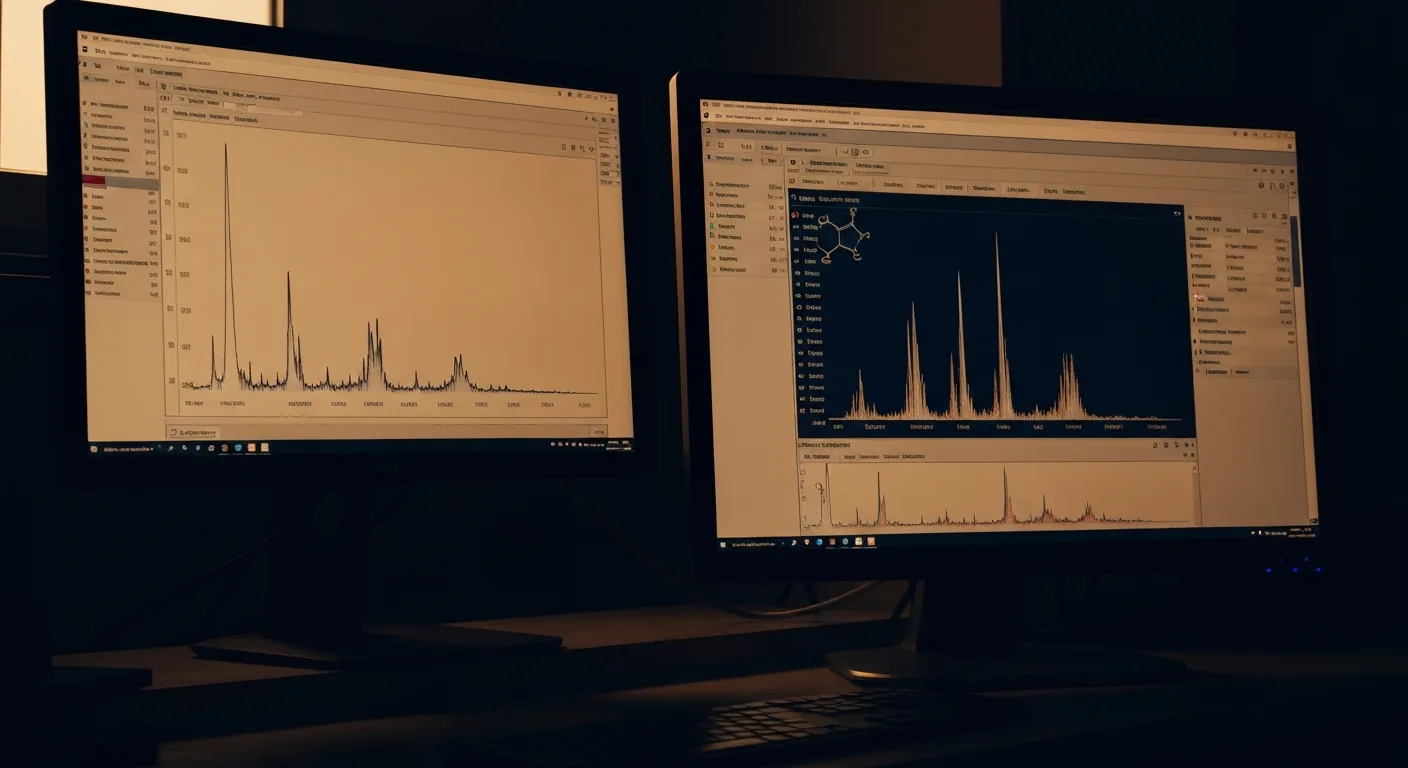
Reversed-phase HPLC (RP-HPLC) is the standard purity assessment method for both peptides per USP General Chapter 621. For BPC-157, optimal separation is achieved on a C18 column (250 mm x 4.6 mm, 5 micrometer particle size) with a gradient of 10-40% acetonitrile in 0.1% TFA over 30 minutes. The peptide typically elutes between 18-22 minutes under these conditions, with a retention time sensitive to the acetate or TFA salt form.
TB-500 analysis requires a broader gradient (15-55% acetonitrile in 0.1% TFA over 35 minutes) due to its larger size and greater hydrophobic surface area. A C4 or C8 column may provide superior peak shape compared to C18 for this larger peptide. Detection at 214 nm (peptide bond absorption) provides the most sensitive and universal detection. For identity confirmation, LC-MS/MS with electrospray ionization (ESI) in positive mode generates multiply charged ions that allow unambiguous molecular weight determination for both peptides.
Salt Forms: Acetate vs. TFA
Both BPC-157 and TB-500 are commonly supplied as either acetate or trifluoroacetate (TFA) salts, reflecting the counterion used during HPLC purification or lyophilization buffer exchange. TFA salt forms are the direct product of RP-HPLC purification using TFA-containing mobile phases. Acetate salts are produced by an additional buffer exchange step into ammonium acetate or acetic acid prior to lyophilization.
The salt form affects the total mass of the lyophilized product without changing the peptide content. TFA contributes approximately 114 Da per counterion equivalent, while acetate contributes approximately 59 Da. For accurate gravimetric preparation, the net peptide content (NPC) provided on the Certificate of Analysis must be used rather than the gross powder weight. TFA salts may exhibit cytotoxicity at high concentrations in cell-based assays, making acetate salts preferable for cell culture applications.
Storage Conditions Comparison
Lyophilized BPC-157 should be stored at minus 20 degrees C in a desiccated environment, protected from light. Under these conditions, the peptide maintains specification purity (greater than 98%) for at least 24 months. Reconstituted solutions in bacteriostatic water should be stored at 2-8 degrees C and used within 30 days.
Lyophilized TB-500 requires minus 20 degrees C storage with identical desiccation and light-protection requirements. Due to its methionine oxidation susceptibility, argon or nitrogen atmosphere packaging is recommended for long-term storage. Reconstituted TB-500 solutions are less stable than BPC-157 solutions and should be stored at 2-8 degrees C with use within 14 days. Aliquoting into single-use volumes before freezing is strongly recommended to avoid repeated freeze-thaw cycles.
Price per Milligram via ChemVerify
ChemVerify aggregates verified supplier pricing for research-grade peptides. BPC-157 (greater than 98% purity, acetate salt) typically ranges from $0.40 to $1.20 per milligram depending on quantity and supplier. TB-500 (greater than 97% purity) commands a higher price of $0.80 to $2.50 per milligram, reflecting the increased synthesis complexity of the 43-residue chain, lower overall yield from SPPS, and more demanding purification requirements.
These prices reflect research-grade material with Certificate of Analysis including RP-HPLC purity, MS confirmation, amino acid analysis, and endotoxin testing. Researchers should verify that suppliers provide complete analytical documentation and third-party testing data. ChemVerify batch verification reports include independent purity confirmation and identity testing for listed suppliers.
Frequently Asked Questions
What is the main structural difference between BPC-157 and TB-500?
BPC-157 is a short 15-amino-acid pentadecapeptide (MW ~1419 Da) derived from human gastric juice protein. TB-500 is a significantly larger 43-amino-acid fragment (MW ~4963 Da) of the thymosin beta-4 protein. This 3.5x difference in molecular weight affects synthesis complexity, HPLC purification behavior, stability profiles, and reconstitution requirements.
Which peptide is more stable in solution?
BPC-157 demonstrates greater stability in acidic environments (pH 2–5) and can tolerate gastric acid conditions without significant degradation. TB-500 is more prone to aggregation in solution due to its larger size and requires careful pH management. Both peptides should be stored lyophilized at −20°C; reconstituted aliquots should be used within 7–14 days when refrigerated.
How can I distinguish BPC-157 from TB-500 on HPLC?
The peptides have distinctly different retention times on C18 RP-HPLC columns due to their size and hydrophobicity differences. TB-500 typically elutes later than BPC-157 under standard gradient conditions (10–90% acetonitrile). Mass spectrometry provides definitive identification: BPC-157 at ~1419 Da and TB-500 at ~4963 Da show no overlap in their mass spectra.
Compounds Referenced in This Article
Explore detailed chemical profiles and research guides for compounds discussed in this article:
- BPC-157: Complete Research Guide → /learn/bpc-157
- TB-500: Complete Research Guide → /learn/tb-500
Further Reading on ChemVerify
- Read more: Melanotan II vs. PT-141: MSH Analog Structural Comparison → https://www.chemverify.com/learn/melanotan-2-vs-pt-141
- Read more: BPC-157: Complete Research Guide & Chemical Profile → https://www.chemverify.com/learn/bpc-157
- Read more: CJC-1295 vs. Ipamorelin: GHRH Analog vs. GHRP Comparison → https://www.chemverify.com/learn/cjc-1295-vs-ipamorelin
- Read more: TB-500: Complete Research Guide & Chemical Profile → https://www.chemverify.com/learn/tb-500
References
Compare Verified Vendors
Browse COA-verified suppliers with exclusive discount codes and transparent pricing.
Continue Reading
Melanotan II vs. PT-141: MSH Analog Structural Comparison
Structural comparison of Melanotan II and PT-141 (bremelanotide) research peptides – cyclic vs linear structure, melanocortin receptor selectivity, molecular weight, and purity analysis.
BPC-157 vs GHK-Cu: Tissue Repair Peptide vs Copper Peptide Compared
BPC-157 and GHK-Cu compared: gastric pentadecapeptide vs copper-binding tripeptide. Structure, mechanisms, research areas, stability profiles, and purity standards analyzed.
BPC-157 Oral vs Injectable: Does Oral Administration Work?
Analytical comparison of BPC-157 oral vs injectable administration routes. Covers gastric stability of this 15-aa pentadecapeptide (~1,419 Da), bioavailability differences, formulation challenges, and detection methods.
BPC-157: Complete Research Guide & Chemical Profile
Comprehensive guide to BPC-157 peptide research. Learn about its chemical properties, molecular structure, research applications, and verified sources.