
Can You Dilute a Previously Reconstituted Peptide? Risks and Best Practices
Yes, you can add more bacteriostatic water to a reconstituted peptide. Learn the contamination risks, sterile technique requirements, concentration math, and when to start fresh.
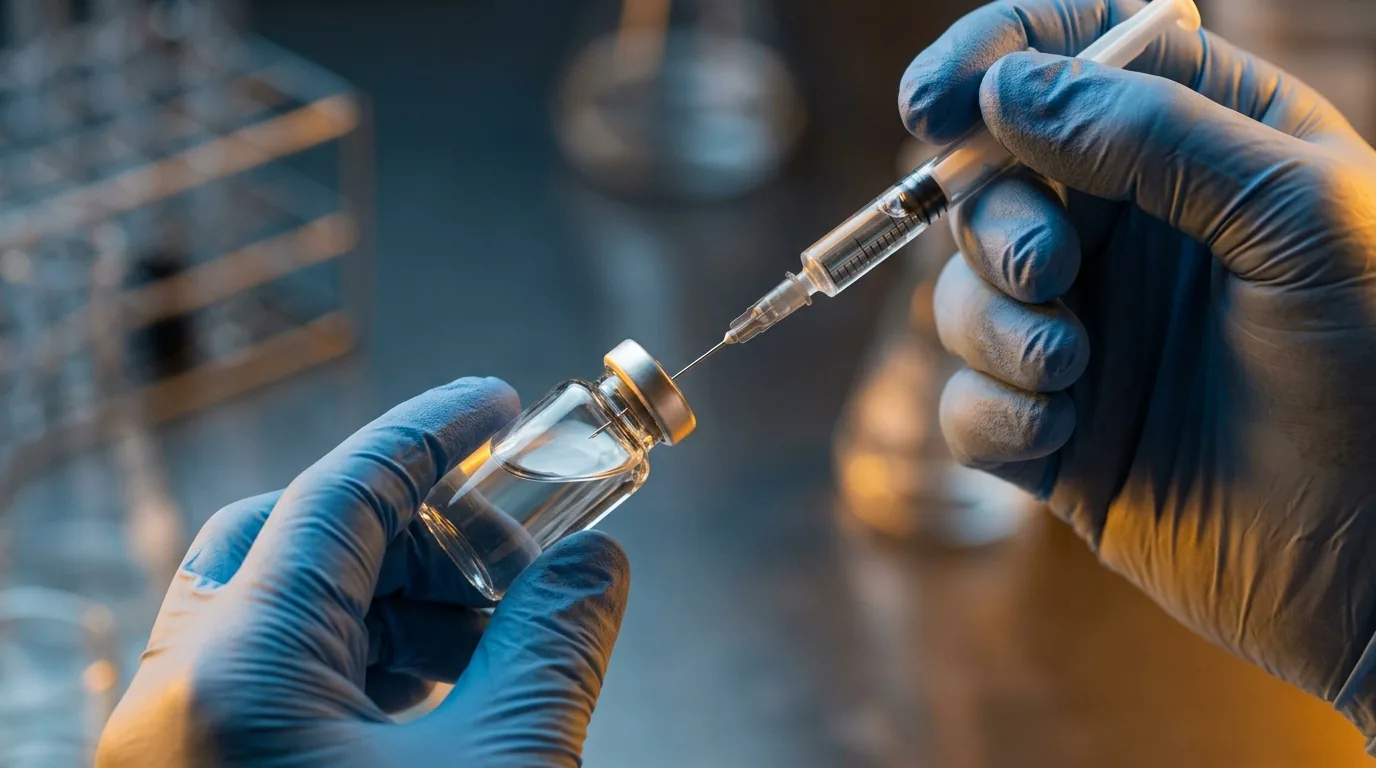
For laboratory research use only. Not for human consumption.
Can You Dilute a Reconstituted Peptide?
One of the most common questions in peptide research laboratories is whether a previously reconstituted peptide can be further diluted by adding more solvent. The concern is valid: once a lyophilized peptide has been dissolved, any additional manipulation introduces potential risks. This guide covers exactly when dilution is appropriate, what hazards to watch for, and how to calculate the resulting concentration accurately.
The Short Answer
Yes, you can add more bacteriostatic water (BAC water) or other appropriate solvent to a previously reconstituted peptide to reduce its concentration. This is a routine laboratory procedure when the initial reconstitution produced a stock solution that is too concentrated for the intended application. However, each time the vial is accessed, the risks of microbial contamination and accelerated chemical degradation increase [1].
Every needle puncture through a vial septum introduces a potential contamination event. Minimize the total number of vial entries to preserve solution integrity.
Contamination Risks When Adding More Solvent
Microbial contamination is the primary concern when diluting a previously reconstituted peptide. Each time a syringe needle penetrates the vial stopper, environmental microorganisms can be introduced. Even with careful technique, the cumulative contamination risk increases with each entry [2].
- Each needle puncture creates a microscopic channel through the rubber septum
- Airborne bacteria and fungi can enter during syringe manipulation
- Skin flora from ungloved or improperly gloved hands can transfer to needle surfaces
- Non-sterile solvents or syringes introduce microbial load directly
- Bacteriostatic water mitigates but does not eliminate contamination risk – benzyl alcohol inhibits growth but does not sterilize
Studies on multi-dose vial contamination demonstrate that the probability of microbial contamination increases approximately linearly with the number of access events. Published data from hospital pharmacy settings show contamination rates of 0.5-3% per access event depending on technique quality [3].
Degradation Risks From Dilution
Beyond contamination, dilution itself can affect peptide stability through several mechanisms:
- Temperature excursion: Removing the vial from refrigerated storage and handling at room temperature accelerates degradation during the dilution procedure
- Oxygen exposure: Opening or puncturing the vial introduces dissolved oxygen, which accelerates methionine and cysteine oxidation [4]
- pH shift: If the added solvent has a different pH than the existing solution, the resulting pH change can alter degradation kinetics
- Adsorption losses: At lower concentrations, a greater proportion of peptide molecules adsorb to glass or plastic surfaces, reducing effective concentration [5]
- Mixing stress: Vigorous mixing or vortexing during dilution can cause surface denaturation and aggregation
Sterile Technique for Dilution
Proper aseptic technique minimizes contamination risk during dilution. The following practices are considered standard for peptide research laboratories [2][3]:
- Work in a laminar flow hood or biosafety cabinet whenever possible
- Disinfect the vial septum with 70% isopropanol and allow to dry completely before needle insertion
- Use a new, sterile syringe and needle for each entry – never reuse injection supplies
- Wear nitrile gloves and avoid touching the needle or syringe tip
- Draw up the additional solvent in a separate sterile syringe before puncturing the peptide vial
- Inject the additional solvent slowly along the vial wall to avoid foaming
- Swirl gently to mix – do not vortex or shake vigorously
- Return the vial to 2-8°C storage immediately after dilution
- Record the dilution volume, new concentration, date, and operator on the vial label
Calculating Concentration After Dilution
Dilution calculations follow the standard formula: C1 × V1 = C2 × V2, where C1 is the initial concentration, V1 is the initial volume, C2 is the final concentration, and V2 is the final volume after adding solvent.
Example: A vial contains 1 mL of peptide at 5 mg/mL. You add 1 mL of BAC water. New concentration: (5 mg/mL × 1 mL) ÷ 2 mL = 2.5 mg/mL. The total peptide mass remains 5 mg, but distributed in 2 mL.
- Always measure volumes precisely using calibrated syringes or pipettes
- Account for any volume already withdrawn from the vial before dilution
- Record the exact volumes added for accurate concentration tracking
- Consider dead volume in syringes – the small amount retained in the needle hub
- For serial dilutions, prepare a dilution log to track cumulative changes
When Dilution Makes Sense
Dilution is appropriate under specific circumstances where the benefits outweigh the risks:
- The initial reconstitution concentration is too high for the experimental protocol
- The peptide is expensive and discarding reconstituted material would be wasteful
- The solution was recently prepared (within 24-48 hours) and has been stored properly at 2-8°C
- Only one additional dilution step is needed – avoid serial dilutions of the same vial
- Sterile working conditions are available (laminar flow hood or equivalent)
- The peptide does not contain highly oxidation-sensitive residues (Met, Cys, Trp)
When to Discard and Start Fresh
In certain situations, discarding the existing solution and reconstituting a new vial is the safer choice:
- The reconstituted solution is more than 14 days old, regardless of storage conditions
- The solution shows any visible turbidity, particulates, discoloration, or precipitate
- The vial septum has been punctured more than 5 times
- The solution was left at room temperature for more than 4 hours
- Sterile technique was not maintained during previous access events
- The experiment requires high-precision quantitative data where even minor degradation matters
- The peptide contains known labile sequences (Asp-Pro, Asn-Gly) and has been in solution for more than 7 days
When in doubt, start fresh. The cost of a new vial is almost always less than the cost of repeating a failed experiment due to degraded peptide.
Step-by-Step Dilution Protocol
Follow this protocol to dilute a previously reconstituted peptide with minimal risk:
- Step 1: Calculate the target concentration and required additional solvent volume using C1V1 = C2V2
- Step 2: Prepare workspace – clean laminar flow hood, gather sterile syringes, alcohol swabs, and pre-chilled BAC water
- Step 3: Remove peptide vial from 2-8°C storage and inspect for turbidity or particulates
- Step 4: Swab the vial septum with 70% isopropanol and allow 30 seconds to dry
- Step 5: Using a new sterile syringe, draw up the calculated volume of BAC water
- Step 6: Insert needle through septum and inject solvent slowly along the inner wall
- Step 7: Withdraw needle and swirl vial gently for 15-30 seconds – do not vortex
- Step 8: Update the vial label with new concentration, dilution date, and total volume
- Step 9: Return vial to 2-8°C storage within 5 minutes of handling
- Step 10: Document the procedure in the laboratory reconstitution log for traceability
Frequently Asked Questions
Can I dilute with sterile water instead of BAC water?
Yes, but sterile water lacks the antimicrobial preservative (benzyl alcohol) present in BAC water. If using sterile water, the solution must be used within 24 hours and stored at 2-8°C, as there is no protection against microbial growth [1].
How many times can I dilute the same vial?
Best practice limits total vial punctures to 5 or fewer. Each additional entry increases contamination risk. If more than two dilution events are needed, reconstituting a new vial at the correct concentration from the start is the better approach [3].
Does dilution affect peptide potency?
Dilution does not directly reduce potency – the total mass of peptide remains constant. However, at very low concentrations (below 0.1 mg/mL), adsorption losses to container walls become significant, effectively reducing the available peptide in solution by 5-20% depending on the container material [5][6].
Should I use a filter when diluting?
Syringe filters (0.22 μm) can remove microbial contaminants but will also adsorb a fraction of the peptide. For small volumes or dilute solutions, filtration losses can be significant. Use filters only when contamination is a primary concern and account for the expected 5-15% adsorption loss [7].
Further Reading on ChemVerify
- Read more: How to Store Reconstituted Peptides: Temperature, Light, and Duration Guide → https://www.chemverify.com/learn/store-reconstituted-peptides-temperature-guide
- Read more: Peptide Stacking: Which Peptides Can Be Combined for Research? → https://www.chemverify.com/learn/peptide-stacking-combinations-research-guide
- Read more: Peptide International Shipping: How to Order Without Quality Loss → https://www.chemverify.com/learn/peptide-international-shipping-quality-guide
- Read more: How to Calculate Peptide Doses from Reconstituted Solutions → https://www.chemverify.com/learn/calculate-peptide-doses-reconstituted-solutions
References
Compare Verified Vendors
Browse COA-verified suppliers with exclusive discount codes and transparent pricing.
Continue Reading
How to Store Reconstituted Peptides: Temperature, Light, and Duration Guide
Complete laboratory guide to reconstituted peptide storage: optimal temperature ranges, light protection protocols, solvent selection, freeze-thaw cycle limits, and stability timelines by peptide class.
Peptide Stacking: Which Peptides Can Be Combined for Research?
Comprehensive guide to peptide stacking in research: synergistic combinations like BPC-157+TB-500 and Ipamorelin+CJC-1295, antagonistic pairs, timing protocols, and reconstitution.
Peptide Reconstitution Math: Calculating Concentrations, Volumes, and Dilutions
Step-by-step guide to reconstitution calculations for research peptides – converting between mass, moles, and concentration units, accounting for net peptide content, and preparing accurate serial dilutions.
Peptide International Shipping: How to Order Without Quality Loss
Guide to international peptide shipping for researchers. Covers cold chain requirements, gel packs vs dry ice, customs declarations, regional import regulations, packaging standards, and arrival checks.