
How to Store Reconstituted Peptides: Temperature, Light, and Duration Guide
Complete laboratory guide to reconstituted peptide storage: optimal temperature ranges, light protection protocols, solvent selection, freeze-thaw cycle limits, and stability timelines by peptide class.
For laboratory research use only. Not for human consumption.
TL;DR: Reconstituted peptides are significantly less stable than their lyophilized precursors, with degradation rates increasing dramatically upon dissolution. Optimal storage of reconstituted peptides requires refrigeration at 2-8°C for short-term use (days to 2 weeks), freezing at -20°C for medium-term storage (2-8 weeks), or -80°C for extended periods (up to 6 months). Light protection, appropriate solvent selection (bacteriostatic water vs. sterile water vs. buffer), single-use aliquoting to avoid freeze-thaw cycles, and sterile technique are critical for maintaining peptide integrity throughout research protocols.
Last verified: April 2026 | Data accuracy confirmed by ChemVerify Editorial Team
Lyophilized vs Reconstituted: Stability Differences
Lyophilized (freeze-dried) peptides represent the most stable form for long-term storage. The removal of water during lyophilization arrests hydrolytic degradation pathways—the primary mechanism of peptide bond cleavage in solution. Properly stored lyophilized peptides at -20°C with desiccant protection maintain chemical integrity for 2-5 years depending on sequence and formulation [1]. The amorphous or microcrystalline solid state restricts molecular mobility and limits oxidative and deamidation reactions.
Upon reconstitution, peptides re-enter an aqueous environment where multiple degradation pathways become kinetically accessible. Hydrolysis of labile peptide bonds (particularly Asp-Pro and Asp-Gly sequences), deamidation of asparagine and glutamine residues, oxidation of methionine and tryptophan side chains, and disulfide scrambling in cysteine-containing peptides all proceed at measurable rates in solution [2]. The rate of these reactions increases with temperature, higher pH, and extended storage duration.
The practical consequence is that reconstitution should be treated as the start of a limited-duration stability clock. Researchers should reconstitute only the amount needed for near-term experiments and maintain the remaining peptide in lyophilized form. This fundamental principle—minimize time in solution—governs all subsequent storage recommendations.
Solvent Selection: Water, BAC Water, and Buffers
Sterile water for injection (WFI) is the simplest reconstitution solvent, providing a neutral, additive-free medium suitable for most peptides. However, sterile water offers no antimicrobial protection, making solutions vulnerable to bacterial contamination within 24-48 hours at room temperature and within 1-2 weeks even at 2-8°C. Sterile water is appropriate only when the reconstituted peptide will be used immediately or stored frozen.
Bacteriostatic water (BAC water) contains 0.9% benzyl alcohol as a preservative, extending the microbiological shelf life of reconstituted peptides at 2-8°C to approximately 28 days [3]. The benzyl alcohol inhibits bacterial and fungal growth through membrane disruption. BAC water is the preferred solvent for peptides that will be accessed multiple times from a single vial over days to weeks. However, benzyl alcohol may interfere with certain bioassays (particularly cell viability assays at high concentrations) and is not suitable for intrathecal administration research.
Buffer systems (PBS, Tris-HCl, HEPES, ammonium bicarbonate) provide pH stabilization that can extend chemical stability. Many degradation reactions are pH-dependent: deamidation accelerates above pH 7, while Asp-isomerization is minimized near pH 5-6 [2]. For peptides requiring specific pH ranges, reconstitution in an appropriate buffer at the optimal stability pH is preferable to unbuffered water. Acetate buffer (pH 4-5) is often recommended for cysteine-containing peptides to minimize disulfide exchange.
Temperature Ranges: 4°C vs -20°C vs -80°C
Refrigeration at 2-8°C (standard laboratory refrigerator) is suitable for short-term storage of reconstituted peptides that will be used within 1-14 days. Chemical degradation proceeds slowly at this temperature (roughly 5-10x slower than at 25°C based on Arrhenius kinetics), and bacterial growth is suppressed in BAC water preparations. Most linear peptides without oxidation-sensitive residues maintain >90% integrity for 7-14 days at 4°C when properly handled [4].
Storage at -20°C (standard laboratory freezer) extends reconstituted peptide stability to 4-8 weeks for most sequences. At this temperature, aqueous solutions do not freeze completely (especially in the presence of salts or buffers), existing in a supercooled glassy state that dramatically reduces reaction kinetics. However, the freeze-concentration effect at the ice-liquid interface can locally increase peptide and salt concentrations, potentially accelerating degradation at phase boundaries. This is the primary argument for -80°C over -20°C storage.
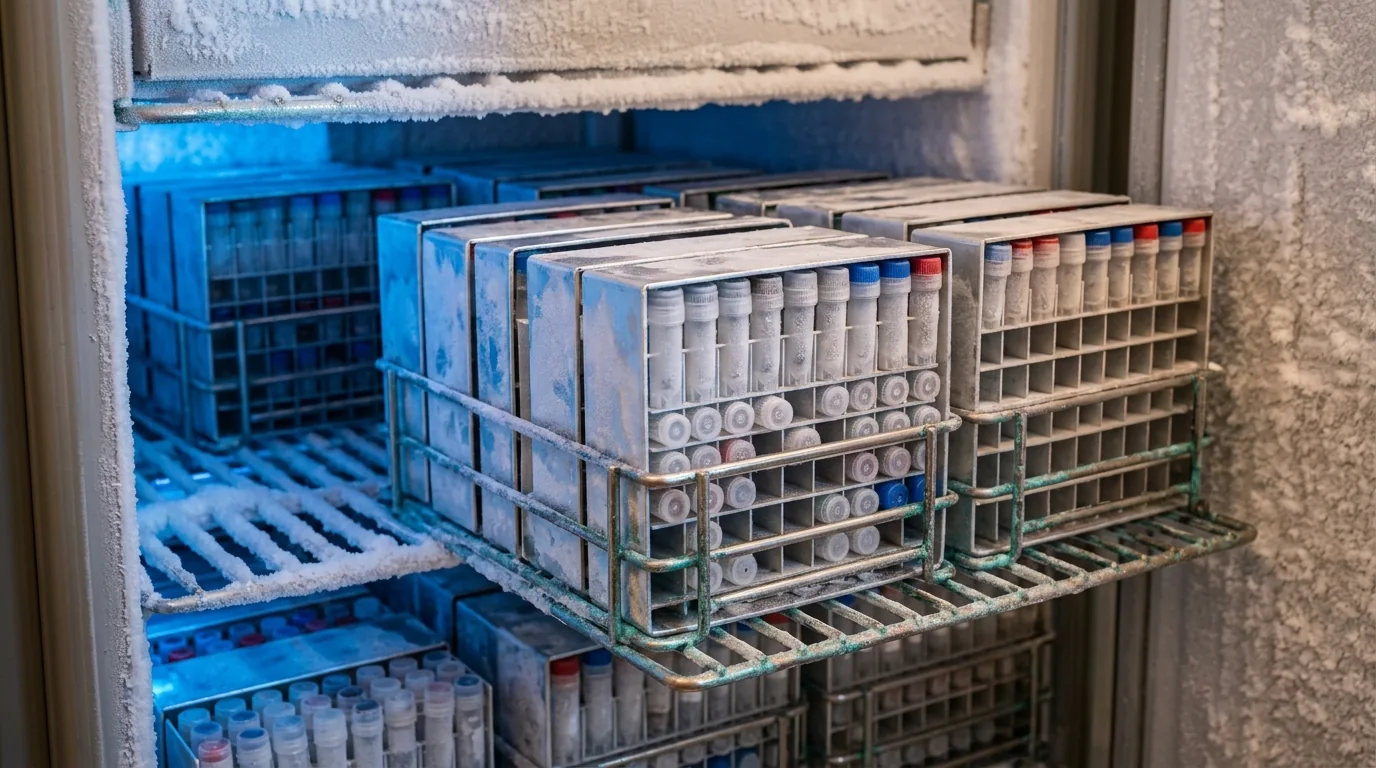
Ultra-low temperature storage at -80°C provides the best stability for reconstituted peptides, supporting integrity maintenance for 3-6 months depending on peptide sequence and formulation. At -80°C, molecular mobility is essentially arrested, and all degradation pathways proceed at negligible rates. The disadvantage is the requirement for specialized freezer equipment and the thermal stress imposed during retrieval (temperature cycling). Single-use aliquots stored at -80°C represent the gold standard for long-term reconstituted peptide storage.
Light Protection & Photodegradation Mechanisms
Photodegradation is a significant concern for peptides containing tryptophan, tyrosine, phenylalanine, histidine, and cysteine/cystine residues. UV-A (315-400 nm) and visible light (400-500 nm range) can initiate photochemical reactions including tryptophan photooxidation to N-formylkynurenine, tyrosine cross-linking to dityrosine, and disulfide bond photolysis in cystine-containing peptides [5]. These reactions are oxygen-dependent and proceed faster in aerated solutions.
Amber glass vials provide effective UV protection by filtering wavelengths below approximately 450 nm. For peptides stored in clear glass or polypropylene containers, wrapping vials in aluminum foil provides equivalent light protection. Opaque storage boxes in refrigerators and freezers further minimize light exposure during storage. The most critical exposure window is during bench-top handling, when solutions are exposed to laboratory fluorescent or LED lighting.
For photosensitive peptides (those containing multiple Trp/Tyr/Cys residues), additional protective measures include reconstitution under dim or red-filtered light, nitrogen sparging to reduce dissolved oxygen before storage, and inclusion of antioxidants (0.01% ascorbic acid or 1 mM methionine) in reconstitution buffers. These precautions are particularly important for extended storage periods where cumulative photon exposure becomes significant.
Freeze-Thaw Cycle Guidelines & Aliquoting
Repeated freeze-thaw cycling is one of the most damaging processes for reconstituted peptides. Each cycle imposes thermal stress, ice crystal formation and growth (which can mechanically disrupt peptide structure), freeze-concentration of solutes at ice-liquid interfaces, and pH shifts in buffer systems during freezing [6]. Studies on protein therapeutics demonstrate measurable aggregation and degradation after as few as 3-5 freeze-thaw cycles, and similar principles apply to peptides.
The recommended practice is to aliquot reconstituted peptides into single-use volumes immediately after reconstitution, before the first freeze. Typical aliquot volumes should match the expected experimental use per session (10-100 µL depending on the assay format). Using low-binding microcentrifuge tubes (polypropylene or siliconized) minimizes peptide adsorption to container surfaces, which becomes proportionally more significant at lower concentrations and smaller volumes.
If multiple freeze-thaw cycles are unavoidable (e.g., limited peptide supply), the maximum recommended number is 3 cycles, with rapid thawing at 37°C or room temperature followed by immediate refreezing. Slow thawing (e.g., overnight in a refrigerator) should be avoided as it extends the time peptides spend at the destructive ice-liquid interface. After the third cycle, a fresh aliquot should be used regardless of remaining volume.
Duration Limits by Peptide Class
Linear peptides without oxidation-sensitive residues (no Cys, Met, or Trp) represent the most stable class in solution. Examples include short linear fragments like GHK and many kinase substrate peptides. These can be stored at 4°C for up to 14 days, at -20°C for 6-8 weeks, and at -80°C for 6 months with minimal degradation when reconstituted in BAC water or neutral buffer.
Cysteine-containing and disulfide-bridged peptides (oxytocin, somatostatin analogs, many antimicrobial peptides) require more stringent conditions due to disulfide exchange, oxidation, and thiol-mediated degradation. Storage at 4°C should be limited to 3-5 days, with -20°C suitable for 2-4 weeks and -80°C for up to 3 months. Reconstitution in mildly acidic buffer (pH 4-5) with oxygen exclusion significantly extends stability [7].
Large polypeptides and mini-proteins (>30 residues, e.g., follistatin, growth factors) exhibit additional aggregation-related instability in solution. These are most susceptible to surface adsorption and aggregation at air-liquid and liquid-solid interfaces. Adding 0.01-0.1% (w/v) bovine serum albumin (BSA) or Tween-20 as a carrier/surfactant can dramatically improve recovery and stability. Aliquoting is critical, as aggregation nucleated during freeze-thaw can propagate through the entire solution.
Container & Closure Considerations
Polypropylene microcentrifuge tubes and cryovials are the standard containers for reconstituted peptide storage. Polypropylene has low non-specific binding for most peptides and is resistant to cracking at -80°C. Low-retention or siliconized tubes further reduce surface adsorption, which is particularly important for hydrophobic peptides and storage at concentrations below 100 µg/mL where surface losses become proportionally significant [4].
Glass vials (Type I borosilicate) are preferred when peptide-plastic interactions are a concern or for long-term storage, as glass is chemically inert and provides superior oxygen barrier properties. Amber glass offers integrated light protection. Crimped septum closures maintain sterility through repeated needle penetrations, making glass vials the standard format for multi-dose peptide preparations used with BAC water reconstitution.
Regardless of container type, headspace should be minimized to reduce dissolved oxygen in solution. For critical samples, nitrogen or argon gas overlay before sealing displaces headspace oxygen and significantly reduces oxidative degradation rates. Parafilm wrapping around cap-vial junctions provides an additional moisture and contamination barrier for long-term freezer storage where frost accumulation is common.
Stability Indicators: When to Discard
Visual inspection provides the first line of quality assessment for reconstituted peptides. Solutions should be clear and colorless (or very faintly yellow for peptides with aromatic residues). Cloudiness or visible particulates indicate precipitation or aggregation and are grounds for immediate discard. Yellowing or browning suggests oxidative degradation or Maillard-type reactions. Color changes are particularly common in tryptophan-containing peptides undergoing photooxidation.
Analytical verification by reversed-phase HPLC provides the definitive assessment of reconstituted peptide integrity. A >10% decrease in the main peak area (relative to a freshly reconstituted reference) or the appearance of new degradation peaks indicates unacceptable degradation. For critical experiments, re-analysis of stored solutions before use is prudent, especially when approaching the recommended storage duration limits.
pH measurement of unbuffered peptide solutions can reveal degradation. Hydrolysis products (free amino acids and short fragments) and deamidation products (aspartic acid from asparagine) alter solution pH. A pH shift of >0.5 units from the initial reconstitution value suggests significant chemical change. Additionally, unusual odors (acrid or sulfurous) indicate cysteine oxidation or general decomposition and warrant immediate disposal of the affected lot.
References & Further Reading
Compounds Referenced in This Article
Explore detailed chemical profiles and research guides for compounds discussed in this article:
- Bacteriostatic Water: Complete Research Guide → /learn/bacteriostatic-water
Further Reading on ChemVerify
- Read more: Complete Peptide Solubility Guide: Solutions for Research Success → https://www.chemverify.com/learn/complete-peptide-solubility-guide-solutions-for-research-success
- Read more: How to Reconstitute CJC-1295 DAC with Bacteriostatic Water: Step-by-Step Guide → https://www.chemverify.com/learn/how-to-reconstitute-cjc-1295-dac
- Read more: Bacteriostatic Water for Peptides: Complete Guide to Safe Reconstitution → https://www.chemverify.com/learn/bacteriostatic-water-for-peptides-complete-guide-to-safe-reconstitution
- Read more: Lyophilized Peptide Handling: Best Practices for Research Applications → https://www.chemverify.com/learn/lyophilized-peptide-handling-best-practices-for-research-applications
References
Compare Verified Vendors
Browse COA-verified suppliers with exclusive discount codes and transparent pricing.
You Might Also Like
Continue Reading
Complete Peptide Solubility Guide: Solutions for Research Success
Master peptide solubility with our comprehensive guide. Learn proper solvents, pH optimization, and troubleshooting techniques for research applications.
Insulin Syringes for Peptides: Gauge, Volume, and Selection Guide
Complete guide to selecting insulin syringes for peptide research. Covers U-100 vs U-40 calibration, needle gauges 28G-31G, syringe volumes 0.3-1.0 mL, dead space, and single-use protocols.
How to Reconstitute CJC-1295 DAC with Bacteriostatic Water: Step-by-Step Guide
Complete reconstitution protocol for CJC-1295 DAC using bacteriostatic water. Covers preparation, sterile technique, concentration calculations, and proper storage at 2-8°C.
Peptide Storage Conditions: Temperature, Humidity, and Container Guidelines
Evidence-based guidelines for storing lyophilized and reconstituted research peptides – temperature ranges, humidity control, container selection, light protection, and degradation pathway prevention.