
How to Reconstitute CJC-1295 DAC with Bacteriostatic Water: Step-by-Step Guide
Complete reconstitution protocol for CJC-1295 DAC using bacteriostatic water. Covers preparation, sterile technique, concentration calculations, and proper storage at 2-8°C.
For laboratory research use only. Not for human consumption.
Last verified: March 2026 | Data accuracy confirmed by ChemVerify Editorial Team
TL;DR: To reconstitute CJC-1295 DAC, add bacteriostatic water (BAC water) slowly down the inner vial wall – do not inject directly onto the lyophilized powder. For a 2 mg vial, adding 1 mL yields 2 mg/mL (2000 mcg/mL); adding 2 mL yields 1 mg/mL (1000 mcg/mL). Store reconstituted solution at 2–8°C. The DAC (Drug Affinity Complex) modification extends solution stability compared to non-DAC CJC-1295.
Equipment & Materials Checklist
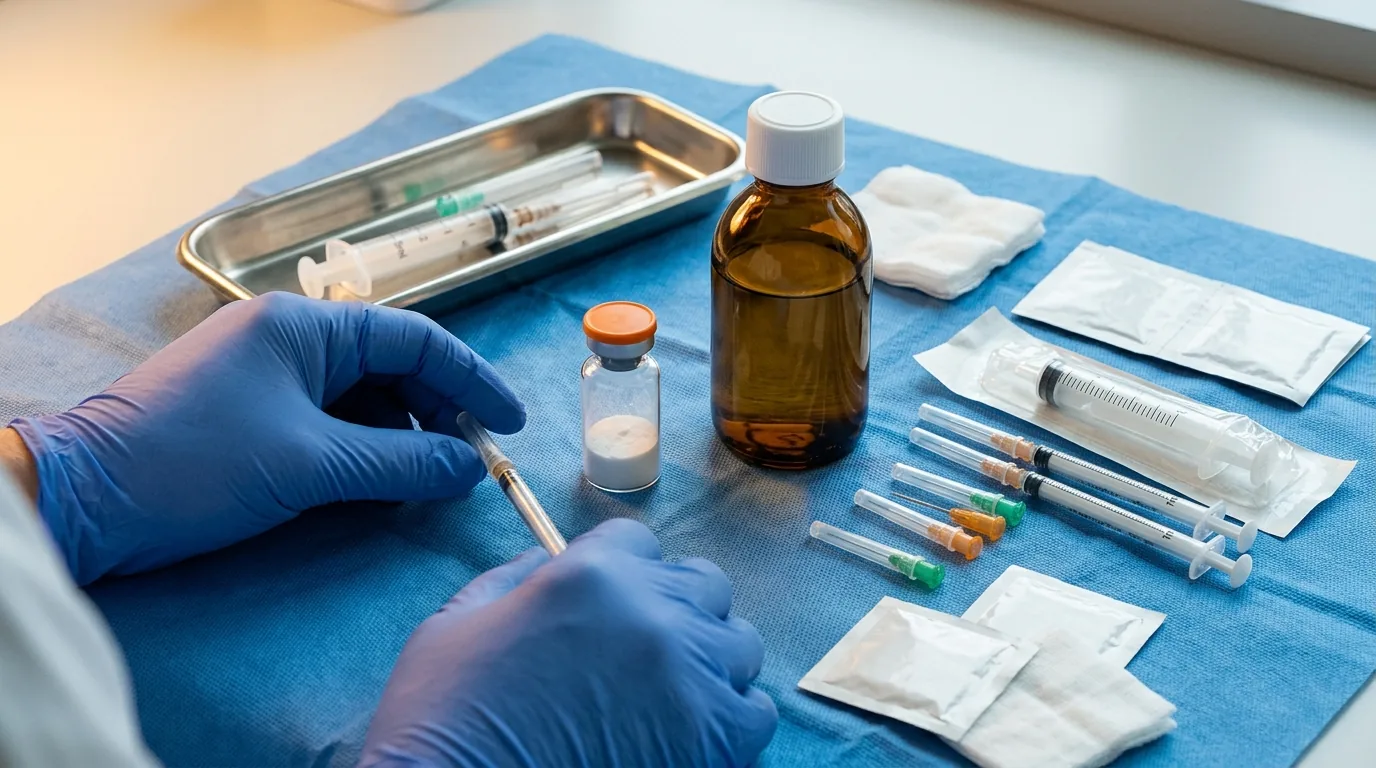
Gather all materials before beginning reconstitution. Working with a complete setup minimizes contamination risk and ensures a smooth process.
Required Materials
- CJC-1295 DAC lyophilized vial (typically 2 mg or 5 mg)
- Bacteriostatic water for injection (0.9% benzyl alcohol, USP grade)
- Sterile syringe (1 mL or 3 mL, Luer-lock preferred)
- Sterile needle (25–27 gauge for drawing BAC water, 29–30 gauge for vial injection)
- Alcohol swabs (70% isopropyl alcohol)
- Sterile gloves (powder-free nitrile recommended)
- Clean, flat work surface
- Sharps disposal container
Never reuse syringes or needles between different compounds. Use a fresh sterile syringe for each reconstitution.
Preparation Before Reconstitution
Proper preparation ensures sterility and prevents contamination of both the peptide vial and the bacteriostatic water. Perform all steps on a clean, disinfected surface. If available, use a laminar flow hood for optimal sterile conditions.
Pre-Reconstitution Steps
- Step 1: Wash hands thoroughly and put on sterile nitrile gloves
- Step 2: Wipe down the work surface with 70% isopropyl alcohol and allow to air dry
- Step 3: Remove the CJC-1295 DAC vial from storage – allow it to reach room temperature (15–25°C) for 5–10 minutes
- Step 4: Do NOT remove the rubber stopper from either vial – work through the stopper with needles
- Step 5: Swab the rubber stoppers of both the peptide vial and BAC water vial with an alcohol swab
- Step 6: Allow alcohol to evaporate completely (~30 seconds) before piercing
Allowing the vial to reach room temperature prevents condensation inside the vial, which can affect reconstitution accuracy and introduce moisture-related degradation.
Step-by-Step Reconstitution Protocol
Follow this protocol carefully. The key principle is gentle handling – peptides are fragile molecules that can denature if agitated violently or exposed to thermal shock.
Reconstitution Procedure
- Step 1: Attach a 25–27 gauge needle to a sterile syringe. Draw the desired volume of bacteriostatic water (see Concentration Calculations section below).
- Step 2: Remove air bubbles from the syringe by holding it needle-up and gently tapping, then pushing the plunger until a small drop appears at the needle tip.
- Step 3: Insert the needle through the rubber stopper of the CJC-1295 DAC vial at a slight angle.
- Step 4: Slowly inject the BAC water down the inner glass wall of the vial – do NOT spray directly onto the lyophilized powder cake. Let the water trickle down the wall and contact the powder gradually.
- Step 5: Once all water is added, withdraw the needle gently.
- Step 6: Let the vial sit undisturbed for 2–3 minutes. The powder will begin dissolving on its own.
- Step 7: If undissolved particles remain, gently roll the vial between your palms for 30–60 seconds. NEVER shake or vortex.
- Step 8: Inspect the solution – it should be clear and colorless. Discard if cloudy, discolored, or containing visible particulates.
Visual Clarity Check
A properly reconstituted CJC-1295 DAC solution is completely clear and colorless. Slight opalescence may be acceptable but true cloudiness, visible particles, or color changes (yellow, brown) indicate potential degradation or contamination. Do not use solutions that fail visual inspection.
Concentration Calculations
The final concentration of your reconstituted solution depends on the peptide amount in the vial and the volume of bacteriostatic water added. The formula is straightforward: Concentration = Mass ÷ Volume.
2 mg Vial Examples
| BAC Water Volume | Concentration (mg/mL) | Concentration (mcg per 0.1 mL) |
|---|---|---|
| 0.5 mL | 4.0 mg/mL | 400 mcg per 0.1 mL |
| 1.0 mL | 2.0 mg/mL | 200 mcg per 0.1 mL |
| 2.0 mL | 1.0 mg/mL | 100 mcg per 0.1 mL |
| 4.0 mL | 0.5 mg/mL | 50 mcg per 0.1 mL |
5 mg Vial Examples
| BAC Water Volume | Concentration (mg/mL) | Concentration (mcg per 0.1 mL) |
|---|---|---|
| 1.0 mL | 5.0 mg/mL | 500 mcg per 0.1 mL |
| 2.0 mL | 2.5 mg/mL | 250 mcg per 0.1 mL |
| 2.5 mL | 2.0 mg/mL | 200 mcg per 0.1 mL |
| 5.0 mL | 1.0 mg/mL | 100 mcg per 0.1 mL |
These calculations assume 100% net peptide content. Actual concentrations may be lower depending on the net peptide content reported on the Certificate of Analysis. See our reconstitution math guide for NPC-corrected calculations.
DAC vs Non-DAC: Stability Difference
CJC-1295 is available in two forms: with DAC (Drug Affinity Complex) and without DAC (also called Mod GRF 1-29 or CJC-1295 no DAC). The DAC modification is a maleimidopropionic acid (MPA) linker conjugated to Lys at position 21, which facilitates covalent binding to serum albumin. This has significant implications for solution stability and storage.
| Property | CJC-1295 DAC | CJC-1295 no DAC (Mod GRF 1-29) |
|---|---|---|
| Molecular Weight | ~3,647.28 Da | ~3,367.9 Da |
| Amino Acids | 30 (modified) | 29 (modified) |
| DAC Linker | MPA-Lys conjugate at position 21 | None |
| Reconstituted Stability (2-8°C) | Up to 21–28 days | Up to 7–14 days |
| Lyophilized Stability (-20°C) | ≥24 months | ≥24 months |
| Albumin Binding | Covalent (via DAC) | None |
| Reconstitution Solvent | BAC water preferred | BAC water or sterile water |
The DAC modification gives CJC-1295 DAC superior reconstituted solution stability compared to the non-DAC version. This is the primary practical advantage for laboratory handling – reconstituted DAC solutions remain stable at 2–8°C for up to 3–4 weeks, while non-DAC solutions should be used within 1–2 weeks.
Storage Protocol After Reconstitution
Proper post-reconstitution storage is critical for maintaining peptide integrity and preventing microbial contamination. Even with the bacteriostatic properties of BAC water, temperature control remains essential.
Storage Guidelines
- Immediately refrigerate at 2–8°C after reconstitution
- Store upright to minimize stopper contact with solution
- Protect from light – wrap vial in aluminum foil or store in opaque container
- Do NOT freeze reconstituted solutions – ice crystal formation can denature the peptide
- Use within 21–28 days of reconstitution (DAC version)
- Always swab the stopper with alcohol before each withdrawal
- Use a fresh sterile needle for each withdrawal to prevent coring and contamination
- Label the vial with: compound name, concentration, reconstitution date, and expiration date
If you need to store reconstituted CJC-1295 DAC for longer than 28 days, aliquot into single-use volumes and flash-freeze at -20°C. Avoid repeated freeze-thaw cycles.
Common Mistakes to Avoid
- Spraying BAC water directly onto the powder cake – causes foaming, incomplete dissolution, and potential denaturation from localized high concentration
- Shaking or vortexing the vial – creates foam and can mechanically denature the peptide through shear forces
- Using non-sterile technique – contamination introduces bacteria that degrade the peptide and produce endotoxins
- Reconstituting a cold vial – condensation inside the vial adds unknown water volume and accelerates degradation
- Using sterile water instead of BAC water for multi-use – sterile water lacks preservative, allowing bacterial growth after first needle puncture
- Storing at room temperature – reconstituted peptides degrade rapidly above 8°C, with significant potency loss within 48 hours at 25°C
- Using too little BAC water – highly concentrated solutions are more prone to aggregation and precipitation
- Forgetting to label – unlabeled vials lead to dosing errors and uncertainty about compound identity and concentration
Frequently Asked Questions
How much bacteriostatic water should I add to a 2 mg vial of CJC-1295 DAC?
The volume depends on your desired concentration. Adding 1 mL of BAC water to a 2 mg vial yields 2 mg/mL (200 mcg per 0.1 mL). Adding 2 mL yields 1 mg/mL (100 mcg per 0.1 mL). Choose a volume that gives you convenient measurement increments for your research protocol. See the concentration calculation tables above for more options.
Can I use sterile water instead of bacteriostatic water?
For single-use reconstitution, sterile water for injection is acceptable. However, for multi-use vials (which is the typical scenario), bacteriostatic water is strongly recommended. The 0.9% benzyl alcohol in BAC water inhibits bacterial growth, keeping the solution safe for repeated needle entries over 21–28 days. Sterile water has no preservative and risks microbial contamination after the first puncture.
What should I do if the reconstituted solution is cloudy?
Cloudiness indicates potential peptide aggregation, denaturation, or contamination. First, confirm you added the water gently and did not shake the vial. If cloudiness persists after 10 minutes of gentle rolling, do not use the solution. Possible causes include: expired or improperly stored peptide, contaminated BAC water, or incompatible pH. Discard and reconstitute a fresh vial.
How long does reconstituted CJC-1295 DAC remain stable?
When reconstituted with bacteriostatic water and stored at 2–8°C, CJC-1295 DAC remains stable for approximately 21–28 days. The DAC modification enhances solution stability compared to the non-DAC version (which is stable for only 7–14 days). For extended storage beyond 28 days, aliquot into single-use volumes and store at -20°C to minimize degradation.
What is the difference between CJC-1295 DAC and CJC-1295 no DAC?
CJC-1295 DAC (MW ~3,647 Da) contains a Drug Affinity Complex – a maleimidopropionic acid linker at Lys21 that enables covalent albumin binding. CJC-1295 no DAC (also called Mod GRF 1-29, MW ~3,368 Da) lacks this linker. The DAC version has a longer half-life in biological systems and superior reconstituted solution stability (21–28 days vs 7–14 days at 2–8°C). Both share the same core GHRH(1-29) modified sequence with Aib substitutions at positions 2, 8, 15, and 27.
For reconstitution math, concentration calculators, and dilution guides, see our complete Reconstitution Math guide. Compare verified CJC-1295 DAC pricing across vendors at chemverify.com/product/cjc-1295-dac
Compounds Referenced in This Article
Explore detailed chemical profiles and research guides for compounds discussed in this article:
- Bacteriostatic Water: Complete Research Guide → /learn/bacteriostatic-water
- CJC-1295: Complete Research Guide → /learn/cjc-1295-no-dac
Further Reading on ChemVerify
- Read more: CJC-1295 (No DAC): Complete Research Guide & Chemical Profile → https://www.chemverify.com/learn/cjc-1295
- Read more: Peptide Storage Conditions: Temperature, Humidity, and Container Guidelines → https://www.chemverify.com/learn/peptide-storage-conditions
- Read more: Peptide Reconstitution Math: Calculating Concentrations, Volumes, and Dilutions → https://www.chemverify.com/learn/reconstitution-math-explained
- Read more: Bacteriostatic Water for Peptides: Complete Guide to Safe Reconstitution → https://www.chemverify.com/learn/bacteriostatic-water-for-peptides-complete-guide-to-safe-reconstitution
References
Compare Verified Vendors
Browse COA-verified suppliers with exclusive discount codes and transparent pricing.
You Might Also Like
Continue Reading
How to Store Reconstituted Peptides: Temperature, Light, and Duration Guide
Complete laboratory guide to reconstituted peptide storage: optimal temperature ranges, light protection protocols, solvent selection, freeze-thaw cycle limits, and stability timelines by peptide class.
Peptide Storage Conditions: Temperature, Humidity, and Container Guidelines
Evidence-based guidelines for storing lyophilized and reconstituted research peptides – temperature ranges, humidity control, container selection, light protection, and degradation pathway prevention.
Peptide Reconstitution Math: Calculating Concentrations, Volumes, and Dilutions
Step-by-step guide to reconstitution calculations for research peptides – converting between mass, moles, and concentration units, accounting for net peptide content, and preparing accurate serial dilutions.
Bacteriostatic Water for Peptides: Complete Guide to Safe Reconstitution
Learn how bacteriostatic water ensures safe peptide reconstitution. Complete guide covering storage, sterility, usage protocols, and best practices for research.