
CJC-1295 (No DAC): Complete Research Guide & Chemical Profile
Comprehensive guide to CJC-1295 (No DAC), a modified GHRH analog peptide. Learn about its chemical properties, research applications, and laboratory uses.
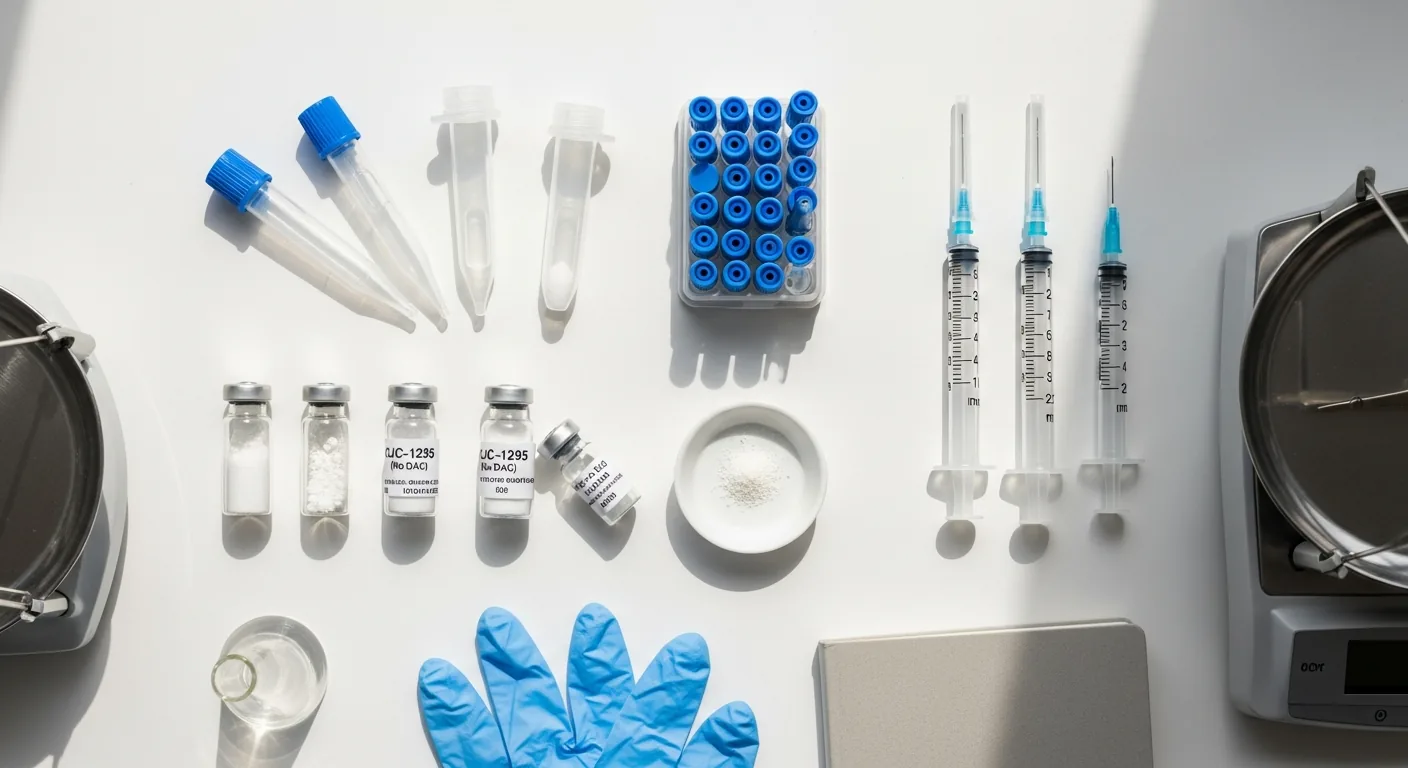
For laboratory research use only. Not for human consumption. This article is intended for educational purposes and does not constitute medical advice.
TL;DR: CJC-1295 (with DAC) is a 30-amino-acid modified GHRH analog (MW ~3647.28 Da) with a Drug Affinity Complex enabling extended half-life via albumin binding. Research-grade CJC-1295 requires ≥95% HPLC purity with MALDI-TOF mass confirmation. The DAC modification distinguishes it from the non-DAC variant (Mod GRF 1-29). Compare verified CJC-1295 pricing across vendors at chemverify.com.
Last verified: March 2026 | Data accuracy confirmed by ChemVerify Editorial Team
What Is CJC-1295 (No DAC)?
CJC-1295 (No DAC) is a synthetic analog of Growth Hormone Releasing Hormone (GHRH) that has been modified to enhance stability and biological activity in laboratory research settings. The peptide consists of 29 amino acids with the molecular formula C152H252N44O42 and a molecular weight of approximately 3367.97 Da.
The "No DAC" designation refers to the absence of Drug Affinity Complex, distinguishing it from the DAC-conjugated version. This modification affects the peptide's half-life and research applications. The compound maintains the core GHRH sequence while incorporating specific amino acid substitutions that improve resistance to enzymatic degradation.
Research laboratories commonly utilize CJC-1295 (No DAC) in combination with other peptides, particularly Ipamorelin, to study growth hormone release mechanisms and related physiological pathways. The peptide's structure allows for targeted investigation of GHRH receptor interactions and downstream signaling cascades.
Research Background & Key Studies
The development of CJC-1295 emerged from research aimed at creating more stable GHRH analogs for laboratory applications. Initial studies by ConjuChem Biotechnologies focused on enhancing the peptide's resistance to dipeptidyl peptidase-IV (DPP-IV) and other proteases that rapidly degrade native GHRH.
Laboratory investigations have demonstrated that CJC-1295 (No DAC) exhibits significantly improved stability compared to native GHRH, with research suggesting enhanced binding affinity to GHRH receptors. Studies indicate that the peptide maintains biological activity for extended periods in controlled laboratory environments.
Research has explored the peptide's pharmacokinetic properties, showing that CJC-1295 (No DAC) has a relatively short half-life of approximately 30 minutes, making it suitable for acute research protocols. This characteristic distinguishes it from the DAC-conjugated version, which exhibits prolonged activity.
Contemporary research applications include studies on growth hormone pulsatility, metabolic regulation, and cellular signaling pathways. The peptide serves as a valuable research tool for investigating GHRH receptor biology and related physiological mechanisms in laboratory models.
Mechanism of Action
CJC-1295 (No DAC) functions as a selective agonist of the Growth Hormone Releasing Hormone receptor (GHRH-R), a G-protein coupled receptor predominantly expressed in anterior pituitary somatotroph cells. Upon binding, the peptide activates adenylyl cyclase, leading to increased cyclic adenosine monophosphate (cAMP) levels.
The elevated cAMP concentrations trigger protein kinase A (PKA) activation, which phosphorylates cAMP response element-binding protein (CREB). Phosphorylated CREB then binds to cAMP response elements in the growth hormone gene promoter, initiating transcription of growth hormone mRNA.
Growth Hormone Pathway Activation
Research indicates that CJC-1295 (No DAC) stimulates growth hormone release through the classical GHRH signaling pathway. The peptide's modified structure enhances receptor binding specificity while maintaining the natural pulsatile pattern of growth hormone secretion observed in laboratory studies.
Studies suggest that the peptide's action is calcium-dependent, requiring adequate intracellular calcium levels for optimal growth hormone release. This mechanism ensures that CJC-1295 (No DAC) works synergistically with endogenous regulatory systems in research applications.
Chemical Properties
CJC-1295 (No DAC) exhibits specific physicochemical characteristics that influence its research applications and handling requirements. The peptide demonstrates good solubility in sterile water and phosphate-buffered saline solutions commonly used in laboratory protocols.
The compound's stability profile shows sensitivity to extreme pH conditions, with optimal stability maintained at physiological pH (7.0-7.4). Temperature sensitivity requires careful handling and storage protocols to preserve peptide integrity during research applications.
Purity Standards
High-quality research-grade CJC-1295 (No DAC) typically meets purity standards of ≥99% as determined by high-performance liquid chromatography (HPLC) analysis. This purity level ensures consistent results in laboratory applications and minimizes interference from impurities or degradation products.
Analytical methods for purity verification include mass spectrometry, amino acid analysis, and peptide content determination. These quality control measures are essential for maintaining research reproducibility and data integrity in laboratory studies.
Storage & Stability
Optimal storage conditions for CJC-1295 (No DAC) include refrigeration at 2-8°C for short-term storage and freezing at -20°C or below for long-term preservation. The lyophilized peptide demonstrates excellent stability when stored under appropriate conditions with protection from light and moisture.
Once reconstituted, the peptide solution should be used promptly or stored under refrigerated conditions for limited periods. Research protocols should account for potential degradation over time and implement appropriate storage validation studies.
Verified Sources on ChemVerify
Researchers seeking verified CJC-1295 (No DAC) suppliers can utilize ChemVerify's comprehensive database of third-party tested research peptides. The platform provides access to vendor verification data, batch testing results, and purity certificates to ensure research quality and reproducibility.
ChemVerify's verification process includes independent laboratory analysis of peptide purity, identity confirmation through mass spectrometry, and vendor compliance assessment. Users can find verified vendors and third-party tested batches for CJC-1295 (No DAC) on ChemVerify at /product/cjc-1295.
The platform's database includes batch-specific information, analytical certificates, and vendor ratings to support informed decision-making in research peptide procurement. This transparency helps researchers maintain consistent quality standards across experimental protocols.
Frequently Asked Questions
**What is the difference between CJC-1295 with DAC and without DAC?**
CJC-1295 (No DAC) lacks the Drug Affinity Complex modification, resulting in a shorter half-life of approximately 30 minutes compared to the DAC version's extended duration. This difference affects research protocol design and experimental timing in laboratory studies.
**How should CJC-1295 (No DAC) be reconstituted for research use?**
Research protocols typically employ sterile bacteriostatic water or sterile saline for reconstitution. The reconstitution process should follow aseptic techniques with gentle mixing to avoid peptide aggregation or degradation during preparation.
**What are common research applications for CJC-1295 (No DAC)?**
Laboratory applications include studies on growth hormone release mechanisms, GHRH receptor pharmacology, metabolic research, and combination studies with other research peptides such as Ipamorelin. The peptide serves as a valuable tool for investigating pituitary function and growth hormone regulation.
**How stable is CJC-1295 (No DAC) in solution?**
Once reconstituted, the peptide maintains stability for limited periods under refrigerated conditions. Research protocols should implement appropriate storage validation and use freshly prepared solutions when possible to ensure optimal peptide activity and experimental reliability.
**Can CJC-1295 (No DAC) be combined with other research peptides?**
Research literature suggests that CJC-1295 (No DAC) is commonly studied in combination with other peptides, particularly Ipamorelin, to investigate synergistic effects on growth hormone release. Combination studies require careful protocol design to account for potential interactions and optimize research outcomes.
**What analytical methods are used to verify CJC-1295 (No DAC) identity and purity?**
Standard analytical methods include HPLC for purity determination, mass spectrometry for molecular weight confirmation, amino acid analysis for sequence verification, and peptide content analysis. These methods ensure research-grade quality and support experimental reproducibility in laboratory applications.
Frequently Asked Questions
Compounds Referenced in This Article
Explore detailed chemical profiles and research guides for compounds discussed in this article:
- GHRP-6: Complete Research Guide → /learn/ghrp-6-research-guide-chemical-profile
- Ipamorelin: Complete Research Guide → /learn/ipamorelin
- Sermorelin: Complete Research Guide → /learn/sermorelin-research-guide-chemical-profile
Further Reading on ChemVerify
- Read more: RFK Jr. Signals Reversal of Peptide Ban: 14 of 19 Restricted Compounds May Return → https://www.chemverify.com/learn/rfk-jr-signals-reversal-of-peptide-ban-14-of-19-restricted-compounds-may-return
- Read more: Peptide Combinations: Compatibility Research & Evidence Assessment → https://www.chemverify.com/learn/peptide-combinations
- Read more: Complete Peptide Solubility Guide: Solutions for Research Success → https://www.chemverify.com/learn/complete-peptide-solubility-guide-solutions-for-research-success
- Read more: Amino Acid Analysis for Peptides: Complete Guide to Verification Methods → https://www.chemverify.com/learn/amino-acid-analysis-for-peptides-complete-guide-to-verification-methods
- Read more: GMP Peptide Manufacturing: Standards and Quality Control Guidelines → https://www.chemverify.com/learn/gmp-peptide-manufacturing-standards-and-quality-control-guidelines
You Might Also Like
Continue Reading
RFK Jr. Signals Reversal of Peptide Ban: 14 of 19 Restricted Compounds May Return
Health Secretary RFK Jr. announces potential reversal of FDA peptide restrictions, with 14 compounds possibly returning to legal compounding pharmacies within weeks.
Peptide Combinations: Compatibility Research & Evidence Assessment
A critical analysis of peptide combination research, examining the theoretical basis for multi-peptide protocols, pH and storage compatibility considerations, and the significant lack of dedicated combination RCT evidence in the published literature.
Complete Peptide Solubility Guide: Solutions for Research Success
Master peptide solubility with our comprehensive guide. Learn proper solvents, pH optimization, and troubleshooting techniques for research applications.
Amino Acid Analysis for Peptides: Complete Guide to Verification Methods
Master amino acid analysis techniques for peptide verification. Learn HPLC, mass spectrometry methods, sample prep, and quality control for accurate research.