
How Reconstitution Changes Peptide Stability: What Happens After Mixing
Reconstituting lyophilized peptides triggers hydrolysis, oxidation, and aggregation. Learn how pH, temperature, and storage conditions affect peptide stability after mixing.
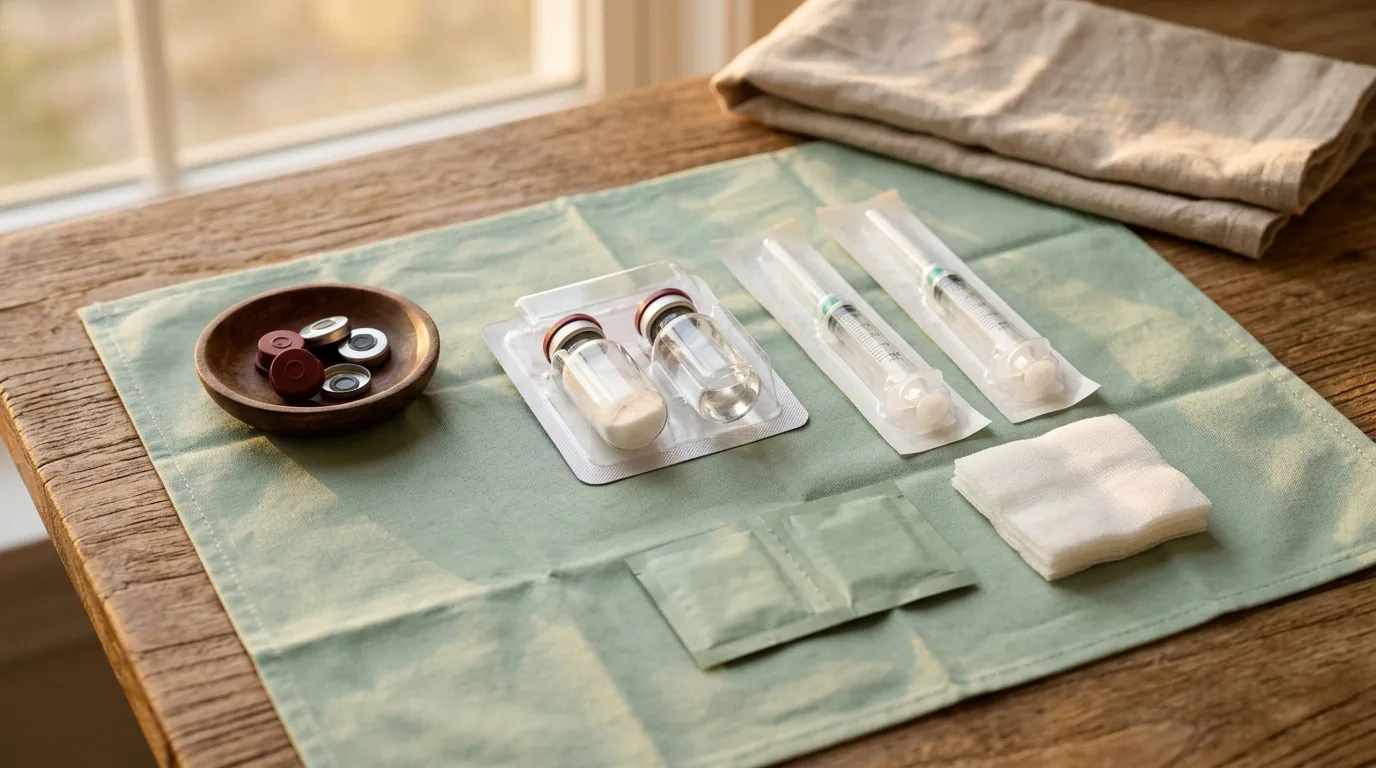
For laboratory research use only. Not for human consumption.
Why Reconstitution Changes Everything
Reconstituting a lyophilized peptide fundamentally alters its chemical environment. In dry powder form, peptides can remain stable for months or years at appropriate temperatures. The moment solvent is added, however, multiple degradation pathways activate simultaneously. Understanding these changes is essential for any laboratory working with reconstituted peptide solutions, because degradation directly impacts experimental reproducibility and data quality.
The stability of a reconstituted peptide depends on four primary factors: solvent pH, storage temperature, peptide concentration, and the specific amino acid sequence. Controlling these variables is the single most important step after mixing.
Why Lyophilized Peptides Are Stable
Lyophilization (freeze-drying) removes water from peptide solutions while preserving molecular structure. The resulting dry powder has extremely low moisture content, typically below 1-3% residual water. Without water molecules available to participate in chemical reactions, the major degradation pathways – hydrolysis, deamidation, and oxidation – proceed at negligible rates [1]. The glassy matrix formed during lyophilization further restricts molecular mobility, creating a kinetic barrier against conformational changes and aggregation [2].
Properly lyophilized peptides stored at -20°C in sealed, desiccated containers can maintain greater than 95% purity for 12-24 months, depending on sequence composition. Peptides stored at -80°C may remain stable for several years [3]. This exceptional shelf life is precisely why lyophilization is the standard form for commercial research peptide distribution.
- Residual moisture below 1-3% halts hydrolysis reactions
- Glassy matrix restricts molecular mobility and conformational change
- Absence of dissolved oxygen limits oxidative degradation
- Low temperature further reduces any residual reaction kinetics
Four Degradation Pathways in Solution
Once a peptide is dissolved, four primary chemical degradation pathways become active. Each pathway proceeds at different rates depending on the peptide sequence, solvent conditions, and storage parameters. Research published in Pharmaceutical Research and the Journal of Pharmaceutical Sciences has characterized these mechanisms extensively [4][5].
Hydrolysis
Hydrolysis is the cleavage of peptide bonds by water molecules. In solution, water is abundant and directly attacks the carbonyl carbon of the amide bond. The rate of hydrolysis depends on pH, temperature, and the specific amino acids flanking the bond. Asp-Pro and Asp-Gly bonds are particularly susceptible, with cleavage rates 10-100x higher than average peptide bonds [4]. At pH extremes (below 2 or above 10), hydrolysis accelerates dramatically. Even at physiological pH, hydrolysis proceeds measurably over days to weeks.
Oxidation
Methionine, cysteine, tryptophan, and histidine residues are vulnerable to oxidation in aqueous solution. Dissolved oxygen, trace metal ions (Fe²⁺, Cu²⁺), and light exposure all catalyze oxidation reactions. Methionine oxidation to methionine sulfoxide is the most common modification, often occurring within hours of reconstitution if solutions are not properly handled [5]. Oxidation can be minimized by using degassed solvents, adding antioxidants, and storing solutions under inert gas.
Deamidation
Asparagine (Asn) and glutamine (Gln) residues undergo deamidation in aqueous environments, converting to aspartate and glutamate respectively. The Asn-Gly sequence is the most labile motif, with half-lives as short as 1-2 days at physiological pH and 37°C [6]. Deamidation introduces a negative charge and can significantly alter peptide activity. The reaction rate is highly pH-dependent, accelerating above pH 6 and reaching maximum rates near pH 10.
Aggregation
Peptides in solution can form dimers, oligomers, and larger aggregates through hydrophobic interactions, disulfide bond scrambling, or non-covalent association. Aggregation is concentration-dependent and accelerates at higher temperatures. For peptides containing cysteine residues, intermolecular disulfide bond formation is a major aggregation pathway. Aggregated peptides typically show reduced biological activity and may produce inconsistent experimental results [7].
How pH Affects Reconstituted Peptide Stability
The pH of the reconstitution solvent is one of the most critical variables determining peptide stability in solution. Each degradation pathway has a distinct pH-rate profile, meaning the optimal pH for stability varies by peptide sequence.
- pH 3-5: Minimizes deamidation but may accelerate acid-catalyzed hydrolysis at Asp-X bonds
- pH 5-7: Generally the most stable range for most peptides; balanced trade-off between hydrolysis and deamidation
- pH 7-9: Deamidation rate increases significantly, especially for Asn-Gly motifs; oxidation also accelerates
- pH >9: Both hydrolysis and deamidation proceed rapidly; not recommended for storage
Bacteriostatic water (BAC water, pH ~5.5) and sterile water (pH ~5.0-7.0) are common reconstitution solvents. BAC water contains 0.9% benzyl alcohol as a preservative, which helps prevent microbial contamination but does not prevent chemical degradation. For peptides with known deamidation-sensitive sequences, slightly acidic buffers (pH 4-5) can extend solution stability by 2-5x compared to neutral pH [6].
Temperature Sensitivity After Reconstitution
Temperature is the second major variable controlling degradation rate. As a general rule, degradation rates approximately double for every 10°C increase in temperature (following the Arrhenius equation). This means a peptide solution stored at 25°C may degrade 4-8x faster than the same solution at 4°C [3].
- 2-8°C (refrigerator): Recommended for short-term storage of reconstituted peptides (days to weeks)
- Room temperature (20-25°C): Acceptable only during active experimental use; return to refrigerator promptly
- -20°C (freezer): Can extend stability but introduces freeze-thaw cycle risks
- -80°C (deep freeze): Best for long-term storage of aliquoted solutions; minimize freeze-thaw cycles
- 37°C (incubator): Use only during active experiments; degradation proceeds rapidly
Repeated freeze-thaw cycles cause physical stress that promotes aggregation and denaturation. If freezing reconstituted peptide, aliquot into single-use volumes before freezing to avoid repeated cycling.
Optimal Storage Conditions After Mixing
Based on published stability data, the following conditions maximize the useful life of reconstituted peptide solutions for laboratory research [1][3][7]:
- Store at 2-8°C for use within 7-14 days
- For longer storage, aliquot and freeze at -20°C or -80°C
- Use amber vials or wrap in foil to protect from light-induced oxidation
- Maintain sterile technique during all handling to prevent microbial contamination
- Use appropriate solvent pH (typically pH 4-6 for maximum chemical stability)
- Minimize headspace air in vials; consider nitrogen or argon overlay for oxidation-sensitive peptides
- Record reconstitution date, solvent, concentration, and storage conditions on each vial
Degradation Timeline: Hours, Days, and Weeks
The rate at which a reconstituted peptide degrades depends on its specific sequence, but general timelines based on published literature provide useful planning guidance [4][5][6]:
- 0-4 hours: Minimal degradation at 2-8°C in appropriate buffer; safe working window for most experiments
- 4-24 hours at room temperature: Measurable oxidation of Met/Cys residues if oxygen is present; 1-5% degradation typical
- 1-7 days at 2-8°C: Deamidation begins to accumulate for Asn-Gly-containing peptides; total degradation typically 2-10%
- 1-4 weeks at 2-8°C: Cumulative hydrolysis, deamidation, and oxidation may reach 5-20% depending on sequence
- 1-3 months at -20°C (no freeze-thaw): Most peptides retain >90% purity if properly aliquoted
- Beyond 3 months: Stability varies widely; verify by analytical testing (HPLC, MS) before use
These timelines are approximations based on published stability studies. Individual peptides may degrade faster or slower depending on their specific amino acid composition. When in doubt, verify purity by HPLC before critical experiments.
Practical Guidelines for Researchers
Combining the evidence from degradation studies, the following laboratory practices will maximize the useful life and data quality of reconstituted peptide solutions:
- Calculate the exact volume needed before reconstitution to avoid unnecessary excess
- Reconstitute with pre-chilled solvent and work on ice when possible
- Aliquot immediately into single-use volumes if the full amount will not be used within 7 days
- Label every vial with: peptide name, concentration, solvent, date, and operator initials
- Store aliquots at -20°C or -80°C; keep one working aliquot at 2-8°C
- Discard any solution showing visible turbidity, particulates, or color change
- Run HPLC quality checks on reconstituted solutions used for critical experiments
- Maintain a reconstitution log for batch traceability and experimental reproducibility
Frequently Asked Questions
How long is a reconstituted peptide stable?
Most reconstituted peptides remain above 90% purity for 7-14 days when stored at 2-8°C in an appropriate buffer. Frozen aliquots at -20°C can last 1-3 months. Stability varies significantly by sequence – peptides with Asn-Gly, Met, or free Cys residues degrade faster.
Does the reconstitution solvent matter?
Yes. Solvent pH, ionic strength, and additives all affect degradation rates. Bacteriostatic water is suitable for most applications. For sensitive peptides, buffered solutions at pH 4-6 with antioxidants provide the best stability profile.
Can I refreeze a thawed peptide aliquot?
It is not recommended. Each freeze-thaw cycle introduces physical stress that can promote aggregation and surface denaturation. If you must refreeze, limit to one additional cycle and verify purity by HPLC before use in critical experiments.
Further Reading on ChemVerify
- Read more: How to Store Reconstituted Peptides: Temperature, Light, and Duration Guide → https://www.chemverify.com/learn/store-reconstituted-peptides-temperature-guide
- Read more: Peptide Stacking: Which Peptides Can Be Combined for Research? → https://www.chemverify.com/learn/peptide-stacking-combinations-research-guide
- Read more: Peptide International Shipping: How to Order Without Quality Loss → https://www.chemverify.com/learn/peptide-international-shipping-quality-guide
- Read more: How to Calculate Peptide Doses from Reconstituted Solutions → https://www.chemverify.com/learn/calculate-peptide-doses-reconstituted-solutions
References
Compare Verified Vendors
Browse COA-verified suppliers with exclusive discount codes and transparent pricing.
Continue Reading
How to Store Reconstituted Peptides: Temperature, Light, and Duration Guide
Complete laboratory guide to reconstituted peptide storage: optimal temperature ranges, light protection protocols, solvent selection, freeze-thaw cycle limits, and stability timelines by peptide class.
Peptide Stacking: Which Peptides Can Be Combined for Research?
Comprehensive guide to peptide stacking in research: synergistic combinations like BPC-157+TB-500 and Ipamorelin+CJC-1295, antagonistic pairs, timing protocols, and reconstitution.
Peptide Storage Conditions: Temperature, Humidity, and Container Guidelines
Evidence-based guidelines for storing lyophilized and reconstituted research peptides – temperature ranges, humidity control, container selection, light protection, and degradation pathway prevention.
Peptide Reconstitution Math: Calculating Concentrations, Volumes, and Dilutions
Step-by-step guide to reconstitution calculations for research peptides – converting between mass, moles, and concentration units, accounting for net peptide content, and preparing accurate serial dilutions.