
Retatrutide: Complete Research Guide & Chemical Profile
Comprehensive chemical profile of retatrutide (LY3437943), the first-in-class triple GLP-1/GIP/glucagon receptor agonist. Covers molecular structure, mechanism, TRIUMPH trials, and purity testing.
For laboratory research use only. Not for human consumption.
Last verified: April 2026 | Data accuracy confirmed by ChemVerify Editorial Team
Chemical Identity & Classification
Retatrutide (LY3437943) is a first-in-class synthetic peptide that simultaneously activates three G-protein-coupled receptors central to metabolic homeostasis: the glucose-dependent insulinotropic polypeptide (GIP) receptor, the glucagon-like peptide-1 (GLP-1) receptor, and the glucagon receptor (GCGR). Developed by Eli Lilly and Company, this triple incretin receptor agonist represents a novel approach to metabolic research by engaging all three receptors through a single molecular entity.
- Generic Name: Retatrutide
- Development Code: LY3437943
- CAS Registry Number: 2381089-83-2
- Molecular Formula: C₂₂₁H₃₄₂N₄₆O₆₈ (PubChem) / C₂₂₈H₃₅₀N₄₈O₆₆ (alternate sources including fatty acid moiety)
- Molecular Weight: ~4,894.58 Da
- Classification: Synthetic acylated peptide, triple incretin receptor agonist
- Peptide Length: 39 amino acid residues
- Administration Route (research): Subcutaneous injection
Molecular Structure & Sequence
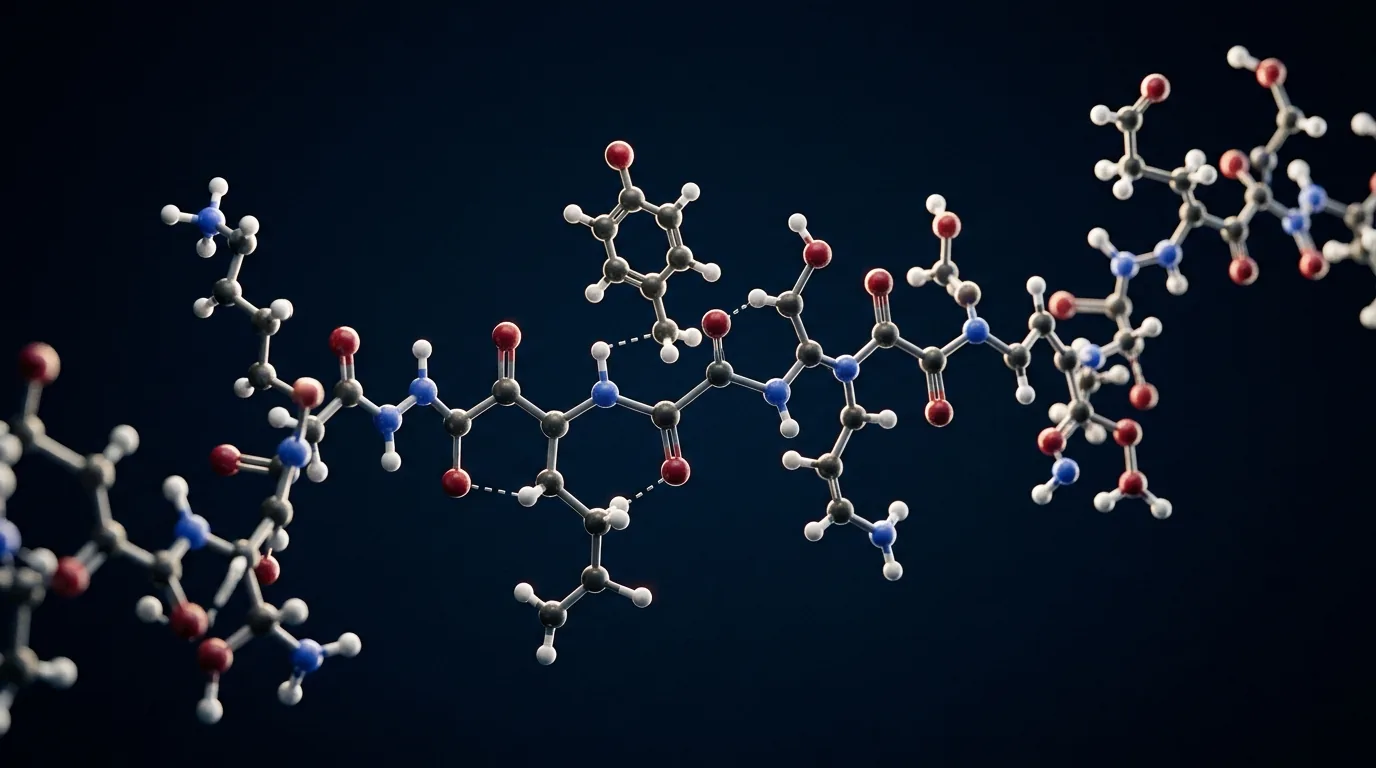
Retatrutide is a 39-amino-acid synthetic peptide engineered through rational molecular design to achieve balanced agonism across three distinct receptor targets. The primary sequence is based on a GIP receptor agonist backbone with strategic amino acid substitutions to confer GLP-1 and glucagon receptor activity. The peptide incorporates the non-natural amino acid alpha-aminoisobutyric acid (Aib) at position 2, which confers resistance to dipeptidyl peptidase-4 (DPP-4) enzymatic degradation.
A defining structural feature is the C18 octadecanedioic acid (fatty diacid) moiety conjugated at lysine-30 (Lys30) via a gamma-glutamic acid (gammaGlu) chemical linker. This lipidation strategy enables reversible, non-covalent binding to serum albumin in the bloodstream, dramatically extending the circulating half-life and enabling once-weekly administration in research settings. The C-terminus is amidated (-NH₂), contributing to metabolic stability.
The fatty acid acylation at Lys30 is critical for the extended pharmacokinetic profile. Loss of this moiety (e.g., through improper storage or degradation) results in a peptide with dramatically reduced half-life and altered receptor binding characteristics.
Mechanism of Action
Retatrutide functions as a simultaneous agonist at three metabolically important G-protein-coupled receptors. Upon binding, each receptor activates adenylyl cyclase through stimulatory G-proteins (Gs), increasing intracellular cyclic AMP (cAMP) concentrations and triggering downstream signaling cascades. The triple-agonist design creates a pharmacological profile distinct from single or dual agonists.
- GIP Receptor Activation: Potentiates glucose-dependent insulin secretion from pancreatic beta cells. GIP receptor agonism also contributes to lipid metabolism modulation in adipose tissue. Retatrutide demonstrates the highest potency at this receptor (EC₅₀: 0.0643 nM).
- GLP-1 Receptor Activation: Enhances glucose-dependent insulin secretion, suppresses glucagon release from alpha cells, and activates central satiety pathways in the hypothalamus. EC₅₀ at GLP-1R: 0.775 nM.
- Glucagon Receptor Activation: Stimulates hepatic glycogenolysis and gluconeogenesis acutely but also activates thermogenic pathways and increases energy expenditure. The glucagon receptor component (EC₅₀: 5.79 nM) is hypothesized to provide additional metabolic benefits beyond those achievable with GLP-1/GIP dual agonism alone.
Receptor Binding Profile
Retatrutide exhibits a defined hierarchy of receptor potency. In vitro cAMP accumulation assays using human receptor-expressing cell lines demonstrate that the molecule is most potent at the GIP receptor (EC₅₀: 0.0643 nM), followed by the GLP-1 receptor (EC₅₀: 0.775 nM), and the glucagon receptor (EC₅₀: 5.79 nM). This imbalanced agonism profile was designed intentionally – the stronger GIP receptor engagement provides robust insulinotropic signaling, while the comparatively lower glucagon receptor potency activates thermogenic and lipolytic pathways without excessive hyperglycemic risk.
The binding selectivity profile distinguishes retatrutide from other multi-agonists. Unlike tirzepatide (dual GIP/GLP-1), retatrutide adds the glucagon receptor component. Unlike survodutide (dual GLP-1/glucagon), retatrutide incorporates GIP receptor agonism. No other clinical-stage molecule engages all three receptors simultaneously.
Research Applications
Retatrutide has become a compound of significant interest in metabolic research due to its unique triple-agonist pharmacology. Key areas of laboratory investigation include:
- Incretin Biology: Studying the synergistic effects of simultaneous GIP, GLP-1, and glucagon receptor activation on pancreatic islet function, insulin secretion kinetics, and glucagon suppression dynamics.
- Energy Expenditure Research: Investigating the glucagon receptor-mediated thermogenic component and its contribution to total energy expenditure in preclinical models.
- Hepatic Lipid Metabolism: Examining the effects of triple agonism on hepatic steatosis, lipogenesis, and fatty acid oxidation pathways in liver cell models and animal studies.
- Receptor Pharmacology: Characterizing the structure-activity relationships of balanced multi-receptor agonism and the pharmacological consequences of different receptor potency ratios.
- Comparative Pharmacology: Benchmarking triple agonism against dual (tirzepatide, survodutide) and single (semaglutide, liraglutide) receptor agonists to elucidate the incremental contribution of each receptor axis.
Pharmacokinetic Properties
The pharmacokinetic profile of retatrutide is primarily governed by its C18 fatty diacid acylation, which enables reversible binding to serum albumin. This albumin-binding mechanism reduces renal clearance, shields the peptide from enzymatic degradation, and creates a depot effect that sustains plasma concentrations over an extended period.
- Half-life: Approximately 6 days (supporting once-weekly administration in clinical studies)
- Absorption: Slow absorption from subcutaneous injection site, with Tmax of approximately 24-72 hours
- Protein Binding: >99% bound to serum albumin via the C18 fatty acid chain
- Metabolism: Proteolytic degradation; the Aib at position 2 confers DPP-4 resistance
- Steady-State: Achieved after approximately 4-5 weekly administrations due to the long half-life
TRIUMPH Clinical Program
The TRIUMPH (Triple Hormone Receptor Agonist in the Management of Persistent Hyper-adiposity) clinical development program represents Eli Lilly's comprehensive Phase 3 evaluation of retatrutide. The program includes multiple pivotal trials spanning different metabolic conditions.
- Phase 2 (NCT04881760): 48-week dose-ranging study in adults with obesity. Published in the New England Journal of Medicine (2023). Demonstrated a mean body weight reduction of up to 24.2% at the highest dose (12 mg) at 48 weeks.
- TRIUMPH-1: Phase 3 trial in adults with obesity or overweight with at least one weight-related comorbidity.
- TRIUMPH-2: Phase 3 trial evaluating cardiovascular and metabolic outcomes.
- TRIUMPH-3: Phase 3 trial in adults with type 2 diabetes and obesity.
- TRIUMPH-4: Phase 3 trial assessing cardiovascular outcomes over extended follow-up.
ChemVerify reports on clinical trial data strictly for chemical characterization and research context. This information does not constitute medical advice and should not inform any clinical decisions.
Storage & Handling Guidelines
Proper storage is essential to maintain the chemical integrity of retatrutide for laboratory research. The acylated peptide is susceptible to degradation through oxidation, deamidation, hydrolysis of the fatty acid linker, and aggregation.
- Lyophilized Powder: Store at -20°C to -80°C in a desiccated environment. Stable for 24+ months when sealed under inert gas (nitrogen or argon).
- Reconstituted Solution: Store at 2-8°C (refrigerated). Use within 14-30 days depending on the reconstitution vehicle. Bacteriostatic water extends usability compared to sterile water.
- Avoid Repeated Freeze-Thaw Cycles: Aliquot reconstituted solutions into single-use volumes to minimize degradation from repeated freezing and thawing.
- Light Protection: Store in amber vials or wrapped in foil. The aromatic amino acids (Trp, Phe) and fatty acid linker are susceptible to photo-oxidation.
- pH Sensitivity: Optimal stability at pH 4.0-5.0. Solutions above pH 7.0 accelerate deamidation of Asn and Gln residues.
Purity Verification Methods
Verifying the identity and purity of retatrutide is critical for reproducible research outcomes. Due to the molecule's complexity (39 residues, fatty acid conjugation, non-natural amino acid), multi-method analytical characterization is recommended.
- RP-HPLC (Reversed-Phase): C8 or C4 column with 300 Å pore size recommended due to the peptide's size and hydrophobicity from the C18 acyl chain. Purity threshold: ≥95% for research-grade material.
- LC-MS/MALDI-TOF: Confirm molecular weight matches the expected mass of ~4,894.58 Da. Key diagnostic ions include the intact peptide mass, the deacylated peptide (loss of fatty acid), and fatty acid fragment ions.
- Amino Acid Analysis (AAA): Verify amino acid composition matches the theoretical ratios. The presence of Aib (position 2) is diagnostic for authentic retatrutide.
- Peptide Mapping: Tryptic or Glu-C digest followed by LC-MS/MS to confirm the complete primary sequence and verify the integrity of the Lys30-fatty acid conjugation.
- Certificate of Analysis (CoA): Verify that the supplier CoA includes HPLC chromatogram, MS spectrum, amino acid analysis data, and peptide content (net peptide content, not gross weight).
Current Research Status
As of April 2026, retatrutide remains in active Phase 3 clinical development under the TRIUMPH program. The Phase 2 trial published in the New England Journal of Medicine (Jastreboff et al., 2023) demonstrated unprecedented weight reduction of up to 24.2% at 48 weeks with the 12 mg dose, generating substantial scientific interest in the triple-agonist approach to metabolic research.
The compound is not yet approved by any regulatory authority. Ongoing Phase 3 TRIUMPH trials are evaluating efficacy and safety across multiple metabolic endpoints. Academic and pharmaceutical research groups continue to investigate the differential contributions of GIP, GLP-1, and glucagon receptor agonism to the overall metabolic effects observed in clinical studies. Retatrutide remains an active area of investigation for researchers studying multi-receptor pharmacology, incretin biology, and hepatic lipid metabolism.
For laboratory research use only. Not for human consumption. All information presented is for scientific reference and does not constitute medical advice.
Further Reading on ChemVerify
- Read more: TRH (Thyrotropin-Releasing Hormone): Research Guide & Chemical Profile → https://www.chemverify.com/learn/trh-thyrotropin-releasing-hormone-research-guide
- Read more: Ipamorelin + CJC-1295 (No DAC) Stack: Synergy Research Guide → https://www.chemverify.com/learn/ipamorelin-cjc-1295-no-dac-stack-synergy
- Read more: TP508 (Chrysalin): Research Guide & Chemical Profile → https://www.chemverify.com/learn/tp508-chrysalin-research-guide-chemical-profile
- Read more: Semax for Cognitive Research: ACTH(4-10) Analog Mechanism → https://www.chemverify.com/learn/semax-cognitive-research-acth-mechanism
References
Compare Verified Vendors
Browse COA-verified suppliers with exclusive discount codes and transparent pricing.
You Might Also Like
Continue Reading
HGH Fragment 176-191: Complete Research Guide & Chemical Profile
Comprehensive research guide on HGH Fragment 176-191, covering chemical properties, mechanism of action, and laboratory applications for peptide research.
TRH (Thyrotropin-Releasing Hormone): Research Guide & Chemical Profile
TRH (pGlu-His-Pro-NH2) is a hypothalamic tripeptide releasing TSH and prolactin. MW 362.38, neuroprotective research, and neuroendocrine signaling reviewed.
Beyond Hair: Complete Research Guide & Chemical Profile
Comprehensive guide to Beyond Hair peptide blend for hair follicle research. Learn about chemical properties, research applications, and laboratory use.
Melanotan 2: Complete Research Guide & Chemical Profile
Comprehensive guide to Melanotan 2 (MT-2), a synthetic α-MSH analogue researched for melanogenesis stimulation. Includes chemical properties and research applications.